


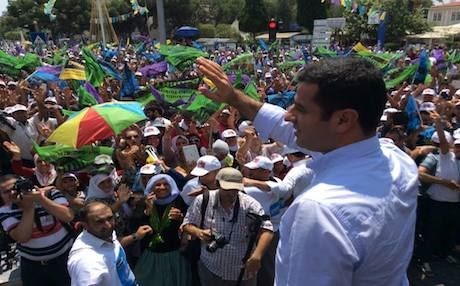
Emboldened by winning 9.7 percent of the Turkish presidential votes last year, the pro-Kurdish People Democratic Party (HDP) is running as a political party in the upcoming June 7 parliamentary polls in Turkey. Its decision has been both praised and criticized, since its chances of crossing a 10 percent threshold for parliamentary representation are no more than 50-50. But regardless of the outcome, HDP will emerge in a stronger position after the polls, able to put the ruling Justice and Development Party (AKP) in a difficult situation.
To circumvent the election threshold, the pro-Kurdish parties were forced to field their candidates as independents in the previous elections. This was the only for Kurdish parties to have Kurds represented in the Turkish Grand National Assembly.
Envisioned and pioneered by the jailed Kurdistan Workers’ Party (PKK) leader Abdullah Ocalan, HDP was founded in 2012 as an umbrella, inclusive party. Its intention was to be present on the national level rather than being restricted to the Kurdish-dominated area of Turkey’s southeast. For this, its election manifesto has been broad and inclusive, appealing to all layers of Turkish society, regardless of their ethnic, religion, gender and sexual orientation.
HDPs’ confidence grew significantly last year when its co-leader Selahattin Demirtas ran as a presidential candidate and gained close to 10 percent of the votes. After the AKP refused to take action on the Kurdish peace process and rejected a lowering of the election threshold, HDP made a decisive decision to run as a broad-based political party.
Last week Demirtas and co-leader Figen Yuksekdag announced the party's election manifesto in Istanbul, featuring 12 points: "We are women; we are youth; we are the rainbow; we are children; we are defenders of democracy; we are representatives of all identities; we are defenders of a free world; we are the protectors of nature; we are the builders of a safe life economy; we are workers; we are laborers; we are the guarantor of social rights."
These slogans, disseminated on social media, have angered and disappointed many Kurds, who feel the HDP has deviated from its Kurdish nationalism path and seeks to appease non-Kurds, meaning the dilution of its Kurdish identity in favor of winning more votes.
In contrast, Kurdish identity has proven resilient in the face of brutal oppression and genocide in the past. Thus elections, democratic measures and openness towards other ethnics will only embolden it rather than dilute it. Furthermore, the HDP’s inclusiveness platform is tremendously successful. It is a modern Kurdish nationalism that would not only embrace Kurds, but other minorities, which in itself sets an example in the Middle East.
The HDP’s entry in the elections as a party has its own historical and symbolic significance: the right wing and nationalist Republican People's Party (CHP) and Nationalist Movement Party (MHP) have proven ineffective by themselves to check the monopoly over Turkish politics of the AKP. Hence, the HDP’s entry in the upcoming elections could be game changer in June.
But questions remain: what are HDP’s strategies if it fails to enter parliament; what are its alternatives to representing Kurds and other minorities and fulfilling promises it has given to its constituents after the polls? Will HDP concede defeat and wait another four years for a new election, or will it become more resurgent in pushing and demanding Kurdish rights via its fraternal “Peace and Democracy Party” (BDP/DBP), which controls the municipalities of most of the Kurdish areas of Turkey?
The latter seems to be a potential path for HDP to take to remain relevant to Kurds and politics according to Rethink, a Washington DC based think-tank. “In the event of the HDP’s failure, the DBP would become the foremost legal Kurdish party, which would place special emphasis on self-determination in Kurdish-populated regions.”
Rethink's statement was published in a report "Turkey's election prospects," published earlier this month.
HDP’s Demirtas has rejected having a “plan B,” but has vowed to continue the struggle and defend people’s rights.
“If we can't pass the threshold, we will definitely continue with everything. We are a party. When a party does not have deputies in Parliament, it is still a party. Even if we get 9.9 percent of the vote, we will still be the fourth-biggest party in Turkey. We simply will not have a group in Parliament. We will continue to defend the things we defend and we will continue to stand behind our promises. That's why I say we have no Plan B,” Demirtas said in a recent television interview.
Notably, non-entry of HDP into the Turkish parliament will lead to a greater quandary for the AKP and Turkey in general, because it will leave Kurds unrepresented in the Turkish parliament for the first time in two decades (counting Leyla Zana’s entry in the Turkish parliament in 1991 as the beginning of “real Kurdish representation”). In addition to pushing Kurds to the periphery of Turkish politics, further polarizing Turks and Kurds, Turkey’s democracy’s legitimacy will suffer a big blow on the national and international levels, as over 15 million Kurds will be pushed out from Turkey politically and representatively.
Rethink further indicates that violence could resume and the alliance between Kurdish leftist and Turkish leftist to fragment. “This would lead the Turkish left to marginalize the Kurdish movement and increase the potential for violent separatism to reemerge.”
In case HDP passes the threshold it will most likely complicate Erdogan’s plans to transition Turkey from a parliamentary political system into a presidential one, because more seats for HDP will translate into less for Erdogan's party. In turn, Erdogan has to go through a popular referendum to fulfill his presidential ambitions without a certain result, unless it makes an alliance with HDP. Moreover, the Kurdish bargaining chip will be stronger in any negotiations with the Turkish government over the peace process. This outcome will create a zone of agreement for HDP and AKP about both the presidential system and the Kurdish peace process.
Although Demirtas’s rhetoric has been vehemently opposed to giving more power to Erdogan, it is likely that HDP would use its stronger representation in parliament to force AKP to make concrete steps towards a Kurdish peaceful settlement, in return for supporting Erdogan’s efforts to empowering the presidency. In this case, there would be a win-win situation for both AKP and HDP.
It is probably because he is considering this option that Demirtas has refused to make statements about election results and how the party will proceed if it swings 10 percent of the votes.
Comments
Rudaw moderates all comments submitted on our website. We welcome comments which are relevant to the article and encourage further discussion about the issues that matter to you. We also welcome constructive criticism about Rudaw.
To be approved for publication, however, your comments must meet our community guidelines.
We will not tolerate the following: profanity, threats, personal attacks, vulgarity, abuse (such as sexism, racism, homophobia or xenophobia), or commercial or personal promotion.
Comments that do not meet our guidelines will be rejected. Comments are not edited – they are either approved or rejected.
Post a comment