



Error occured during this request! Please try again later.
There has been much speculation over whether or not France will invoke Article 5 of NATO's charter in light of the horrific terrorist attack in Paris this month. Invoking Article 5 may well pit the whole NATO military alliance against the Islamic State (ISIS).
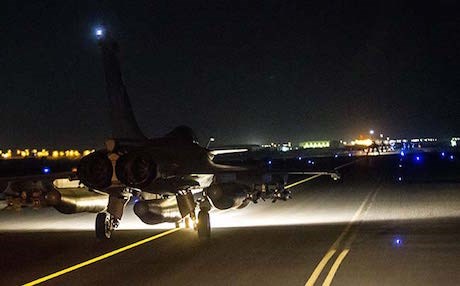
Given the fact that a sizable U.S.-led coalition – France has arguably been the most active of the European powers in this campaign, even before this latest attack – has been targeting that group from the air in both Iraq and Syria for over a year now, it's worth questioning what a NATO alliance would do differently.
France has already hit the so-called “capital-city” of the Islamic State, Raqqa, with at least twenty air strikes in the aftermath of the Paris attacks. The coalition has been hitting ISIS-related targets in that city from the air for well over a year now. Additionally in recent days France, and now the U.S., have begun bombing targets related to ISIS's black market oil trade to further hurt that group's ability to generate revenue.
There is something a French-led NATO effort could do differently which could deliver a more decisive and damaging blow to the group. That would be the establishment of a buffer-zone along a 68-mile stretch of Syria's border with Turkey.
Turkish premier Recep Tayyip Erdogan has recently reignited his idea of setting up such a zone in Northern Syria. Many accuse and suspect him, quite rightfully, of wanting to intervene and ensure that Syria's Kurds do not link up their three cantons– something that would give them effective control over Syria's entire frontier with Turkey stretching from the east by the Iraqi border to the northwest of the major Syrian city of Aleppo.
Ankara was particularly incensed when Syrian Kurdish Peoples Protection Units (YPG) fighters kicked ISIS out of the border-town of Gire Spi (Tal Abyad) and linked up their two biggest cantons of Jazira and Kobani over the summer. That move gave the YPG effective control over a contiguous piece of border territory that is roughly two-thirds of Syria's northern frontier. West of the Euphrates is a 68-mile stretch of terrain which divides Kobani from the remaining westernmost, and smallest, of Syria Kurdistan's three cantons: Afrin.
ISIS and other Islamist groups are presently in that area. In fact it's the only part of the Syrian border with Turkey they still have some control over. France and Turkey's interests could well converge on this issue. But for different reasons: France wants to deliver a decisive blow to ISIS and Turkey wants to ensure that the YPG does not cross the Euphrates from Kobani. On the west bank of that iconic river sits the town of Jarablus. It is occupied by ISIS and ISIS has recently been firing mortars at Kurdish villages near Kobani. Turkey hasn't fired on ISIS there but has fired on YPG fighters in Kobani and said they will intervene to stop them from crossing that river to push ISIS out of Jarablus.
Having a NATO force intervene in that 68-mile stretch of territory and kick out ISIS, and other similar Islamist's like the al-Nusra Front, the pressure on Syria's Kurds would be relieved in both Kobani and Afrin and the Kurds might prefer a buffer zone under NATO than Turkey if there is ever going to be one. And ISIS would be completely cut off and all of Syria's frontier with Turkey would effectively be in control of that group’s enemies.
Also any NATO ground forces deployed in that part of Syria would be operating along the Turkish frontier with Syria, the “southern flank” of that alliance. ISIS would have to stretch its resources to retain a presence there, something they are likely unable, and unwilling, to do. When the YPG pushed ISIS out of Gire Spi over the summer they came from Kobani to the towns west and Jazira from east ISIS stood no chance and were unable to retain hold or send in reinforces to try and defend it.
Jarablus would likely be a similar case. Routing ISIS out of there would not only be the symbolic victory President Hollande and the coalition need but it would also constitute, in the long-term, a strategic victory since it would further cut-off ISIS from the outside world, further increase the pressure on it and speed up its long overdue demise.
Comments
Rudaw moderates all comments submitted on our website. We welcome comments which are relevant to the article and encourage further discussion about the issues that matter to you. We also welcome constructive criticism about Rudaw.
To be approved for publication, however, your comments must meet our community guidelines.
We will not tolerate the following: profanity, threats, personal attacks, vulgarity, abuse (such as sexism, racism, homophobia or xenophobia), or commercial or personal promotion.
Comments that do not meet our guidelines will be rejected. Comments are not edited – they are either approved or rejected.
Post a comment