


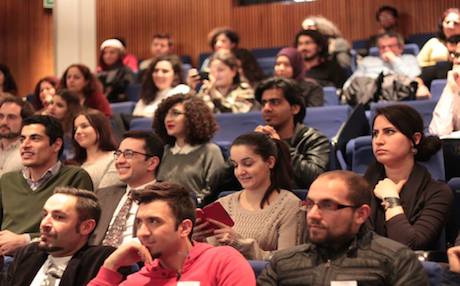
LONDON – Organizing a party to celebrate Nowruz was a lesson in diplomacy for Rosa Burc, head of the Kurdish Society at the School of Oriental & African Studies (SOAS), part of the University of London.
“The selection of songs proved to be political so we made sure there were both Northern and Southern Kurdish (Turkish and Iraqi Kurdish) ones,” she says. “It became an issue during the planning and we tried to include all Kurds.”
The party is one of many activities organized by the Kurdish Society, which “aims to bridge students with Kurdistan’s culture, language and political discourse,” as stated on its Facebook page.
The society’s 90 members are a mixture of Kurds and students of other ethnicities who simply want to learn about Kurdish issues. They are able to attend seminars, conferences, presentations by PhD students of their research, cultural events as well as the annual Nowruz party.
Burc was brought up in Germany, where she completed her undergraduate degree that included a year at SOAS, where she decided to return for her master’s degree in international politics, focusing on the Middle East.
“I was unsatisfied with the Eurocentric approach in Germany where they focus a lot on America and Europe. I personally wanted to focus on the Middle East and Kurdish issues,” she says.
SOAS is a world-renowned institution, with students from across the globe, and Burc loves the internationalism of London, where she found the Kurdish community to be young and dynamic.
“In Germany, I never felt it was that dynamic, but maybe because Britain’s an island, people feel protected and independent,” she says.
She was born to secular, leftist parents, as she describes them. Her Kurdish father met her Turkish-Armenian mother when they were both students at Ankara University and they left Turkey in 1989. Her mother lives in Cologne and her father is currently working as an editor and coordinator for IMC TV in Istanbul.
“I do have a lot of feelings for the Armenian issue, but my Kurdish identity is dominant,” says Burc. “My mother and I care about protecting all identities, Armenian, Kurdish, Yezidi and so on.”
The Kurdish Society is one of many societies at SOAS that cater to all regional, cultural and religious interests. The Islamic Finance and Ethics Society recently made headlines in the British press when it invited an outspoken preacher to speak.
Haitham al-Haddad spoke about why lending money with interest is forbidden in Islam, but he also spoke in support of female genital mutilation and argued that authorities should not become involved in domestic disputes.
The organizers said his views did not necessarily reflect those of the Islamic Finance and Ethics Society, and other students said his Illiberal views had no place on a university campus.
The Kurdish Society has generated no similar media attention, although it also grapples with thorny political issues reflected from the Middle East, including the conflict in Syria and the Gezi Park protests in Istanbul last summer.
In particular, Burc is keen to promote the academic discipline of Kurdish studies, which rarely exists as a stand-alone subject. It is usually included in regional courses or those dealing with countries with large Kurdish populations, such as Iraq and Turkey. She says Kurdish courses also often concentrate only on culture and language at the expense of politics.
“We hope to put some pressure to include Kurdish studies in, for example, courses on the politics of the Middle East. Courses on Iraq might have something on Southern Kurds but we want to see something with a total perspective of the Kurds,” she says.
She pointed to Exeter University in the west of England that has a Center for Kurdish Studies, one of the few that exist in the West. The center was established in 2006 with funding from the Kurdistan Regional Government (KRG) and the Ibrahim Ahmad Foundation, a charity established by the family of the Kurdish Iraqi politician and poet.
Exeter’s center has around 30 PhD students and will restart a masters program within a couple of years, says Clemence Scalbert-Yucel, director and senior lecturer in ethnopolitics.
“I’m aware that there is growing interest in this topic but there aren’t necessarily more courses yet around the world,” she says. “The role of Kurdish young people is important, either those living in the West or others who come to study.”
Groups such as the Kurdish Studies Network and the Kurdish Studies Journal were also helping to generate interest in the field.
Burc is hoping to pursue an academic career and could well prove to be at the forefront of expanding Kurdish studies.
Comments
Rudaw moderates all comments submitted on our website. We welcome comments which are relevant to the article and encourage further discussion about the issues that matter to you. We also welcome constructive criticism about Rudaw.
To be approved for publication, however, your comments must meet our community guidelines.
We will not tolerate the following: profanity, threats, personal attacks, vulgarity, abuse (such as sexism, racism, homophobia or xenophobia), or commercial or personal promotion.
Comments that do not meet our guidelines will be rejected. Comments are not edited – they are either approved or rejected.
Post a comment