


ERBIL, Kurdistan Region--International aid agencies have warned about the increasingly dire humanitarian situation of the more than 75,000 people who are trapped along a berm on Syria’s border with Jordan, after sending them a month’s worth of humanitarian rations on Thursday.
“Unable either to cross the border or turn back, the situation facing these women, men and children has grown more dire by the day,” warns a press statement released jointly by the Executive Director of the United Nations’ World Food Programme (WFP), Ertharin Cousin, his counterpart in the UN’s High Commissioner for Refugees (UNHCR), Filippo Grandi, and UNICEF’s Anthony Lake, along with the Director-General of the International Organization for Migration (IOM), William Lacy Swing.
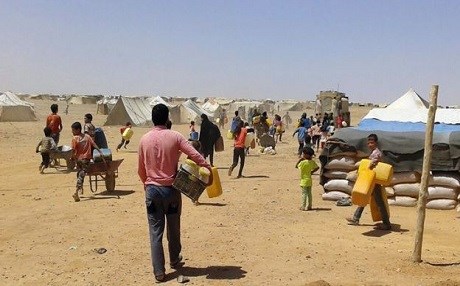
“Sheltering in makeshift tents in harsh desert conditions with temperatures of up to 50 degrees Celsius and sudden sand storms, they are without sufficient food and have barely enough water to survive,” the statement added.
“Pregnant women, children, the elderly and the sick are especially vulnerable,” the aid leaders said, adding, “Life-saving health care is also urgently required.”
More than 75,000 people are struggling to survive in makeshift camps in a no-man’s land on the Syrian side of the border with Jordan.
Jordan closed the border and declared it a militarized zone after seven of its soldiers were killed in a suicide attack on June 21. It had blocked all food and medical aid from crossing the border, allowing only water trucks to enter until permitting the UN’s aid across on Thursday.
The UN agency heads thanked the Kingdom of Jordan “for supporting this critical operation,” adding that the agencies collectively “look forward to further efforts to reach people at the berm with humanitarian assistance in time to save their lives.”
“Unable either to cross the border or turn back, the situation facing these women, men and children has grown more dire by the day,” warns a press statement released jointly by the Executive Director of the United Nations’ World Food Programme (WFP), Ertharin Cousin, his counterpart in the UN’s High Commissioner for Refugees (UNHCR), Filippo Grandi, and UNICEF’s Anthony Lake, along with the Director-General of the International Organization for Migration (IOM), William Lacy Swing.
“Sheltering in makeshift tents in harsh desert conditions with temperatures of up to 50 degrees Celsius and sudden sand storms, they are without sufficient food and have barely enough water to survive,” the statement added.
“Pregnant women, children, the elderly and the sick are especially vulnerable,” the aid leaders said, adding, “Life-saving health care is also urgently required.”
More than 75,000 people are struggling to survive in makeshift camps in a no-man’s land on the Syrian side of the border with Jordan.
Jordan closed the border and declared it a militarized zone after seven of its soldiers were killed in a suicide attack on June 21. It had blocked all food and medical aid from crossing the border, allowing only water trucks to enter until permitting the UN’s aid across on Thursday.
The UN agency heads thanked the Kingdom of Jordan “for supporting this critical operation,” adding that the agencies collectively “look forward to further efforts to reach people at the berm with humanitarian assistance in time to save their lives.”
Comments
Rudaw moderates all comments submitted on our website. We welcome comments which are relevant to the article and encourage further discussion about the issues that matter to you. We also welcome constructive criticism about Rudaw.
To be approved for publication, however, your comments must meet our community guidelines.
We will not tolerate the following: profanity, threats, personal attacks, vulgarity, abuse (such as sexism, racism, homophobia or xenophobia), or commercial or personal promotion.
Comments that do not meet our guidelines will be rejected. Comments are not edited – they are either approved or rejected.
Post a comment