
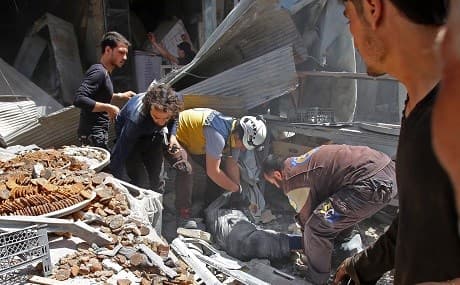

The offensive has left hundreds of civilians dead and hundreds of thousands displaced.
“The Syrian-Russian military alliance is using a cocktail of internationally banned and indiscriminate weapons on a trapped civilian population,” Lama Fakih, acting Middle East director at Human Rights Watch, said today.
Cluster munitions and incendiary weapons have been used in populated civilian areas, based on reports by first responders, witnesses, and open-source material, according to HRW.
Around 200 civilians, including 20 children, have been killed across the Idlib, Hama, and Aleppo governorates since April 26, 2019.
The UK-based Syrian Observatory for Human Rights (SOHR) puts the number of civilian deaths at more than 291 over the same time period.
Idlib and parts of the neighbouring provinces of Aleppo, Hama, and Latakia are under the control of Hayat Tahrir al-Sham (HTS), a jihadist group led by Syria’s former Al-Qaeda affiliate.
Despite distancing itself from Al-Qaeda, HTS is considered a terrorist organization by the United States, Russia, and Turkey.
The area had been subject to a ceasefire deal agreed in September 2018 between Russia and Turkey. However, the failure of rebel-backer Turkey to implement the deal on the ground led to the ceasefire’s collapse.
Russia and Bashar al-Assad’s forces have stepped up their bombardment since late April, seizing parts of HTS territory.
The offensive on Idlib and its surrounding areas have already seen accusations of “indiscriminate attacks” on vulnerable sites, including busy streets and hospitals.
President Assad’s regime has been accused of using banned weaponry, including cluster munitions, incendiary, and chemical weapons throughout the Syrian conflict, which began back in 2011.
“What is happening in Idlib today is the latest chapter in eight years of failure to protect civilians in Syria,” Fakih said.
Cluster munitions typically open in the air, dispersing multiple bomblets over a wide area. Many of these bomblets fail to immediately explode, potentially killing or maiming civilians for years or even decades to come.
Their wide-area effects mean they lack a specific target and leave civilians and combatants indistinguishable.
Incendiary weapons use highly flammable substances that cause excruciating burns and destroy buildings.
The United Nations’ Convention on Cluster Munitions sought to ban the use of such weapons in 2008. Some 121 countries have signed the convention – Russia and Syria are not among them.
The UN has warned that an all-out offensive on the region would lead to a humanitarian catastrophe for its nearly three million residents, at least half of whom are displaced from elsewhere in Syria.
Despite the warning, the UN Security Council has been in a state of paralysis, unable to act because of Russia’s veto power on the Council. An emergency meeting called on May 17 attained no solution.
More than 200,000 people have already been displaced from the HTS stronghold, according to the UN. Some have sought refuge close to the Turkish border, while others have crammed into already crowded camps in Syria. Many of them had already been displaced from elsewhere in Syria due to the long-raging conflict.
“To ensure that the final act is not the tragedy we are anticipating, the Security Council and UN member countries should signal to Russia that it will bear a heavy cost if it does not halt these unlawful attacks,” said Fakih.
.jpeg&w=3840&q=75)