


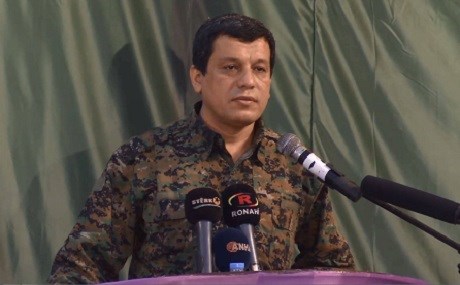
ERBIL, Kurdistan Region – Mazlum Kobane, commander-in-chief of the US-backed Syrian Democratic Forces (SDF), said Saturday the Kurdish-led force will soon undergo a major restructuring, details of which will be discussed at an upcoming congress.
Reforms could see military councils established at the local level to serve each city under SDF control, he said.
The apparent decentralization comes in response to new circumstances in northern Syria, where the Islamic State group (ISIS) has been territorially defeated and the threat of imminent Turkish attack appears to have receded.
“In order for the SDF to play a role in the Syrian crisis as a whole, to do its duty, and to enhance capabilities, we have prepared a big project,” Kobane told SDF troops at an event in Rumela.
The SDF will soon hold a congress “where these things will be discussed in detail,” he said. “This is a new phase of Rojava revolution in Syria.”
Rojava is the Kurdish name for the Kurdish-majority areas of northern Syria, where local fighters have established an autonomous administration.
Kobane did not say when or where such a congress might take place, but said the process would be inclusive. Wounded SDF fighters will play an “active” role in this new phase, he said.
“Physical impairments will no longer be an obstacle because this project is huge and everyone can take part and play a role. The main roles will be given to the injured … the same way they were during war,” he added
The SDF was established in October 2015 by the Kurdish People’s Protection Units (YPG), four years after the Syrian uprising began. It liberated vast areas of the country from ISIS control, including the group’s de facto capital of Raqqa.
Mostly comprised of Kurdish fighters, the force also includes Arabs, Assyrians, and other ethnic and religious minorities.
SDF wants dialogue
Turkey has repeatedly threatened to attack the YPG and push it back from the Turkish border. Ankara views the group as the Syrian branch of the Kurdistan Workers’ Party (PKK), which it regards a terrorist organization.
Meanwhile, the Russian-backed regime of Bashar al-Assad in Damascus has threatened to retake the northern Syrian provinces by force.
As a result, the SDF has strengthened its defenses. But Kobane prefers dialogue to confrontation.
“We do not want war to take place in this region again. We never side with war. We have fought on behalf of all humanity. We have done our job and do not want to see war in the region again,” Kobane said.
Abdullah Ocalan, the leader and founder of the PKK who has been imprisoned by the Turkish state since 1999, was allowed to meet with his lawyers for the first time in eight years at the beginning of May.
In a letter sent through the lawyers, Ocalan said the Syrian crisis can be resolved through the SDF.
“We believe the Syrian crises – in their current state – should be resolved in the framework of the Syrian Democratic Forces by staying away from the culture of conflict in the perspective of local democracy, guaranteed through a Syrian constitution in light of Syrian [territorial] integrity,” Ocalan wrote.
“In this regard, Turkish sensitivity should be taken into consideration.”
Although he has been incarcerated for 20 years with limited access to his lawyers and family, Ocalan remains an influential figure for Kurds, especially in Turkey and Syria.
The SDF led the ground war against ISIS with international coalition support. Its fighters clear the jihadist group’s last holdout in Baghouz, Deir ez-Zor province in March this year.
US President Donald Trump is eager to withdraw American troops from northern Syria, which could leave the SDF vulnerable to attack.
This has motivated the SDF and its political arm, the Syrian Democratic Council (SDC), to consider direct negotiations with Damascus to protect its hard-won autonomy.
Reforms could see military councils established at the local level to serve each city under SDF control, he said.
The apparent decentralization comes in response to new circumstances in northern Syria, where the Islamic State group (ISIS) has been territorially defeated and the threat of imminent Turkish attack appears to have receded.
“In order for the SDF to play a role in the Syrian crisis as a whole, to do its duty, and to enhance capabilities, we have prepared a big project,” Kobane told SDF troops at an event in Rumela.
The SDF will soon hold a congress “where these things will be discussed in detail,” he said. “This is a new phase of Rojava revolution in Syria.”
Rojava is the Kurdish name for the Kurdish-majority areas of northern Syria, where local fighters have established an autonomous administration.
Kobane did not say when or where such a congress might take place, but said the process would be inclusive. Wounded SDF fighters will play an “active” role in this new phase, he said.
“Physical impairments will no longer be an obstacle because this project is huge and everyone can take part and play a role. The main roles will be given to the injured … the same way they were during war,” he added
The SDF was established in October 2015 by the Kurdish People’s Protection Units (YPG), four years after the Syrian uprising began. It liberated vast areas of the country from ISIS control, including the group’s de facto capital of Raqqa.
Mostly comprised of Kurdish fighters, the force also includes Arabs, Assyrians, and other ethnic and religious minorities.
SDF wants dialogue
Turkey has repeatedly threatened to attack the YPG and push it back from the Turkish border. Ankara views the group as the Syrian branch of the Kurdistan Workers’ Party (PKK), which it regards a terrorist organization.
Meanwhile, the Russian-backed regime of Bashar al-Assad in Damascus has threatened to retake the northern Syrian provinces by force.
As a result, the SDF has strengthened its defenses. But Kobane prefers dialogue to confrontation.
“We do not want war to take place in this region again. We never side with war. We have fought on behalf of all humanity. We have done our job and do not want to see war in the region again,” Kobane said.
Ocalan letter
Abdullah Ocalan, the leader and founder of the PKK who has been imprisoned by the Turkish state since 1999, was allowed to meet with his lawyers for the first time in eight years at the beginning of May.
In a letter sent through the lawyers, Ocalan said the Syrian crisis can be resolved through the SDF.
“We believe the Syrian crises – in their current state – should be resolved in the framework of the Syrian Democratic Forces by staying away from the culture of conflict in the perspective of local democracy, guaranteed through a Syrian constitution in light of Syrian [territorial] integrity,” Ocalan wrote.
“In this regard, Turkish sensitivity should be taken into consideration.”
Although he has been incarcerated for 20 years with limited access to his lawyers and family, Ocalan remains an influential figure for Kurds, especially in Turkey and Syria.
The SDF led the ground war against ISIS with international coalition support. Its fighters clear the jihadist group’s last holdout in Baghouz, Deir ez-Zor province in March this year.
US President Donald Trump is eager to withdraw American troops from northern Syria, which could leave the SDF vulnerable to attack.
This has motivated the SDF and its political arm, the Syrian Democratic Council (SDC), to consider direct negotiations with Damascus to protect its hard-won autonomy.
Comments
Rudaw moderates all comments submitted on our website. We welcome comments which are relevant to the article and encourage further discussion about the issues that matter to you. We also welcome constructive criticism about Rudaw.
To be approved for publication, however, your comments must meet our community guidelines.
We will not tolerate the following: profanity, threats, personal attacks, vulgarity, abuse (such as sexism, racism, homophobia or xenophobia), or commercial or personal promotion.
Comments that do not meet our guidelines will be rejected. Comments are not edited – they are either approved or rejected.
Post a comment