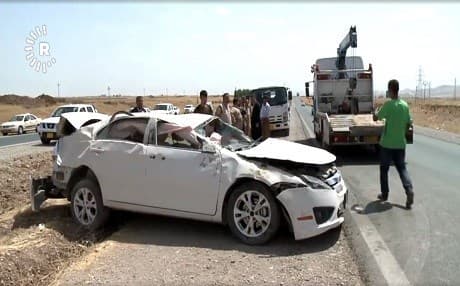

Of these accidents, 5,602 occurred outside cities, and 5,187 inside cities.
Speeding was identified as the cause of 6,327 accidents, vehicle faults caused 996, and negligence and poor road conditions caused 3,466.
There were 1,746 deaths as a result, and 21,377 people were injured or left disabled.
“There are many reasons behind these accidents, but the main reasons are: the divers’ lack of commitment to driving instructions, increasing number of cars, bad road conditions, bad quality of some vehicles and lack of public transportation,” Colonel Assad Malakarim, director of statistics and planning at Kurdistan Region’s transportation department, told Rudaw.
According to traffic police investigations, 75 percent of accidents were caused by speeding and driver distraction, and 25 percent were the result of bad road conditions and bad vehicle maintenance.
“The number of accidents and victims is more than what these figures show, and this is because we don’t have vehicle insurance here. That is why sometimes drivers reach an agreement among themselves to repair the vehicles while they run into a car accident and therefore do not notify traffic police,” Colonel Assad said.
“According to our investigations, nearly 20,000 car accidents happen. But only around 5,000 accidents are recorded by us.”
According to figures produced by the Kurdistan Region statistics body, 7,999 car accidents happened over the past two years in Erbil, Sulaimani, and Duhok provinces, in which 1,557 people died, 14,957 were injured or disabled.
According to these figures, 61.2 percent of these accidents were due to collisions, 19.1 percent due to vehicles overturning, 14.5 percent due to cars hitting people, and 5.2 percent attributed to other causes.
“Through analyzing data, we have found out that human cost and material damage from car accidents are increasing year by year,” Sirwan Mohammed, head of the statistics body in the Kurdistan Region, told Rudaw. “The number of these accidents and magnitude of the cost appear less however due to the lack of insurance companies and complete data of these accidents.”
According to figures produced by the statistics body, 3.592 million people in the Kurdistan Region are aged 18 to 64, which is a suitable driving age. There are more than 1.5 million cars registered in the Kurdistan Region. This is in addition to the estimated 150,000 vehicles that are not registered or do not have number plates.
“In light of the number of cars and persons eligible to drive, we have noted that Kurdistan has more cars than it needs and cars are used excessively due to the lack of public transportation. That is why streets are crowded and car accidents are on the rise,” Mohammed said.
He said according to a survey they have conducted, 43 percent of the families in the Kurdistan Region do not have a car of their own, 57 percent have 1 to 3 cars.
“According to investigations, 2/3 of car accidents are not reported because there are no insurance companies,” Najat Najim, head of Redline Organization for Traffic Awareness, told Rudaw.
“Most drivers reach an agreement among themselves at times of car accidents about compensations for damages inflicted, some do not alert the police because they don’t have driving license or because of not registering their cars. This is especially the case outside cities. That is why we predict nearly 15,000 car accidents happen a year.”
“The reason why the financial cost of a collision or car turning over is so high is because cars are very pricey in the Kurdistan Region. And it is costly to repair them and their price falls when selling the car. That is, if the cost of repairing a car is $2,000, the price of selling it drops by $2,000 too,” he said.
“We estimate $20 million is spent on repairing cars involved in accidents in a year.”

.jpg&w=3840&q=75)