
ERBIL, Kurdistan Region –The health of Rudaw’s cameraman Youis Mustafa who sustained several injuries from an improvised explosive device Saturday in Mosul is stable now, his brother told Rudaw English.
Younis and Rudaw’s reporter and anchor Shifa Gardi who died in the explosion were chasing a lead to an ISIS mass grave south of Mosul.
The 30-year old cameraman was with a Rudaw crew who pursued the story of what became known as the lost horse of Mosul battle.
The horse was left abandoned without food and water where the crew find her in the Christian town of Bartella, east of Mosul in October last year.
She was hungry, thirsty and exhausted from standing too long.
“With members of my crew we gave her some pieces of bread and fruit we had with us and some water,” Rudaw’s Ayub Nuri reported describing the condition of the horse.
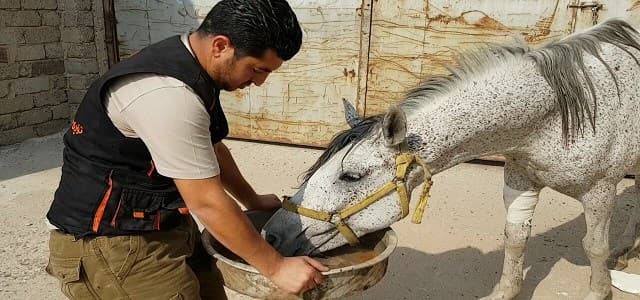
Younis later that day shared a photo showing him holding a basin filled with water from which the horse was drinking, perhaps for the first time in days. The caption said “Today in Bartella, this injured horse was very innocent, left without food and water.”
The horse was too hurt to take even one step to reach the food that was provided to her by the crew.
Her brief story aired on Rudaw TV and on social media and got the attention of millions of people in Kurdistan and around the world. The horse had to be saved.
Rudaw made two more trips to the site where the horse was, the third time with an animal rights organization who offered to take care of her. By then she had disappeared. The crew tried looking for her and they did inside nearby shops but the army forced Rudaw team to leave as heavy fighting was going on with ISIS a few kilometers down the road.
Almas Haidar, Mustafa’s mother, told Rudaw today that she is so sad that Gardi lost her life in Mosul, and expressed her condolences. As for her son, she said she is thankful to God that he is alive.
“His condition is very good compared to the magnitude of the incident,” Haidar said in reference to his son’s injuries in his leg, hand, and face.
“I talked to him,” she said, “He had asked for me this morning, and I talked to him. He opened his eyes.”
“It is like God has given him back to me again,” she said.
Mustafa , married and father of a girl of about five years old named Ranya, has joined Rudaw for over a year. He was working for the Erbil-based Kurdistan TV before joining Rudaw.
He has been covering the unfolding war against the ISIS group for Rudaw since he joined the Network, both with Peshmerga and the Iraqi Security Forces.
He was one of Rudaw’s cameramen who filmed the ISIS’s October deadly attacks in Kirkuk where there were intense clashes in several parts of the city as the extremist group tried to take control of several key places in the city.
He has been working with another ten cameramen at Rudaw’s headquarters in Erbil, news and current affairs department where they are on call to film any unfolding story here in Erbil or elsewhere, including Mosul with Rudaw dispatching teams almost on daily basis to report on the war between the Iraqi forces and the ISIS militants in Mosul.
None of the eleven cameramen have received medical training to enable them do the first aid on the battlefield, several cameramen told Rudaw English.
The Committee to Protect the Journalists (CPJ) says the training is a need for conflict journalists.
“Hemorrhage is the number one preventable death on the battlefield,” Lily Hindy, a CPJ blogger said in 2012, “And yet large numbers of journalists covering wars and political unrest all across the world are untrained in this life-saving skill. It doesn't need to be that way.”
It is not clear whether a first aid training could have prevented Gardi’s death, but everyone we talked to at Rudaw agrees that journalists’ should be better prepared.
There is a great rivalry between the Kurdish channels, BBC’s Jiyar Gol who himself have covered the war against ISIS in in Iraq said as he was reporting on the death of Gardi for BBC Persian, each is trying to reach the news first, he noted.
Gol says time and again he has seen the Kurdish channels advancing shoulder to shouder with Iraqi and Kurdish fighters in the front line.
“Many don’t take into considerations the safety issues,” Gol concluded
Rudaw Executive Director Ako Mohamm said that the network has always instructed its journalists "to be behind the frontlines of the war".
“We were always urging them to be behind the frontlines of the war, telling them that they were not soldiers or Peshmerga fighters,” Ako told a crowd of Gardi's colleagues and ordinary people gathered to pay respect to her body outside the network's headquarters. “Rather, you are journalists. Hence, you shouldn’t be on the frontlines. It appears that Shifa had moved closer to the frontlines out of seriousness to her job,” he continued with tears in his eyes.
Gardi searched for a long time to find the mass grave without much success, Rudaw’s Ranja Jamal said.
Jamal and his team were close in distance to Gardi’s.
Jamal said the Rudaw team came across an armed unit of Hashd al-Shaabi paramilitaries on the Mosul-Baghdad road, who told Gardi that they knew the whereabouts of the mass grave.
Rudaw’s team were trying to film the mass grave as the roadside bomb exploded near the site of the mass grave, and killed Gardi, and another five members of the paramilitary force, including a commander, Jamal said, another eight people, including Rudaw’s cameraman Yunis Mustafa were injured.
Younis Mustafa in October 2016 as he covered the intense clashes in the city of Kirkuk between the ISIS militants and the security forces in the city. More than one hundred people were killed in those attacks, many of whom members of the security forces.