


By ANWAR FARUQI
ERBIL, Kurdistan Region - Landing at the modern and efficient airport in Erbil, capital of Iraq’s autonomous Kurdistan Region, within 30 minutes I was through immigration and welcomed into a city of wide roads, proper traffic lights with pedestrian crossings, glittering shopping malls, the five-star Rotana hotel and people going about their business, carefree.
The Kurds have taken the autonomy granted to them after the 2003 US-led “liberation” that toppled Saddam Hussein in Baghdad, and transformed their northern enclave into an oasis of normality and oil-fueled prosperity.
Life for the estimated five million inhabitants of the Kurdistan Region is in sharp contrast to the rest of Iraq, which still writhes in violence and bloodshed, and where economic growth is stunted by the Shiite-led Baghdad government’s feuds with the Kurds, the large minority Sunnis and even some Shiite groups.
Erbil is only 300 kilometers from Baghdad. But for people in the three-province Kurdistan Region which embraces Erbil, Sulaimani and Duhok, the Iraqi capital is a world apart.
In Baghdad last Thursday, as young Iraqis enjoyed water pipes or pool at a packed third-floor cafe of a Sunni neighborhood, a suicide bomber shattered dozens of lives, killing at least 27 people and wounding more than 50. Earlier the same week, a series of coordinated attacks killed 42 people and wounded more than 250 across Iraq.
But in Erbil, returning home alive is not a worry.
At its New City Center hypermarket, the greatest concern for shoppers is getting the best bargains, among shelves stacked with everything from Belgian chocolates and imported cheeses to flat-screen television sets. Outside the entrance, a car on a podium promises to go to a lucky shopper in a lottery draw. Nearby, clean, brand new taxis await clients.
On Iskan Road, not far from the ancient Erbil Citadel that is claimed as the world’s oldest continuously inhabited town, both sides of the narrow street are packed shoulder-to-shoulder with bustling cafes and restaurants. Cooks vigorously fan the coals beneath skewers of tempting kebabs, bakers pull loaves of piping hot “samoun” bread from fiery brick ovens in the wall, and clients young and old tuck into traditional stews and pizzas, or sit street-side on aluminum benches as waiters pour kettles of steaming tea into tiny, delicate glasses thin at the waist.
Last week, at the dimly-lit and super-elegant Venus Restaurant in Erbil’s Christian Ainkawa district, as wealthy clients sipped French wines or emptied entire bottles of Black Label Scotch, a female singer had customers dancing at their tables as, mid-performance, she quickly reworked the words to an Arabic song, breaking into “Habibi Barcelona” – My Love Barcelona in Arabic – after news circulated that the favorite Spanish football club had climbed into the Champions League with a 1-1 draw against the powerful Paris Saint Germain.
My last foray into Iraqi Kurdistan -- brief and in 1991 -- was nothing like this. Never could I have imagined that, only 12 years later, the Kurds would be rid of Saddam’s countless brutalities, and that only a decade later I would be enjoying luxurious hospitality in the Kurds’ own prosperous and peaceful capital.
In my first encounter with Iraq’s Kurds, when I experienced both their misery and courage, I don’t think even they knew that history – never friendly to a people who have traditionally called the mountains their only friends -- would be so kind to them in so short a time.
It was a terrified but determined people I met then, fighting hunger and cold, and many unsure if they would live another day. It was April 1991, and only weeks before Saddam had once again turned his guns on the Kurds, this time for an anti-government uprising in the wake of his daft invasion of Kuwait.
 It was a terrified but determined people I met then, fighting hunger and cold, and many unsure if they would live another day.
I had landed in the Iranian capital Tehran as a reporter for The Associated Press. After days of unsuccessfully negotiating with Iranian authorities for permission to travel to the Iraqi border to report on the plight of hundreds of thousands of Kurdish refugees that Iranian media said were massed on the border for a chance to get into Iran and escape Saddam’s guns, I had set out on my own in a rented car, knowing that as a foreign journalist without a permit I could be stopped anywhere on the trip. But I spoke the language like a native, and figured there was little chance anyone would ask to see permits or passport. Besides, working for a news agency meant never having to say “I’m sorry, but I can’t get the story.” That was not an option.
The drive turned out to be memorable, as I shivered all the 500 kilometers from Tehran to the border town of Marivan in an old Fiat Mirafiori with a broken heater and a hole in the floor.
The journey took about 10 hours, and by the time evening turned to night and we had climbed into mountains where temperatures plunged well below zero, I was covered in every stitch of clothing packed for the trip, legs and feet wrapped in shirts and a sweater, teeth chattering and sleep out of the question.
At one point, in pitch dark and without another car in sight, a pack of wild dogs unexpectedly attacked the car as it slowed at a hairpin bend, angrily butting heads and claws at doors and windows, howling and barking, as the glint of bare teeth and gleaming eyes flashed in the beam of our headlights.
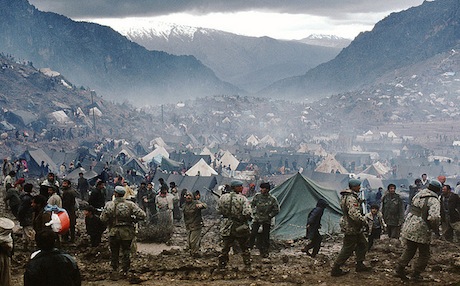
The whole valley had turned into a sprawling shantytown where hundreds of thousands were fighting hunger, cold and disease.
“Not a good place for a breakdown,” the driver stuttered with a nervous grin, probably aware that I had been silently cursing him throughout the trip for not telling me about the broken heater before we set out. Of the dozen or so taxis and cars I had tried to bargain with in Tehran, telling the drivers up front that I was a foreigner who wanted to go to the border, and that once there they would have to take me wherever I demanded regardless of the rules and dangers, he was the only one to agree; for a fistful of dollars, of course.
It was still night when we drove into Marivan in Iranian Kurdistan, and an hour or so before dawn when we found our way to the border, where the Iranian guards said they would open the frontier gate at first light. That is when the daily traffic of refugees going back and forth would begin anew.
The first rays of the sun lit up a scene that is photographed in my mind.
Opposite the iron bar that separated Iran from Iraq, a winding muddy track lay carved into a lush green valley like a giant anaconda, its tail disappearing into an unseen distance. As far as the eye could see, it was bumper-to-bumper with cars, all with Iraqi number plates, and most from Sulaimani.
There were entire families living in the cars, some waiting for weeks to cross into Iran, where authorities had at first let everyone through, but were soon overwhelmed and were now trying to control the flow.
The whole valley had turned into a sprawling shantytown where hundreds of thousands were fighting hunger, cold and disease. Many, especially the very old and young, were daily losing the battle.
Thousands of makeshift tents of plastic sheeting and white cotton dotted the landscape. Families of eight or more were jammed inside, seeking shelter from biting cold and freezing rain.
Refugees told stories of losing elderly relatives en route, their bodies left unburied as people hurried to flee from Saddam’s guns, which could still be heard in the distance.
The more fortunate had been living in cars, buses and trucks, halted patiently in a near endless chain on the winding muddy track that climbed out of the valley. Men, women and small children - many of them barefoot and without so much as a blanket or coat - continued to stream into the valley every day, often after a two-week trek on foot, fleeing Iraqi troops through the snow.
Lacking medical care, enough to eat or shelter through the freezing night, children under five were dying by the dozens.
Refugees told stories of losing elderly relatives en route, their bodies left unburied as people hurried to flee from Saddam’s guns, which could still be heard in the distance. Other victims were buried in plots beside the muddy path.
Nine-year-old Sooran Ramadan recalled being awakened at her home in Kirkuk one morning by the roar of Saddam’s warplanes pounding the rebel-held city. Minutes later, like thousands of other residents, she had set out on foot for the Iranian border with her grandmother, her parents, her two younger sisters and newborn brother. The baby died of exposure to the cold. In the disorderly flight, her younger sister was lost in the town of Penjwin. Sooran's family arrived at the border after a 15-day walk. They ate a little bread and nuts they had brought with them, drank water when they could find it and slept in the open in below-freezing temperatures.
Many of the cars in that chain of misery were expensive Mercedes’ and BMWs, belonging to doctors, engineers, college professors and other such professionals. How could people who probably had comfortable lives only weeks before, end up like this, I remember thinking? Lives, I learned then, can be shattered in an instant – anywhere, and for reasons beyond our thinking.
The Iranians said 1 million refugees had already entered Iran.
The refugees' suffering did not end once they reached Iran, where besieged authorities were struggling to provide food, shelter and medical care. Iranian army trucks and private relief vehicles descended into the valley from time to time, flinging out parcels of bread and other supplies. If the trucks failed to come, most of the refugees went without food. As the trucks rumbled through, hungry refugees clung to the sides or ran beside, shouting for food to be tossed in their direction.
As often as not, the parcel, loosely wrapped in plastic, landed in the mud, but was quickly pounced upon by a dozen or more refugees. I remember a boy of about 14, running with dozens of other refugees behind a truck tossing out parcels of bread and dates, the driver careful not to slow down too much for fear of being overrun by the crowds. When a parcel landed in a puddle, the boy jumped on it, breathless from running, and cheeks red from the cold. As he wiped his runny nose on his sleeve, tore open the plastic and was devouring the food inside, his eyes met mine. It was a look I will never forget. The Kurds, I knew, were a proud people, and being reduced to this indignity could not be easy. I wanted to take his photograph for my report, but decided to leave him with his food, and the little dignity he had left.
The Kurds, I knew, were a proud people, and being reduced to this indignity could not be easy.
I returned to Marivan to file my story. The town was overrun with refugees. Every Iranian home, I was told, had opened its doors to the refugees, who also were Kurds after all. It was a town overrun and overwhelmed, and in the freezing cold of the streets, women and children – many barefoot – still had to beg for food or shelter to survive.
I was a young journalist then, and remembered the advice of more esteemed colleagues: Never interfere when covering a story, not even to help anyone. It was advice I ignored for the first time that day, rolling down the window of the car to hand out fists full of Iranian money – probably just enough to buy shoes, food or shelter for a few days. Amid so much misery, I didn’t know what do to; but I knew I could also not do nothing.
There was a barefoot young woman, her feet covered in mud up to the ankles, carrying a baby and without a coat or blanket. I could only imagine her cold and misery, as I shivered in my car. I wondered if that baby was still alive, and if alive, how long it could survive. She was walking away from me, and I remember the look in her eyes after the car pulled up, a window rolled down, and a hand with a clutch of money reached her way. She stood there stunned, money in hand, as we drove off as suddenly as we had stopped. I don’t remember how much I gave her, but it was dollars, and I remember I wanted it to be enough that it would give her faith in miracles. That, I figured, was the best thing I could give her.
Since then, I have learned, it is not only the hand that receives that is chosen by destiny, but also the hand that gives.
I still had to file my story. At a quiet field in Marivan, we stopped the car and I set up my satellite telephone, which in those pre-Internet days was a journalist’s lifeline. I don’t remember if we had cell phones then, or if they worked in Iran. The satphone was the size of a small suitcase and seemed to weigh a ton. In Iran, where authorities were suspicious of journalists working for Western news organizations, and often regarded them as spies, a satphone had to be used discreetly.
Just as I had filed my story to my bureau in Cyprus and was closing the lid on my Toshiba laptop, I felt a hand on my shoulder, and heard someone ask, “Are you a journalist?” I was prepared for the worst, thinking how I would talk my way out if this were an Iranian policeman or soldier.
There is no way I can reach Saddam’s throat. But I can make sure that his crimes against us Kurds do not go undocumented,
I turned to find a young man, smiling at me as he offered a handshake. “I am a journalist, too,” he said, introducing himself as Reza. “I work for an Iranian newspaper,” he explained, adding that his paper did not want to pay for his trip, so he had come on his own to cover this story. He was an Iranian Kurd, and had come to do whatever he could for his ethnic kin.
We struck up a friendship, and I told him that next day I wanted to cross the border and see how far I could get inside Iraq. Since I did not speak Kurdish and needed a translator, I offered to pay him by the day if he would agree to come as my translator. He readily agreed, and we set up a time to meet early next morning.
It was remarkably easy to cross the border the next day, as the guards were too overwhelmed to check everyone’s papers. They thought I was Iranian, and Reza and I walked right into Iraq. We interviewed more refugees, and came across people who had set up makeshift businesses in the shantytown that had sprouted alongside that trail of misery. There were people buying used household goods from desperate refugees to sell to the Iranians, and offering to sell alcohol, which was banned and hard to find in Islamic Iran. The story I filed recounted the plight of the refugees through this shantytown.
Reza had never seen a laptop, or a satphone. He looked at my sophisticated professional camera and lenses, then fished out his own, and asked how it compared. It was a toy camera he had bought for this trip, the type I remembered my brother receiving for one of his boyhood birthdays. I didn’t have the heart to say anything to Reza, but admired greatly his will: I had come as just another reporter, and to me this was just another story. He had come out of a conviction, and was paying his own way. In this encounter, I had the better equipment, but there was little doubt who was the better man.
In those days before the Internet, I don’t remember if I even knew that there are an estimated 30 million Kurds in the world, that they have never had a homeland, and are the world’s largest homeless nation. Saladin, the Muslim hero of the Crusades to whom Saddam likened himself in his fight against the West, I knew. But I did not know he was of Kurdish origin.
It was a ghostly town, deserted except for Peshmarga fighters who were also rushing to arm and leave.
“Saddam has been a monster, and we all know that,” Reza said, as he replaced the film in his camera. “There is no way I can reach Saddam’s throat. But I can make sure that his crimes against us Kurds do not go undocumented,” he added. “The world should never be able to say, ‘we didn’t know,’” Reza vowed.
I wanted to go deeper into Iraq, so we kept on walking, being the only ones traveling in the direction opposite to the human traffic. But the mud was so thick that with every few steps I would lose a shoe, which would remain stuck in the mud. Then, lady luck smiled, and a couple of Iranian journalists working for the government news agency stopped in their 4 X 4 and offered us a lift. They were going to the Kurdish town of Penjwin, and agreed to take us with them.
We could hear the guns all around us getting louder and knew Saddam’s soldiers were close by. We also knew what would happen to us if they caught us – four guys with cameras and a satphone. But we arrived in Penjwin without incident.
It was a ghostly town, deserted except for Peshmarga fighters who were also rushing to arm and leave. With Saddam’s forces closing in, no one had time to talk. Dressed in their baggy pants and turbans, they were loading guns, collecting ammunition, as commanders barked orders and ignored us completely. Saddam’s troops were very close, they warned, and advised us to get out quickly. I got some quotes and I had my story: Everyone had fled Penjwin, Saddam’s forces were closing in and the Peshmarga were girding for the fight.
We drove out of town at great speed, but suddenly the driver stopped, and his words sent a chill down all our spines. “Hey, we’re lost,” he said. “Which way is the Iranian border and which way is Iraq?”
Arriving in Erbil now, it is gratifying to see that all that suffering and sacrifice of the Kurds more than two decades ago was not for naught.
It was a forked road, and turning back was not an option, since the thunder of explosions was coming from behind, now so close that the ground shook every time we heard a blast. After a few minutes of arguing and trying to figure out where we were, we put our heads together – all of us being experienced journalists – and decided on the most intelligent course of action: We tossed a coin. That coin knew more than we did; it got us back to Iran. Thereafter, on assignments in warzones, I always carried a compass.
It was close to late evening when we crossed back into Iran, and late night when we drove into Marivan. We searched for a place to spend the night, but after two hours of looking, found nothing: Every place was crammed with refugees. Then Reza said he had a relative in town, but did not know the address. He would have to call his own home in a different town to see if he could locate them.
We found a place to make the call, and Reza got an address. It was midnight when we knocked on a door and Reza called the name of the relative, explaining to us he was a distant uncle. We woke up the surprised family, but after hearing our story the head of the household broke out in a large grin and ushered us in. Within 20 minutes we were inside a warm living room, sipping hot tea and warming ourselves beside the kerosene heater. It was a modest home, but rich in goodness and the hospitality for which Kurds everywhere are famous.
The lady of the house, roused from sleep and still rubbing the sleep from her eyes as a toddler clung to her leg, good-humoredly lit a stove, fried some eggs and was soon deftly flipping thin circles of freshly made “tiri” bread. By the time we devoured a meal that to our hungry palates tasted like manna from heaven, clean beds had appeared from nowhere and laid out on the floor. After the trip from Tehran and days spent trudging through the mud and cold, that luxury of warmth, clean bed and fresh food so graciously served, felt like nothing short of a blessing. As my thoughts drifted to the unfortunate many I knew would be spending another freezing night, and to the many who would not survive, I was soon lost in slumber.
Next morning I said goodbye to the family and Reza, and set out for Tehran to catch a flight to Dubai. It has always been my regret that I never stayed in touch with Reza, and I wonder where he is today.
Arriving in Erbil now, it is gratifying to see that all that suffering and sacrifice of the Kurds more than two decades ago was not for naught. Today, the Kurds of Iraq have a place they can call their own, where they can speak their own language, play their own songs and wear their own clothes.
Today, in the Kurdistan Region, surrounded by the mountains that have been their eternal friends, the Kurds of Iraq have built a place that for the first time they can call home.
Comments
Rudaw moderates all comments submitted on our website. We welcome comments which are relevant to the article and encourage further discussion about the issues that matter to you. We also welcome constructive criticism about Rudaw.
To be approved for publication, however, your comments must meet our community guidelines.
We will not tolerate the following: profanity, threats, personal attacks, vulgarity, abuse (such as sexism, racism, homophobia or xenophobia), or commercial or personal promotion.
Comments that do not meet our guidelines will be rejected. Comments are not edited – they are either approved or rejected.
Post a comment