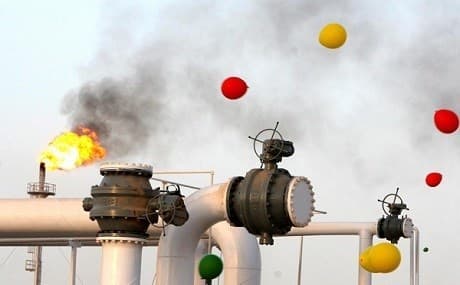
Under the 2019 budget agreement, approved in January 2019, the KRG was granted a 12.67 percent share of the federal budget – short of its pre-2014 share of 17 percent – on the condition it sends 250,000 barrels of oil per day to the state marketing body SOMO and deposits all revenues into the central treasury.
However, the KRG has so far failed to keep its end of the deal. As parliament prepares to discuss the 2020 budget, Iraqi lawmakers are concerned the KRG will again fail to keep its end of the bargain.
When Kurdistan Region President Nechirvan Barzani met with Baghdad officials on June 20, he said he discussed oil matters with Iraqi Prime Minister Adil Abdul-Mahdi and emphasized that an agreement should be reached that would be acceptable to both parties.
Abdul-Mahdi and Barzani agreed to form two committees to set the agenda for future talks.
“We have reached the final stages and what is left is the just a visit from a high ranking KRG delegation to Baghdad to sign a final agreement as we have already spoken on all the issues,” Shakawan Abdulla, a former Kurdistan Democratic Party (KDP) MP and negotiator in Baghdad said.
The KRG delegation is expected to consist of KRG Prime Minister Masrour Barzani, Finance Minister Awat Sheikh Janab, Peshmerga Minister Shorish Ismael, and MPs from various parties.
Iraqi lawmakers are piling pressure on Abdul-Mahdi’s government to implement the agreement, accusing him of being too soft on the KRG, which is yet to send a single barrel of oil to Baghdad in exchange of its 2019 budget share.
Iraqi MPs have even urged the government to freeze the KRG’s share of the budget until oil deliveries are secured.
The KRG has been using revenues earned through its independent oil sales to clear its debts, which piled up in recent years after Baghdad cut its share of the federal budget to zero, global oil prices crashed, and the region was struck by war and financial crisis.
“In principle, we do not have any issues with handing over the 250,000 barrels of oil per day to Baghdad,” said Barzani, but added “before it happens, agreements should be made.”
“The matter is not just that we should hand over 250,000 barrels of oil. There are also legal dimensions. There is an accumulation of loans on the KRG because of budget cuts from 2014. We have discussed these things and talked about how we can reach a deal that Baghdad and the Kurdistan Region can agree on.”
A leading member of the Patriotic Union of Kurdistan (PUK), who spoke to Rudaw on condition of anonymity, said last week: “The Americans and UN and even Europeans have pressured both sides to hold constructive and fruitful meetings [and] not just waste time.”
“Good understanding has emerged between Erbil and Baghdad in order for Erbil to hand over 250,000 barrels of oil per day and for Baghdad to continue the budget that it does now and the matter of the budget law should no longer be the center of issues.”
“The signing of the first agreement will give way to a second agreement on the subject of disputed and Kurdistani areas outside KRG and Peshmerga control,” he added.
Dana Jaza, a KDP MP in Baghdad, described the KRG visit to Baghdad as “instrumental”.
“There is a strong possibility that an agreement will be signed,” Jaza added.
The KRG began selling oil independently of Baghdad in 2013, leading then-PM Nouri al-Maliki to suspend the Region’s budget share altogether.
When Peshmerga forces took control of security in Kirkuk in 2014, the KRG also seized the province’s bountiful oilfields.
When Iraqi forces retook these oilfields in October 2017, the KRG lost around half of its oil revenues. Oil exports via the pipeline linking the Kurdistan Region to ports in Turkey were suspended for several months.
Erbil-Baghdad relations have vastly improved since Abdul-Mahdi took office, and exports have resumed. Although a smaller share than before, the Region is again receiving federal funding.
If the KRG does not show it is willing to send even a portion of the oil quota to Baghdad, the Iraqi government may again cut its budget.
Although Iraq is unlikely to use force, the events of October 2017 remain fresh in the minds of Kurdish leaders.
If criticism of Abdul-Mahdi continues, MPs may remove him from office. His predecessor Haider al-Abadi, who took a more uncompromising approach to the KRG, recently hinted he would like to return to power.