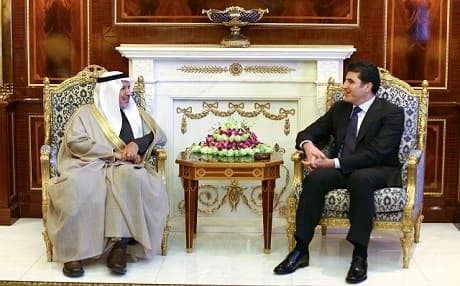

ERBIL, Kurdistan Region— A senior advisor to Saudi Arabia’s King Salman Bin Abdelaziz has praised the Kurdistan Region and conveyed the monarch’s blessings for future partnership between the two countries.
Abdulla bin Abdelaziz bin Muhammad al-Rabiya who is currently visiting Erbil told his Kurdish hosts that “his visit is a testament to the devotion of the Saudi King Salman for Iraq and the Kurdistan Region in particular, since the visit was at the personal request of the monarch aimed at studying the conditions to open a center for the King Salman Foundation in the Kurdistan Region for humanitarian purposes,” according to a statement from the office of the Kurdish Prime Minister Nechirvan Barzani after his meeting with the Saudi representative on Monday.
The statement said the Kurdish premier had asked “the King Salman Foundation to start its services in the Kurdistan Region while the Kurdistan Regional Government’s (KRG) partners will work to provide the foundation, through the Saudi consulate, with a report about the humanitarian needs in the region.”
The King Salman Center for Relief and Humanitarian Works, launched in Riyadh in 2015, has streamlined the Kingdom’s donations to refugees and people affected by armed conflicts in several countries including in Yemen.
Relations between Riyad and Erbil have thrived over the past decade as Iraq’s Shiite-led government increasingly favored stronger ties to the Islamic Republic in Iran whose rivalry with the Saudi kingdom has recast regional alliances in the Middle East.
Tehran has openly accused Saudi Arabia of funding Iranian Kurdish groups opposed to the Islamic Republic, a claim Erbil has long rejected.
Riyadh, an arch supporter of the anti-regime forces in Syria, has also expressed concern over what it sees as Iran’s expanding influence in the Gulf region including in Iraq.
In Monday’s meeting Barzani said the Iraqi government did not address the ongoing refugee crisis in the Kurdistan Region “seriously,” while embracing nearly 1,5 million displaced people had added to the woes of the cash-strapped KRG, spending around $1,4 billion a year on refugees.