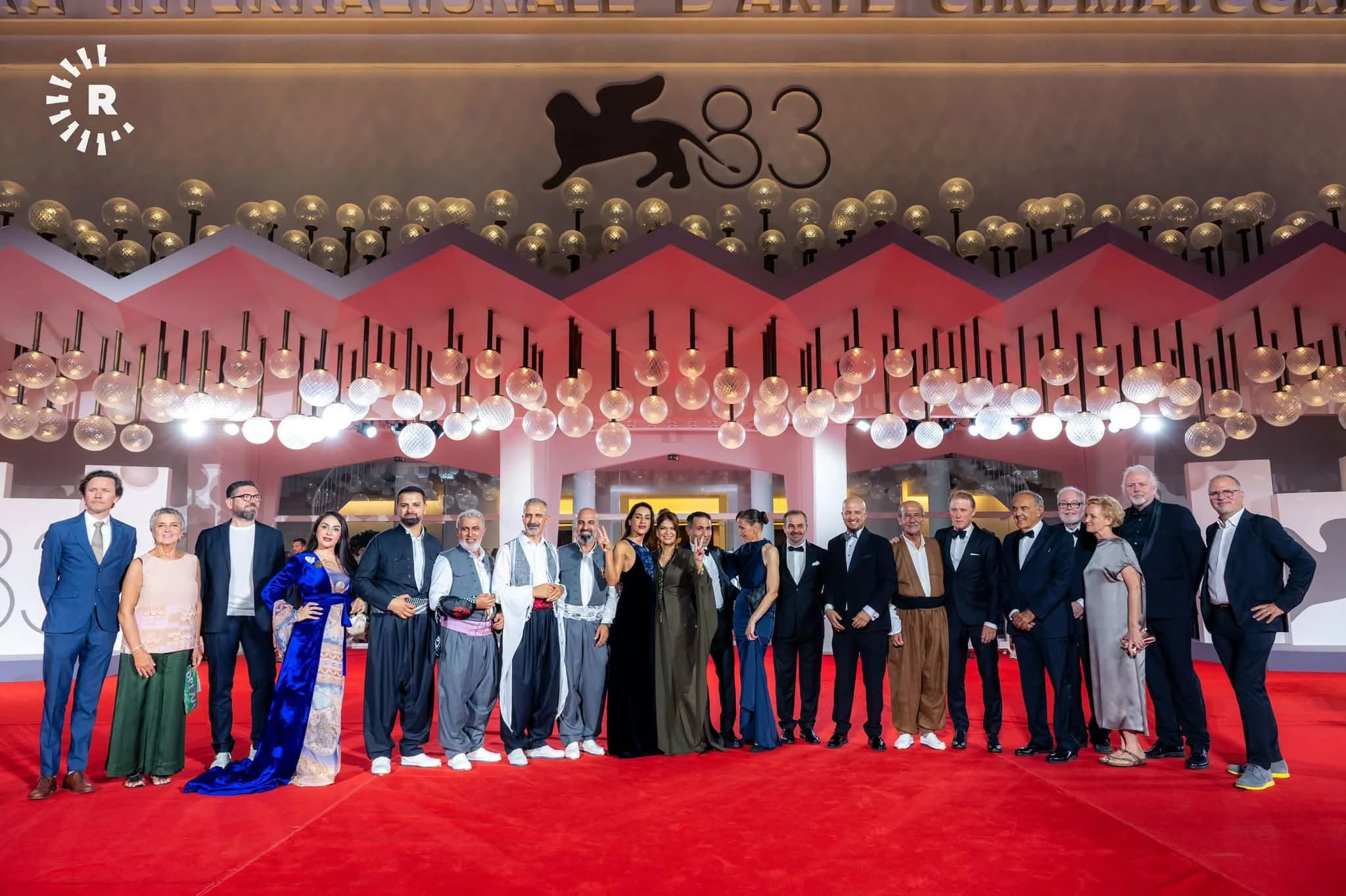

VENICE, Italy – An official red carpet premiere at the Venice Film Festival was transformed into a rare cultural show of force as Halkawt Mustafa's combat drama No Paradise if Killed by a Woman made its world premiere before an international audience and a roaring auditorium.
The film's arrival outside the Palazzo del Cinema upended the typical promotional rhythm of the festival. Rather than the standard mix of shouting photographers and canned music, the entrance was marked by the haunting, unmistakable voice of Kurdish singer Kizhan Ibrahim Khayat, drawn directly from the film's soundtrack. Flanked by director Halkawt Mustafa, the cast walked the red carpet in traditional Kurdish attire, turning one of world cinema's most watched corridors into an immediate cultural statement.
The atmosphere along the perimeter barricades mirrored the tension on screen. Kurdish spectators traveled from across the European diaspora and beyond to converge on the island for the screening. Among those at the film festival was UK-based filmmaker Alan Hamwan, who made the trip to support the production. "A group of people came from the UK specifically to watch the Kurdish film," Hamwan told Rudaw, describing an unprecedented gathering of diaspora filmmakers and supporters at the world's oldest film festival.
The momentum carried straight into the festival's historic Sala Grande for the official screening. Granting the high-octane combat production an official red carpet berth reflected a deliberate, calculated move by festival artistic director Alberto Barbera to spotlight large-scale storytelling from the region.
"We were impressed by the film," Barbera told Rudaw regarding the festival's selection. "I didn't expect such a strong and spectacular movie about the role the Peshmerga and the Kurdish people played against ISIS."
Barbera's emphasis on the film's spectacle underscores why the work stands out on the festival circuit. Bypassing the minimalist, low-budget realism often associated with Middle Eastern festival cinema, Mustafa directed an expansive, kinetic combat thriller anchored by the tactical precision and resolve of women fighters. The film combines visceral, wide-screen combat set pieces with relentless narrative drive.
That equilibrium between high-velocity drama and historical gravity registered sharply with international journalists at the festival. Italian film journalist Marco Consoli praised the film's ability to bridge wide commercial appeal with genuine narrative heft.
"The film was great, it was one of the best I have seen this year at the Venice Film Festival," Consoli told Rudaw. "It's an entertaining film that can reach a large audience, but at the same time it has a story and characters that are very relevant."
Inside the Sala Grande, the conclusion of the film triggered an immediate standing ovation that rolled through the hall for several uninterrupted minutes, holding the cast and director in an unbroken wall of applause. Rezan Hama Salih, the Kurdistan Regional Government's representative in Italy, cast the moment in terms of a global cinematic campaign.
"Today is a historic day for the Kurdish Nation, and I hope that it will reach the Oscars," Salih told Rudaw.
For Mustafa, standing under the house lights alongside his cast after years spent developing and financing the production, the overwhelming reception marked a hard-won arrival on the international stage.
"I had such a great feeling, it was a feeling of pride and calmness," Mustafa told Rudaw after leaving the stage. "You work on a project for many years and get to a point where the world needs to see it. Tonight was the night that I feel like I can breathe when it comes to that project."