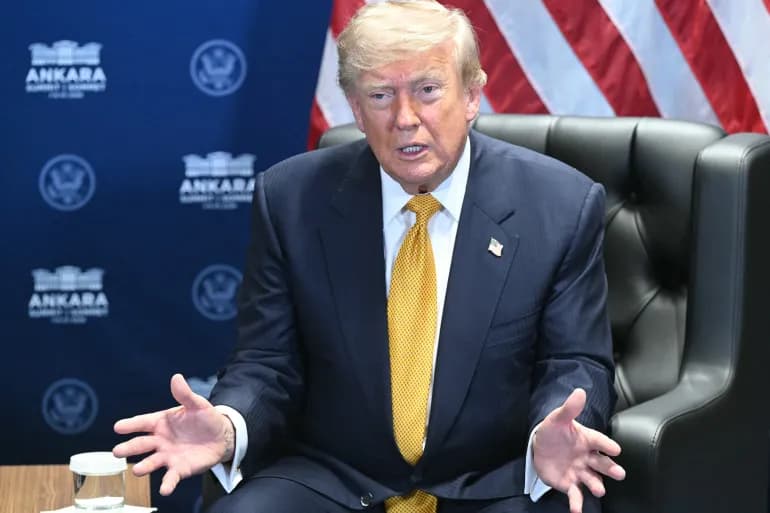

ERBIL, Kurdistan Region - American forces will likely hit Iran "hard" in the coming hours for the second day in a row, US President Donald Trump said on Wednesday, shortly after declaring earlier in the day that the ceasefire with Tehran "is over" and that he has no interest in "dealing with" the Iranian side, calling it "a waste of time."
"We hit them [Iran] very hard last night, very, very hard, and we'll probably hit them hard again tonight," Trump told reporters on the sidelines of a meeting with Ukrainian President Volodymyr Zelensky in Ankara, where the two leaders are attending a NATO summit.
The US Central Command (CENTCOM) said on Wednesday that its forces "completed a new round of offensive strikes against Iran … hitting over 80 targets with precision munitions."
The targets included "Iranian air defense systems, command and control networks, coastal radar sites, anti-ship missile capabilities, and more than 60 Islamic Revolutionary Guard Corps [IRGC] small boats in and near the strait to degrade Iran's ability to continue attacking international commerce flowing through the international trade corridor," the Command said.
CENTCOM added that the strikes were "an immediate response to Iran's attacks on commercial vessels transiting the Strait of Hormuz" - namely the Marshall Islands-flagged Motor Tanker (M/T) al-Rekayyat, Saudi Arabia-flagged M/T Wedyan, and Liberian-flagged M/T Cyprus Prosperity, all recorded in the preceding 24 hours.
"The unwarranted aggression by Iranian forces is a clear and dangerous violation of the ceasefire and undermines freedom of navigation," the Command said, stressing that its forces remain "prepared to hold Iran accountable when the agreement is not adhered to or obeyed."
For its part, the Iranian military said the US launched an "aerial assault on a number of coastal bases and civilian stations on the coasts of the [southern] Hormozgan province and [the city of] Mahshahr,” located in Iran’s southwestern Khuzestan province as well.
The IRGC added that its "naval and aerospace forces" responded to the escalation, launching "a joint missile and drone operation, crushing 85 important positions and US military facilities" in Bahrain and Kuwait, and downed an American "MQ9 drone that intended to interfere in the operation."
The status quo
The escalation marks the second such flare-up in recent weeks, following a high-intensity exchange between the two sides across the region in late June, before backchannel diplomacy led to an emergency stand-down.
The earlier round had caused a brief collapse of the Islamabad Memorandum of Understanding - a preliminary agreement struck between Iran and the US in mid-June, under which the two sides agreed to a cessation of military operations and committed to talks aimed at reaching a comprehensive settlement to the regional war within 60 days of signing, with the possibility of extension by mutual consent.
However, asked about the MoU by reporters on Wednesday, US President Trump remarked, “To me, it's over,” adding, “as far as I'm concerned, it's just a waste of time dealing with them. They're liars.”
Iran's chief negotiator and Parliament Speaker Mohammad Bagher Ghalibaf on Wednesday accused Washington of repeatedly violating established understandings, saying "the era of bullying and extortion is over. It leads nowhere. We don't fold."
The remarks by US and Iranian officials, pointing to the total collapse of the ceasefire, notably come after Qatar - a key mediator in the peace talks - indicated that the two sides had "agreed to continue discussions over the coming period.”
Doha's foreign ministry spokesperson, Majed al-Ansari, added in a statement posted on X last week that "the next meeting" was "scheduled at the earliest possible time following the funeral processions of the former Iranian Supreme Leader [Ali Khamenei]."
Khamenei’s (1939 - 2026) funeral processions began Friday across multiple Iranian cities. His body arrived in Iraq on Tuesday evening, where rites were held in southern shrine cities on Wednesday, ahead of his scheduled burial in Iran's northern shrine city of Mashhad on Thursday.
With the latest escalation in both military operations and rhetoric, however, it remains to be seen whether a resumption of talks will unfold.