
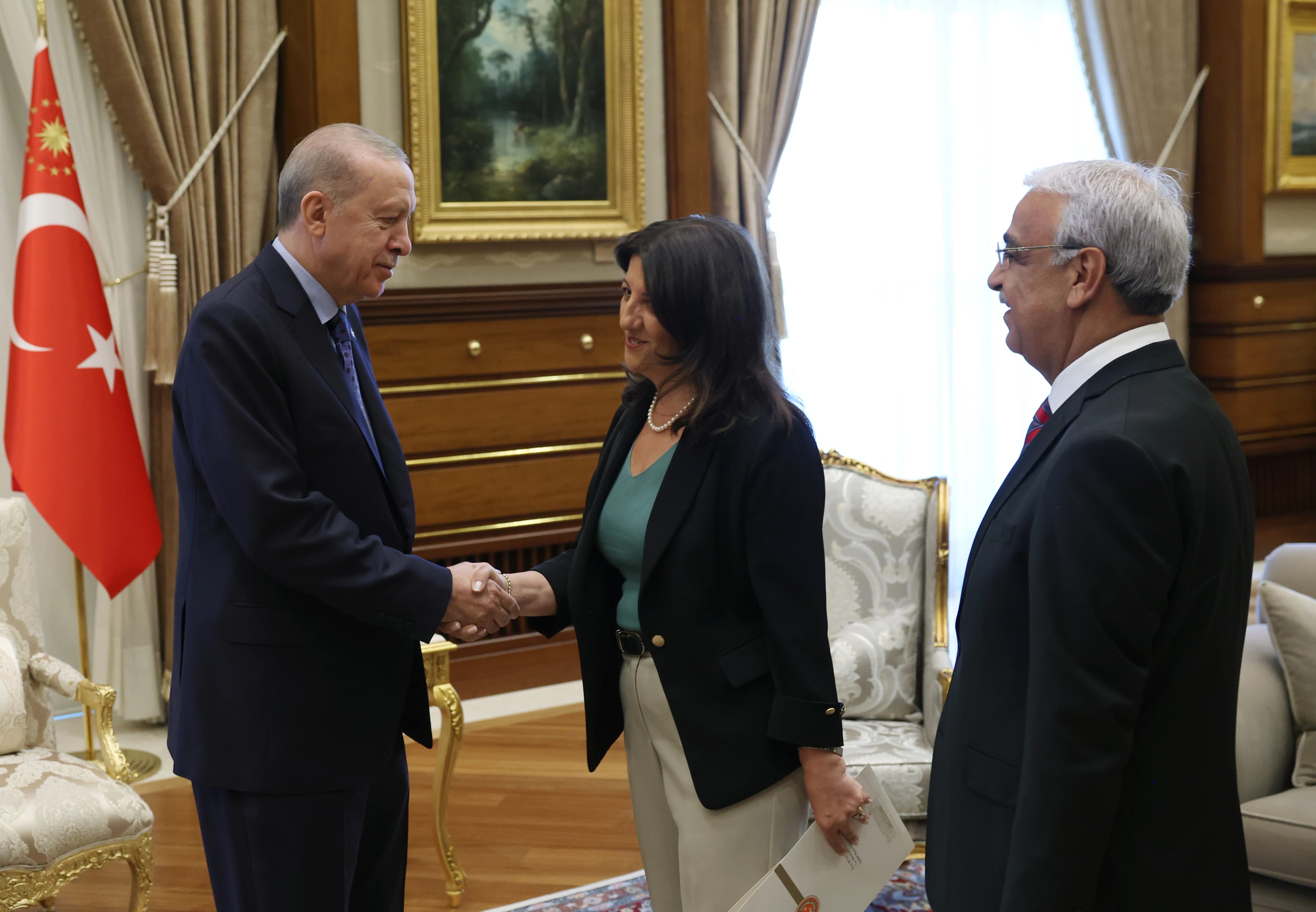

ERBIL, Kurdistan Region - Pro-Kurdish lawmakers mediating the ongoing peace talks between the Turkish state and the Kurdistan Workers' Party (PKK) met President Recep Tayyip Erdogan on Thursday, days after parliament passed a law providing a legal framework for the process - seen as the first major state contribution to the peace initiative.
Pervin Buldan and Mithat Sancar, lawmakers from the pro-Kurdish Peoples' Equality and Democracy Party (DEM Party), said in a joint statement that they held a one-and-a-half-hour meeting with Erdogan at the presidential palace to discuss the law, which was passed on Monday with 468 votes in favor, 88 against, and six abstentions in Turkey's 600-seat parliament.
"Both sides assessed the significance of the stage reached in the process and the steps to be taken going forward," read the statement. "It was emphasized that, with this law, opening the door to a period in which democracy and the political sphere will be strengthened is of vital importance for all our citizens and our country. During the meeting, the shared determination to continue the process with resolve was reaffirmed."
There was no immediate statement from the Turkish presidency on the meeting.
Ahead of the meeting, the DEM Party delegation told reporters that they will discuss all issues with Erdogan, adding that they plan to visit jailed PKK leader Abdullah Ocalan soon.
The law allows PKK fighters who have not been involved in violent actions to be reintegrated and temporarily suspends PKK-related prosecutions. However, it does not address the fate of Ocalan - an omission that has drawn criticism from the group.
Mustafa Karasu, a senior PKK commander, has criticized the law for failing to define Ocalan's status and role, saying his direct participation is essential for the peace process to move forward.
“The failure to refer to the resolution of the Kurdish issue in the law is considered a significant shortcoming,” Karasu said in a recent interview with the PKK-affiliated Firat News Agency (ANF) published on Wednesday.
“It concerns thousands of fighters. It concerns thousands of cadres. Yes, the PKK has dissolved itself, but there is still a community here,” said Karasu, affirming that, “without the direct and official participation of Ocalan, this law will not be effective."
Karasu said the legislation focuses too heavily on disarmament while failing to address the Kurdish issue and democratic reforms.
The DEM Party has strongly endorsed the law while acknowledging that it falls short of its expectations.
"This law does not meet all our expectations, but we cannot devalue it. To meet our expectations, it is necessary to intensify the joint struggle. We evaluate the law as a law that creates the ground for democratic politics," DEM Party spokesperson Aysegul Dogan told reporters during a press briefing on Thursday.
She later told Rudaw's Mashallah Dakak that two committees will be formed - one affiliated with the presidency and the other with parliament - to oversee the process.
“These two committees need to work together in coordination. Once these committees are established, it will become clear how applications will be received," she said.
Dogan also said that the PKK is awaiting instructions from Ocalan on how to lay down its arms, noting that the law stipulates that it will not be enacted until the National Security Council confirms that the PKK has dissolved itself and laid down its arms, with the results subsequently published in the Official Gazette.
“Coordination between the committees and Ocalan is seen as necessary for the return of the PKK," Dogan stressed.
Asked about the future of the DEM Party as the process moves forward, Dogan said the party has decided to hold a congress on September 6, bringing it forward from the previously scheduled date of September 20.
"The congress will be a preparatory congress for restructuring. Our preparations for the congress are continuing. With the September 6 congress, we will launch the restructuring process," she said. “For this process to conclude successfully, we will also hold meetings with different segments of society.”

