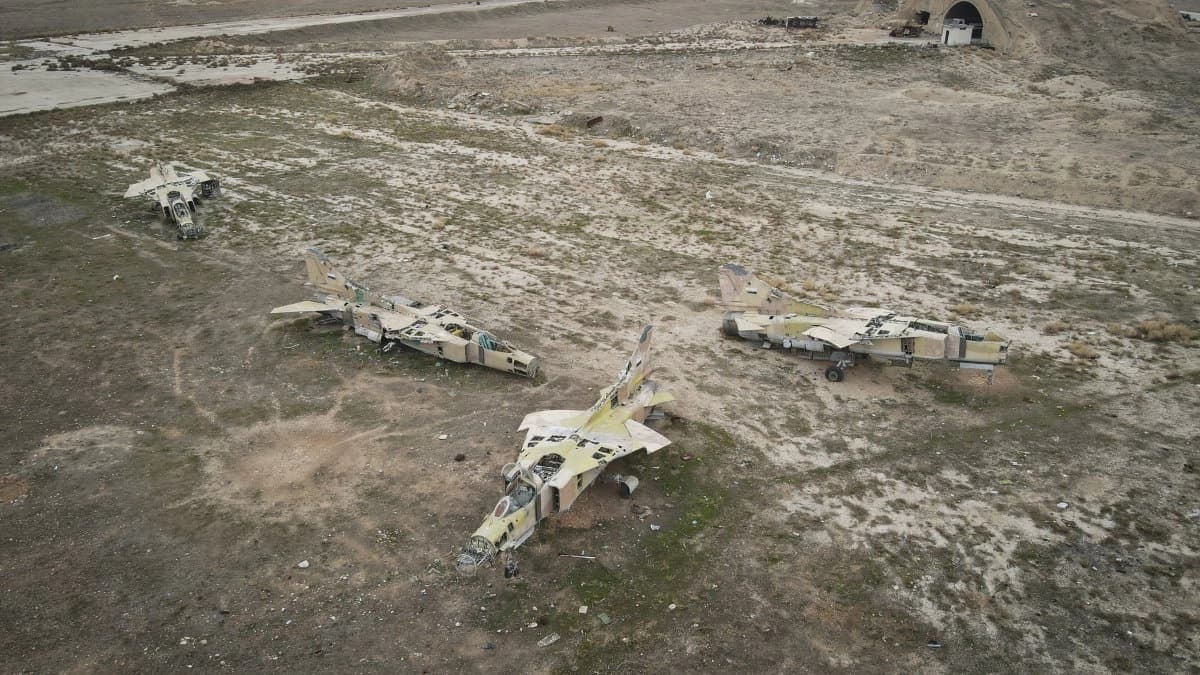

ERBIL, Kurdistan Region - Syria on Tuesday accused Israel of trying to undermine its defensive capabilities since the interim government took power in late 2024, as Damascus's foreign ministry condemned fresh Israeli airstrikes on an airbase in northwestern Syria that coincided with reports of rehabilitation efforts at the site, purportedly backed by Turkey.
"The Syrian Arab Republic condemns in the strongest terms the Israeli airstrikes targeting Abu al-Duhur Military Airbase in Idlib province," the ministry said in a statement, calling the strikes an "unjustified act of aggression" that constitutes "a flagrant violation of Syria's sovereignty and territorial integrity, and a dangerous escalation that threatens security and stability in the region."
The statement said "the continuation of these Israeli attacks" since the late December 2024 ouster of longtime Syrian president Bashar al-Assad aims to "undermine" Syria's efforts to "consolidate stability and avoid escalation," accusing Israel of attempting to "drag the region towards further tension and instability."
Syria further urged the international community and the UN Security Council to "clearly condemn this aggression and take a firm position against Israel's repeated violations of Syrian sovereignty," while affirming it will "continue to defend its rights and national interests through legitimate means."
Earlier in the day, the UK-based Syrian Observatory for Human Rights (SOHR), which relies on a network of sources inside Syria, reported that the strikes came amid "ongoing Turkish rehabilitation work inside the facility," pointing to a recent visit by "a Turkish military delegation" to "inspect the ongoing rehabilitation work."
Citing its sources, SOHR also reported that "non-Syrian fighters" had been deployed to the base, describing the activity as part of "synchronized Turkish military and technical moves involving multiple sites," after Turkish forces deployed radars across northern and western Syria.
Meanwhile, Tom Barrack, the US special presidential envoy for Syria and Iraq, said Washington was "deeply concerned that the confirmed Israeli airstrikes on Abu al-Duhur Airbase constitute an unnecessary escalation that does not advance regional stability."
He added that the government of Syrian interim President Ahmed al-Sharaa had "repeatedly indicated a preference for de-escalation with Israel," and that the US "will continue to host discussions to encourage diplomatic cadence over kinetic frustration for both nations."
In the immediate aftermath of Assad's fall, Israel launched an unprecedented campaign of airstrikes across Syria, carrying out over 350 strikes in the first 48 hours to destroy strategic military assets, naval vessels, and air defense systems.
Despite a UN-brokered disengagement agreement dating to 1974, Israeli forces also entered buffer zones east of the Golan Heights in southern Syria and pushed into Quneitra province after Sharaa and his allied forces took power, citing concerns that security vacuums could be exploited by elements linked to the Islamic State (ISIS), al-Qaeda, and Iran-aligned armed groups.
By December 2025, monitoring groups documented more than 600 Israeli strikes inside Syria since the fall of the Assad regime, averaging nearly two attacks per day, concentrated heavily in Quneitra, Daraa, and Rif Dimashq provinces.
Military operations continued throughout 2026, expanding beyond airstrikes to include non-kinetic measures such as aerial herbicide spraying over farmland in Quneitra in late January 2026 to clear border zones. Cross-border clashes and strikes escalated into mid-2026, including a deadly raid near Hodr in late June.
The two sides have held several rounds of rare talks, mediated by Washington, aimed at de-escalating tensions and reactivating the 1974 Disengagement Agreement in the Golan Heights.
Syrian interim President Sharaa, in late July, addressed the Israeli presence in Syrian territory, affirming that Damascus is seeking a negotiated arrangement rather than confrontation. "Israel also has ambitions in the region. We shouldn't just overlook this aspect. We try to engage with them through reaching a security agreement," he said, adding that Damascus avoids "getting into clashes" with Israel.