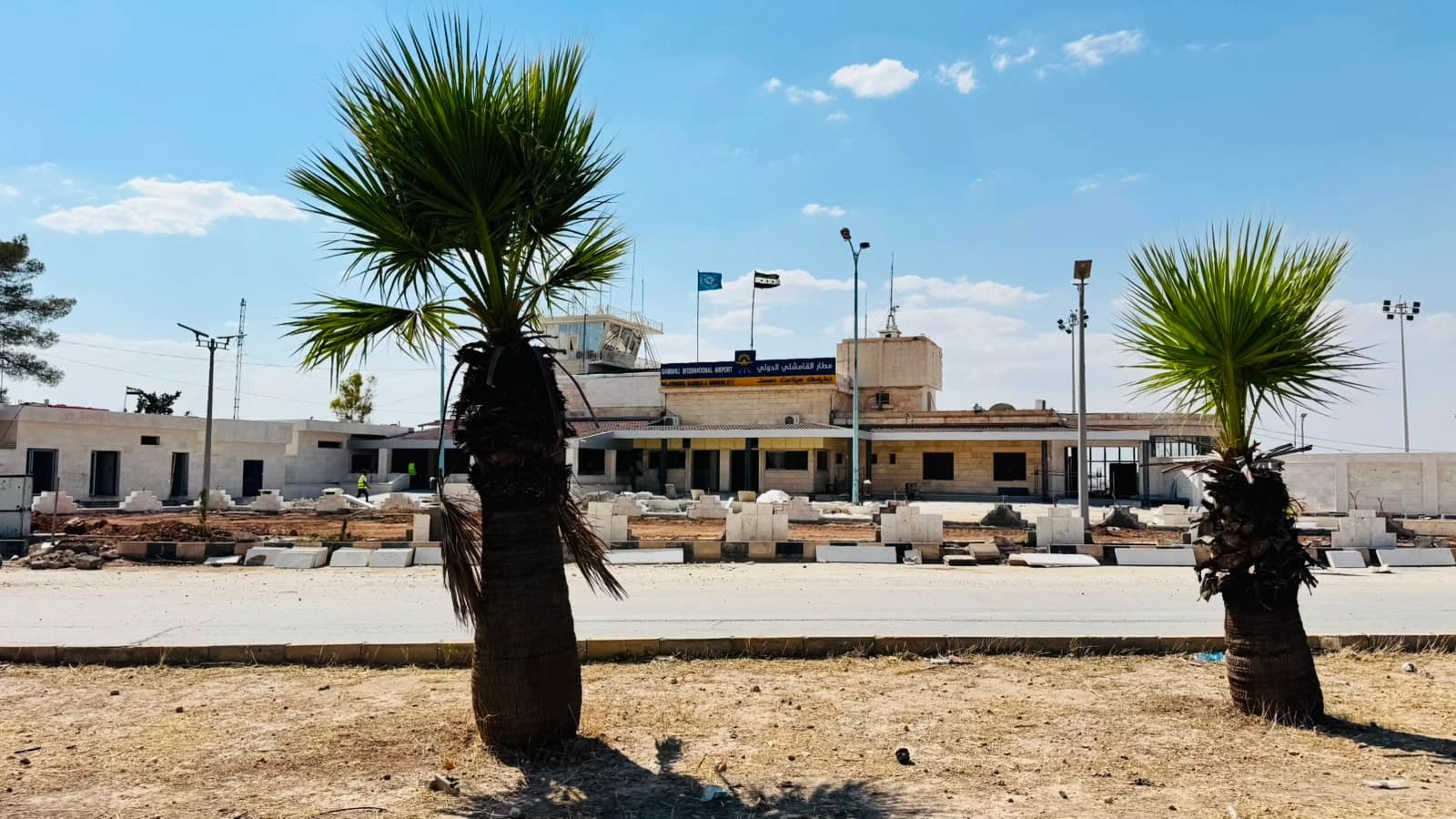

ERBIL, Kurdistan Region - Nearly 80 percent of renovation work at Qamishli International Airport has been completed, the head of Syria's Civil Aviation Authority said on Monday, bringing northeast Syria's (Rojava) only airport closer to resuming operations after years of disruption.
Omer Hosari, director general of Syria's Civil Aviation Authority, told Rudaw’s Nushin Heme that major progress had been made on the project, with work now focused on final technical requirements.
Hosari said authorities were working to complete technical details and the remaining tasks.
“This work encompasses infrastructure, preparations, and core systems related to safety, security, and the operation of the airport,” he said.
Hosari said the next phase would involve test flights and technical evaluations before a date for the airport's reopening is announced.
“We have a clear temporary roadmap, but we want to link the announcement of the flight start date to the practical results of the technical preparations,” he said, adding that “the most important thing is for the airport to resume service in a safe, stable, and suitable manner for normal and regular flights.”
Opened in the 1950s as a regional hub for northeast Syria, Qamishli International Airport occupies a strategic location near the borders with Turkey and Iraq.
The airport remained under the control of Bashar al-Assad’s government until its fall in December 2024. Following the government's withdrawal, the Kurdish-led Syrian Democratic Forces (SDF) took control of the facility.
Earlier this year, the Damascus government and the SDF signed a comprehensive agreement following weeks of fighting aimed at de-escalating tensions and beginning a phased political and military integration process. The deal allowed government forces to enter the Kurdish-majority cities of Hasaka and Qamishli in Rojava.
Under the agreement, the airport would return to government oversight while retaining staff from the Kurdish autonomous administration.
Hosari said authorities also planned to coordinate operations between Qamishli and Deir ez-Zor airports as part of a broader strategy for northeast Syria.
“We want to develop the capacity of both airports according to practical demands so that the distribution of flights and routes is achieved in a successful and economic way,” he said.
The aviation chief said both airports could eventually handle cargo and logistics services, citing the region's agricultural and economic activity. Such an expansion, however, would depend on demand and economic viability.
Hosari said authorities were already in discussions with several airlines about launching services to Qamishli but declined to identify the carriers or potential destinations before legal and commercial procedures are finalized.
“Our primary goal is to establish a sustainable and permanent operation for the airport, rather than just opening a few routes for a short period,” he said. “Therefore, the expansion of flights will be based on demand, economic efficiency, and the capacity of airline companies to provide regular and lasting flights.”
The airport, originally a civilian facility, became a semi-military zone during the height of Syria's conflict as Moscow used it to project power in the region.
Russian forces completed their withdrawal from the airport earlier this year following the SDF-Damascus agreement, ending a significant Russian military presence in the Kurdish-majority northeast.
Since 2019, Russia - the main backer of Assad during the Syrian conflict - had used the airport as a strategic military hub.