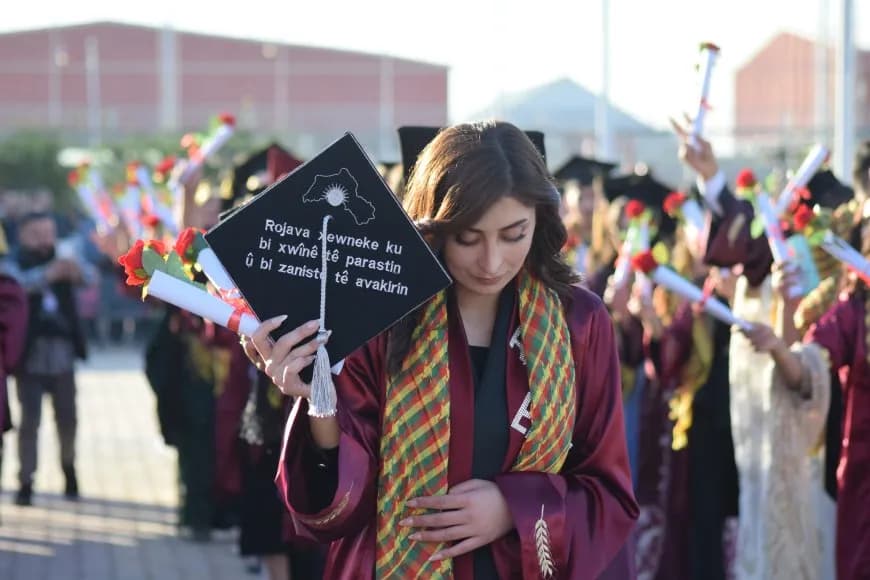

ERBIL, Kurdistan Region - Efforts are underway to officially recognize northeast Syria’s (Rojava) largest university, a Kurdish lawmaker in the Syrian parliament told Rudaw on Wednesday, in a move geared to have significant implications for local students, particularly in improving access to public sector employment and further studies abroad.
“Efforts are underway to secure official recognition for Rojava University, based in the city of Qamishli, to ease the burden on students who must travel to other provinces to pursue their studies,” Yasser Suleiman Mansour said in an interview with Rudaw’s Dilbixwin Dara.
Highlighting the challenges faced by Kurdish students who travel to universities in Damascus or Aleppo, he said several lawmakers in the Syrian parliament are “working to establish a public university” in Rojava, describing the move as “very important for the future of our youth” to avoid long-distance travel and high costs.
Of note, Mansour was appointed earlier this month by Syrian interim President Ahmed al-Sharaa as one of 70 lawmakers named to complete the country’s 210-seat People’s Assembly.
Originally from the Kurdish-majority city of Qamishli in Rojava, Mansour told Rudaw that “Kurdish representation in the Syrian parliament is a source of both pride and a heavy responsibility,” adding, “When my people ask me for something, this increases my responsibility. We want to be the voice of our people.”
The push to officially recognize Rojava University is part of broader efforts to integrate civilian and military institutions in the Kurdish-majority enclave into the Syrian state, following a late January agreement between the Democratic Autonomous Administration of North and East Syria (DAANES), which governs Rojava, and the interim authorities in Damascus.
Article 11 of the accord stipulates that Damascus will recognize and accredit diplomas previously issued by educational institutions in Rojava.
In addition to diploma recognition, Kurdish authorities have pushed to institutionalize Kurdish-language curricula, which have been implemented in Rojava since 2011 outside the Syrian state education system.
The Syrian education ministry in mid-June announced the start of a process to accredit certificates previously issued by the DAANES, while allowing Rojava students to sit national general certificate examinations for the 2026 and 2027 academic years.
The ministry also announced that more than 35,000 DAANES-employed teachers have been transferred to the Syrian government payroll while retaining their positions in the Kurdish regions.