Iraqi Prime Minister Ali al-Zaidi on Saturday announced that Iraq aims to end its chronic power crisis by 2027 through importing more than 10,000 megawatts from neighboring countries and adding 37,000 megawatts of domestic generation capacity.
However, if electricity waste continues at its current rate, roughly half of the targeted 47,000 megawatts could be squandered, just like half of the current 30,000 megawatts capacity. Even if the plan is fully executed, analysts warn that meeting total demand by 2028 will remain an arduous task.
In fact, Iraq's electricity demand does not reach 60,000 megawatts; rather, the core problem is that more than half of the electricity generated and imported is lost before it ever reaches the consumer. If that waste were reduced, even the current supply would be enough to provide citizens with 24-hour electricity, as in France and Germany, and to end the crisis and the annual summer protests over power outages.
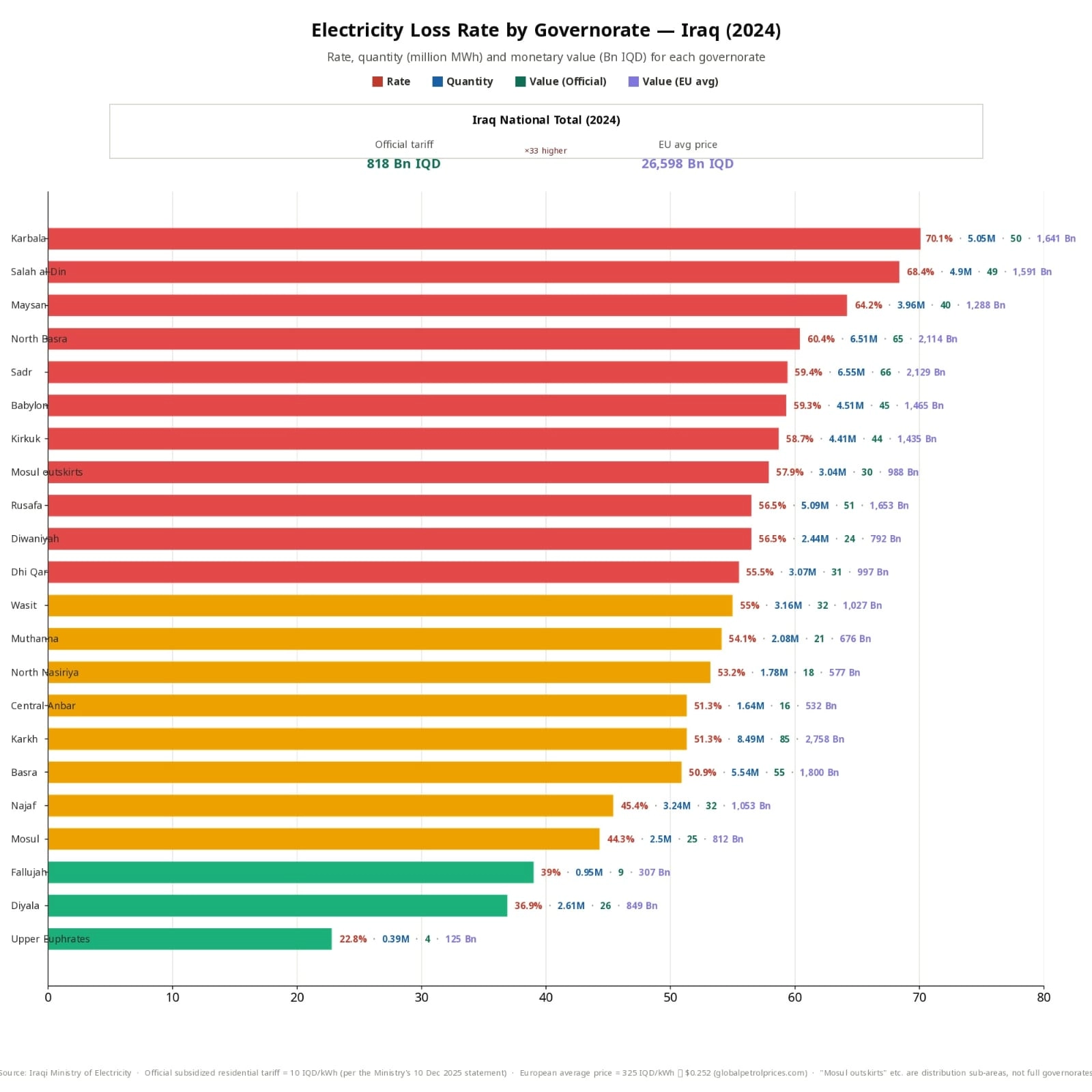
According to data from Iraq's Central Statistical Organization and Geographic Information Systems, 58 percent of the electricity generated and imported in Iraq is wasted before reaching consumers. In the southern Karbala province, that figure rises to 70 percent. The central question is therefore: does Iraq need more electricity, or does it need to restructure the sector entirely? 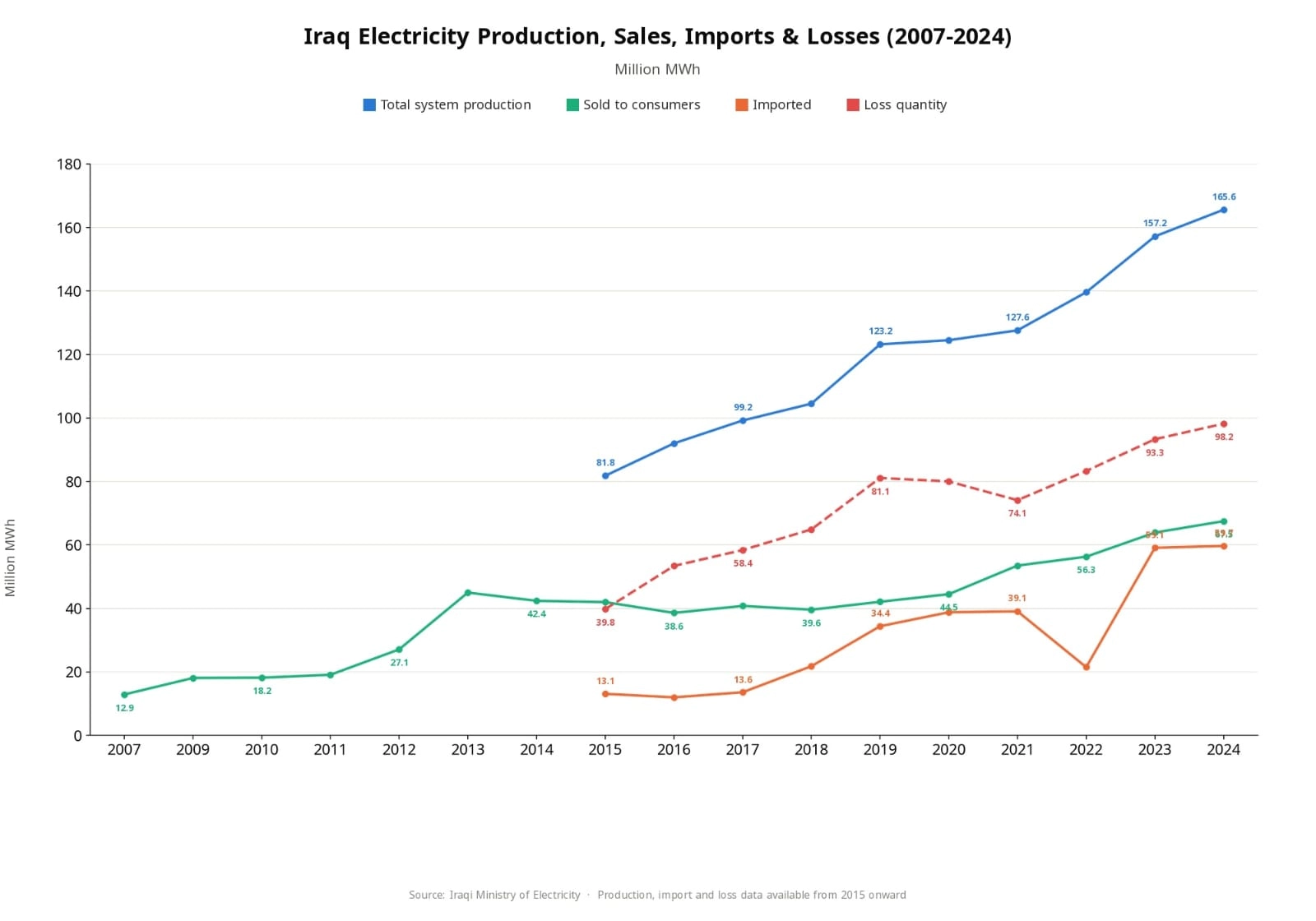
Supply, waste and consumption
According to Ember electricity data for 2026, global per capita consumption averaged 3.7 megawatt-hours, though disparities among countries are stark. Annual per capita consumption is highest in Canada at 16.1 megawatt-hours, followed by the United States at 13.1, South Korea at 12.1, Japan at 8.4, Russia at 8.2, and China at 7.5. India sits at the bottom of the scale at 1.4 megawatt-hours.
Calculations based on Iraq's current generation and imports of roughly 30,000 megawatts suggest that every resident should theoretically have access to electricity comparable to France at 7.2 megawatt-hours per capita or Germany at 6.2 megawatt-hours.
However, Iraq's Statistical Organization data for 2024 shows that per capita electricity delivered to citizens peaked in the southernmost Basra province at 2.85 megawatt-hours and dropped as low as 1.24 megawatt-hours in the capital of the northern Nineveh province, with a national average of 1.76 megawatt-hours. That places Iraq at or below India's average of 1.4 megawatt-hours - a country where hundreds of millions of people still lack reliable access to power.
In terms of pricing, Iraq ranks among the world's cheapest countries for electricity, at just 10 dinars (about $0.01) per megawatt-hour - behind only Cuba, Ethiopia and Kyrgyzstan.
At that rate, the value of electricity wasted in 2024 exceeded 818 billion dinars (about $624.3 million) nationally, with the southern Najaf province alone accounting for more than 50 billion dinars (about $38.1 million). Measured at average European pricing of 325 dinars (about $0.24) per megawatt-hour, the waste in Najaf surges to 1.6 trillion dinars ($1.2 billion) annually - and across all of Iraq, to more than 26 trillion dinars (about $19.8 billion).
That loss comes against a sector already in deficit. The total cost of Iraq's electricity sector in 2024 reached 32 trillion dinars ($24.4 billion), while revenues stood at just 25.9 trillion dinars ($19.7 billion) - a shortfall of 6.1 trillion dinars ($4.6 billion).
Of note, roughly 80 percent of Iraq's electricity is consumed by households and government institutions, while just 20 percent goes to commercial, industrial, and agricultural sectors. Statistical data for 2024 shows that out of 67.5 million megawatt-hours supplied, households accounted for 60.6 percent, government institutions for 19.1 percent, industry for 10.2 percent, commerce for 7.8 percent, and agriculture for 2.2 percent.
The dominance of household and government demand - four times that of all productive sectors combined - is a critical warning sign. It underscores that Iraq's electricity crisis is not fundamentally a generation or supply problem, but a failure to manage demand alongside runaway waste. Even the best-performing province tells a damning story. The eastern Diyala province, which has the lowest waste rate in the country, still loses more than 36.9 percent of its electricity.
While electricity demand is rising globally on the back of Artificial Intelligence (AI) data centers and advanced manufacturing, Iraq's surge is being driven by households and government institutions rather than productive sectors. Per capita household consumption in Iraq is four times that of China and twice that of the United States.
The total electricity lost in Iraq from all causes is double the country's entire annual import volume. Meanwhile, 65 percent of electricity provision costs in central and southern Iraq are government-subsidized at the 10-dinar rate - making it 33 times cheaper than the European average. The International Energy Agency (IEA) estimates that maintaining this subsidy costs Iraq more than $4.4 billion annually in gas and oil consumption alone.
Bottom line
These colossal figures of electricity waste and the persistent sight of thousands of tangled wires and diesel generators across Iraqi neighborhoods and streets occur despite Iraqi governments disbursing 19.58 trillion dinars (about $15 billion) to the electricity ministry between January 2015 and May 2026 - 17.74 trillion dinars (about $13.5 billion) of which was for sector investment.
Taking 2015 as a baseline, a decade of spending has yielded modest returns despite those 17 trillion dinars ($12.98 billion USD). Annual generation grew by 8.2 percent, supplied volume by 5.4 percent, and imported volume by 18.4 percent. Imports, revenue shortfalls, and waste have all risen in parallel.
Ultimately, unless the rate of electricity waste is curtailed, adding another 47,000 megawatts under Iraq's current economic conditions will resolve nothing. It will instead create a massive financial burden on the state - pushing the annual value of wasted electricity to 3 trillion dinars (about $2.29 billion) at subsidized local prices and exceeding 15 trillion dinars (about $11.45 billion) at global market rates.