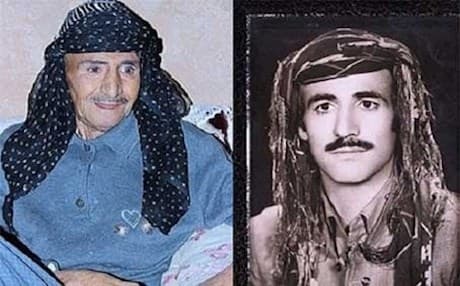

Abudullh Ghorbani, nicknamed Abdullah Machkaei, a familial and familiar voice, one of the most famous and enduring performers of Kurdish folk music who dedicated most of his life and vision in life to Kurdish music died on Dec 20 after a long illness as a result of which he had lost the ability to speak. He was 74 at the time of his death. He was born in Qasr-e-Shirin in 1941; during his teen-age years, he moved from Kermansha to Machka village in the Laylakh region where his warm and captivating voice made him a popular voice. His nickname Machkaei originates from his residence in the village of Machka. Hundreds of his hometown folks, fans, and fellow artists in Senna attended his funeral to show their affection for the beloved singer, to honor him and to celebrate his musical life as a pioneer and reviver of Kurdish music. The mourners whispered his songs as oboes and drums instruments used in his performances played dirges. Many held up the image of the artist who had deeply affected their lives as a cross generational popular goranibej, a folk singer.
Abdullah Machkaei also known as Khalo Abdullah, “Uncle Adbullah” began his musical career in Radio Kermanshah, working with iconic singers such as Mazhar Khaleqi and Hassan Zirak. His appreciation for Kurdish music was reflected in his enthusiasm, endurance, his impassioned voice, and embodied performances of seminal yet anonymous musical traditions and genres. He will be remembered for many soulful and perennial favorite songs including: lilakh”, “khalo reboar”, “magri”, “Zaneera zolofo” “ fadai shivat behm”, “areh glavezh, “chaw rasha” “bazem maykhaneh” “ deli asiram” “ ta kay benalm sozah”. These songs which vary in theme and genre range from melancholic to rhythmic tunes constitute the enduring legacy of a goranibej (vocalist) who had a natural and unpretentious musical talent, endowed with an extensive repertoire. As heir to Kurdish oral traditions with very little formal education, he had learned his musical folk traditions in childhood by simply being immersed in a culture which intrinsically and intimately intertwined music with social and daily life and our particular myths and memories. His songs recount idyllic scenes of Kurdish life, interrelated themes of nature, beauty, mystique, simple pleasures of life, loss, longing, nostalgia, and mediations on the meaning of life and love.
In his later years, like all musicians and singers he faced prohibitions and restrictions; he was silenced as a result of the theocratic censorship of any type of music except for only those that promoted the political and cultural agenda of the clergy and their moral codes. Despite his fame and formative contributions to the revival and preservation of Kurdish music, Machkaei was confined to a life of isolation, despair, and depravation; it was only two years ago that some officials of Sanandaj and city artists and writers belatedly recognized his contributions. However, his funeral underscored the deep respect and affection his hometown people had for their beloved singer, a phenomenon that was also observed during the funeral of the virtuoso dehol player, Barat Ali Nurani known as Ka Barat who died in 2014. Prominent artists such as Abdullah Machkaei and Ka Barat represent the essence of Kurdish folk music which was orally and aurally transmitted through rather than through formal education. Their deaths signal a tremendous loss to a cultural practice that is becoming obsolete without properly being recorded, preserved, and promulgated during a time that internet affords us the opportunity to overcome theocratic obstacles. Although some of Machkaei’s works have been recorded and made available for dissemination, this style of work ironically may not survive modernity because our folkloric musical culture and practice is not being transmitted to the younger generation.
No one can hide the deplorable condition and tragic fate of prominent folkloric Kurdish musicians and performers in Iran. Apart from political and cultural repression, the proliferation of modern technology in and through musical instrumentation and synthesizers also threatens and drives away folkloric forms and performances. However, the work of Abdullah Machkaei shows that the sophisticated technology cannot produce the timber and sound quality and nuances of traditional performances that despite their perennial compositions and re-adaptations still offer freshness, enchantments and charm.
In Iran there is no institutional support for documenting, recording, storing, retrieving, and publishing the richness of our musical expressions in all their diversity rooted in our cultural heritage and history let alone any support for folk singers such as Abdullah Machaei. Machkaei helped revive and re-popularize many of our favorite songs. His death reminds us that we are losing vital parts of our Kurdish musical heritage and treasure without which we would not know who we are.
Dr.Amir Sharifi, President of the Kurdish American Education Society-Los Angeles