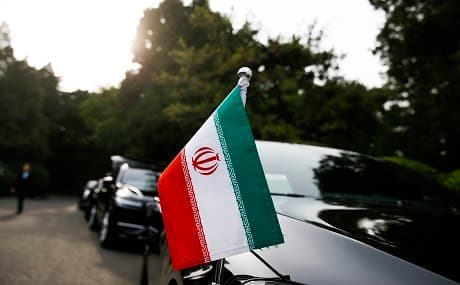

President Donald Trump announced on Tuesday the US withdrawal from the Iran nuclear deal in which Iran agreed to limit its nuclear activities. On Saturday, Iranian Foreign Minister Mohammad Javad Zarif announced a plan to salvage the deal in a tour, visiting China, Russia, and the leaders of European powers including Germany, France, and Britain.
The deal came after years of tension and sanctions by the international community on Iran. Based on the accord, Iran agreed to reduce its atomic capabilities, decreasing its centrifuges from 20,000 in 2015 to a maximum of 5,060 until 2026. The deal also opened the door for the International Atomic Energy Agency to visit Iran’s uranium enrichment plants. The deal was seen by former US President Barack Obama, the European Union, and reformists in Iran as an historic diplomatic success.
The return of US economic sanctions will bring significant damage to key economic sectors of Iran. According to the US Energy Information Administration, from 2011 to 2012 Iran’s oil exports declined from 2.5 million barrels to about 1.5 million barrels due to the economic sanctions of the United States and European Union. As Iran is a rentier state and oil comprises about 80 percent of its exports, the return of US sanctions could critically damage the Iranian economy. In 2011, the US Treasury banned US entities from trading with Iran and also required non-US partners to reduce the volume of their trade with Iran. The US Treasury also sanctioned Iran’s central bank, so the importers of Iran’s oil could not deliver their payments.
Since the lifting of sanctions in 2015, European countries have been key partners for Iran. Only in the last year, German auto industry exports to Iran rose 20 percent, reaching 900 million euros (in 2017 the trade volume between Germany and Iran was 3.4 billion euros, witnessing 16 percent growth. Similarly, French exports to Iran increased from about 51 million euros in 2014 to 159 million euros in 2017, according to Trading Economics. Overall the trade volume between Iran and France has increased threefold after the lifting of sanctions in 2015. Now, major business deals between Iran and European countries are at risk, including the purchase of more than 200 airplanes from Airbus, Boeing, and ATR.
France and Germany will try to make another comprehensive agreement on Iran’s nuclear deal and also on its regional involvement in countries like Syria, Yemen, and Iraq to appease the United States. Iranian President Hassan’s Rouhani’s cabinet also will try to keep the deal afloat in order to maintain its only significant achievement over its hard-line rivals in Iran.
On the US side, the return of economic sanctions seems likely. Trump has pleased both his voter base and international allies including Saudi Arabia and Israel with his decision to withdraw. More importantly, as the United States is a much bigger trading partner, it is difficult for European countries to keep good trade relations with both the United States and Iran.