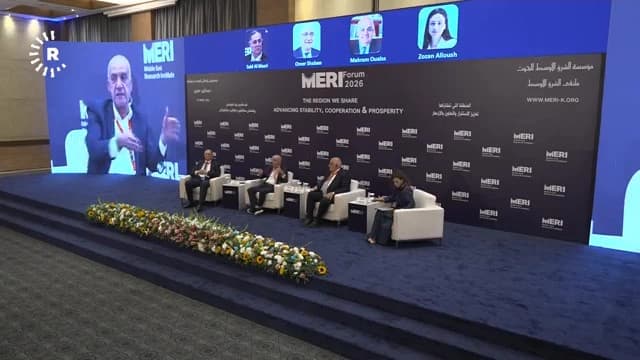
ERBIL, Kurdistan Region - Turkish President Recep Tayyip Erdogan and Kurdish officials are “serious” about advancing the peace process that kicked off around two years ago in Turkey, Kurdistan Region President Nechirvan Barzani said Monday. He also hailed Kurdish authorities in northeast Syria (Rojava) for acting pragmatically against overwhelming odds regarding the integration of Kurdish institutions within the Syrian state apparatus.
“Over the past two years, what I have observed from President Erdogan has convinced me that he is serious about peace,” President Barzani stated at the annual Middle East Research Institute (MERI) Forum in Erbil.
“From what I have observed regarding Imrali, and knowing Abdullah Ocalan's [jailed PKK leader] stance, I believe he is equally committed,” he added. Ocalan has been jailed in the Imrali island northwest of Turkey since early 1999.
A peace process was initiated in October 2024, when Turkish far-right politician and Erdogan’s key ally Devlet Bahceli called for summoning Ocalan to the Turkish parliament to order the disbandment of the PKK. From his cell in Imrali in February 2025, Ocalan asked the Kurdish armed group to lay down weapons and called for its dissolution.
In August, the Turkish parliament passed a bill establishing a framework for the reintegration of PKK members, including provisions for suspending certain prosecutions and sentences once Turkish authorities verify the group's dissolution and disarmament.
The PKK announced total withdrawal from Turkish territories last week while criticizing Ankara’s “inadequate approach” for a swift and reciprocal implementation of the peace process, namely, enacting appropriate legislation ensuring aforementioned Kurdish language rights and constitutional recognition of Kurdish identity per the agreement.
Commenting on the subject, President Barzani said Monday he believes the process is “moving in the right direction” and that resolving a decades-long conflict is arguably a long process.
“We are addressing 40 years of conflict, four decades of mutual misunderstanding, denial, and telling an entire people they do not exist,” he noted.
“The fact that no lives have been lost over the past two years, and that mothers have been spared grief, is a significant achievement in itself,” he added.
Kurdish integration in Syria
In the same panel, he praised the former leader of the now-dissolved Syrian Democratic Forces (SDF) Mazloum Abdi and other Kurdish officials in Syria for maintaining a “realistic understanding of the situation.”
“Perhaps no more could have been done than what they did. That was all that was possible,” he stated.
Damascus and its affiliated forces launched a military offensive against the SDF in January, capturing areas held by the Kurdish-led force since the withdrawal of the ousted Syrian government’s military in 2012 following the outbreak of the Syrian Civil War (2011-2024).
Subsequently, the Syrian interim government, led by Ahmed al-Sharaa, and the SDF signed an agreement in January to accelerate the then stalled integration process. Accordingly, Kurdish officials were appointed to key governmental positions, including the governor of the Kurdish-majority Hasaka province and deputy defense minister. The SDF’s leader, Abdi, became an advisor of the Syrian presidency in August after he announced the dissolution of the group.
Abdi was present in Monday’s event in Erbil.
“Now 13,000 SDF fighters are integrated into the Syrian army,” Barzani noted, adding that such a progress would have been a “dream” in the country where the right to citizenship for Kurds was denied for decades.
Under Assad family rule, thousands of Kurds have been denied access to citizenship since the early 1960s. Sharaa ordered the issuance of citizenship documents to the Kurds after he came to power in late 2024. He has also provided the right to study a selection of courses in Kurdish “as a duty and a legitimate right.”
“However, in my opinion, we can only say there is complete progress when these rights are enshrined in the permanent Syrian constitution, the rights of the Kurds and the rights of other components [minorities],” President Barzani said.
Departure of US-led Coalition from Baghdad
Regarding the departure of the US-led Global Coalition against the Islamic State (ISIS), President Barzani said Iraq is capable of “standing on its own feet” as a sovereign state while cautioning that Baghdad should accelerate steps to install air defense systems and restrict arms under state control.
“Arms groups should not pose a threat to neighboring countries and the Kurdistan Region,” he stated, adding that Iraq needs to make certain of that now that the US-led Global Coalition has departed the country.
September 30 was the scheduled deadline for the departure of the US-led international coalition to defeat ISIS. It was scheduled as the original deadline for the disarmament of armed factions operating in Iraq - some who are aligned with Iran - primarily operating under the umbrella group of the Islamic Resistance in Iraq (IRI).
IRI sided with Iran during its war against the US and Israel earlier this year, striking alleged US bases outside Iraq as well as in the Kurdistan Region. It claimed more than 700 attacks from early March toward April.
The umbrella group overlaps with the state-funded Popular Mobilization Forces (PMF), whose fighters celebrated the departure of the Coalition forces by trampling on the US flag.
Saudi Arabia, in coordination with the US, in late July struck PMF bases across several Iraqi provinces, killing around 20. Riyadh said the action was executed after attacks from Iraqi soil on its oil infrastructure.
Although initially denied it, the Iraqi government took measures against the armed groups in September, including by removing a security official in the Maysan province south of the country.
“No armed group should pose a threat to neighboring countries and the Kurdistan Region,” President Barzani said on Monday.