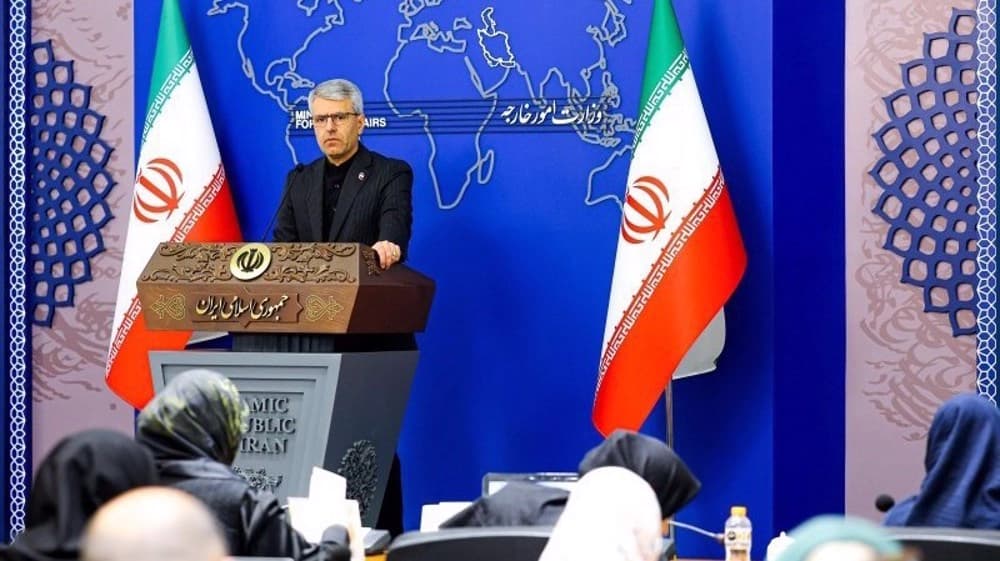

ERBIL, Kurdistan Region - Iran’s foreign ministry spokesperson on Monday did not rule out a back-channel negotiation with Washington facilitated by Kurdistan Region President Nechirvan Barzani but insisted that decision making in the country is institutionalised and reports of disagreement between the ruling elites was fabricated by the foreign media out of desperation.
“The report you referred to is also part of media tactics and psychological operations aimed at creating divisions among the decision-making bodies of the Islamic Republic of Iran,” Esmail Baghaei said during his weekly press briefing. “It has been proven that decision-making in the Islamic Republic is an institutional process, and it is these institutions that, after considering all relevant factors and foreign policy issues, make the best decision.”
His comments came a day after the US-based Axios reported that the Trump administration had turned to President Barzani during negotiations earlier this year because US officials were uncertain whether Iran’s diplomatic team had the authority to make commitments on behalf of the increasingly powerful Islamic Revolutionary Guard Corps (IRGC).
Axios reported that then-US Director of National Intelligence Tulsi Gabbard contacted Barzani and asked him to establish a channel with Ahmad Vahidi, who was then deputy commander of the IRGC and has since been promoted to command the force. Gabbard told Barzani that the request had the backing of President Donald Trump and Vice President JD Vance.
Axios said that no meeting took place in Erbil as the Iranians were worried that the Israelis might target them on the way there or in Erbil. “The report about a secret meeting between Iran and the United States in Erbil is completely fabricated,” Baghaei said.
Baghaei’s comments came hours after Kurdish authorities said two drones launched from Iran targeted the office of Kurdistan Region Prime Minister Masrour Barzani and the residence of the head of the Kurdistan Region’s security agency in Erbil province’s Pirmam district. No casualties were reported.
He said the Region had been attacked by Tehran and Iraqi militia groups more than 1,000 times. The attacks have killed 32 people and wounded 154, according to Rudaw tracking.
In May, the IRGC and affiliated militias were reported to have launched drone attacks targeting the residences of President Masoud Barzani, leader of the ruling Kurdistan Democratic Party (KDP), and President Nechirvan Barzani. The attacks were strongly condemned by Kurdish authorities.
Pakistan, Turkey and Qatar have played key roles in facilitating negotiations between Iran and the United States, but the diplomatic efforts have so far failed to produce a lasting peace between the two sides.
Baghaei also rejected the broader suggestion that different centers of power in Tehran were competing over negotiations, saying decision-making on war, peace and diplomacy was institutional and involved all relevant branches of the state.
There have, however, been reports of disagreements within Iran’s ruling establishment in recent months over negotiations with the United States. Mohammad Bagher Zolghadr, secretary of the Supreme National Security Council, was removed from his position last week and replaced by Mohsen Rezaei, who commanded the IRGC for nearly two decades in the 1980s and 1990s.
Large gatherings across Iran in recent months have called on authorities to avenge the death of Supreme Leader Ali Khamenei, who was killed on February 28 along with several senior security and military officials, instead of negotiating with the US.
Axios said Washington’s search for a direct channel to the IRGC reflected uncertainty over who held ultimate authority in Tehran after the US-Israeli war killed senior political and military leaders and significantly strengthened the Guards’ influence over national security and foreign policy.