
The repercussions of the US-Israeli war with Iran, which began in late February, have not remained confined to Iraq and the Kurdistan Region's oil export levels or the deterioration of general reserve funds - they have directly hit the livelihoods of every citizen in the federal state.
Disrupted supply chains and the government's printing and injection of new liquidity to cover expenses have pushed prices for a significant portion of commodities and food items up by as much as double. Official statistics show the general inflation rate surpassed 3.4 percent between the start of this year and the end of May, while food inflation crossed 5.2 percent.
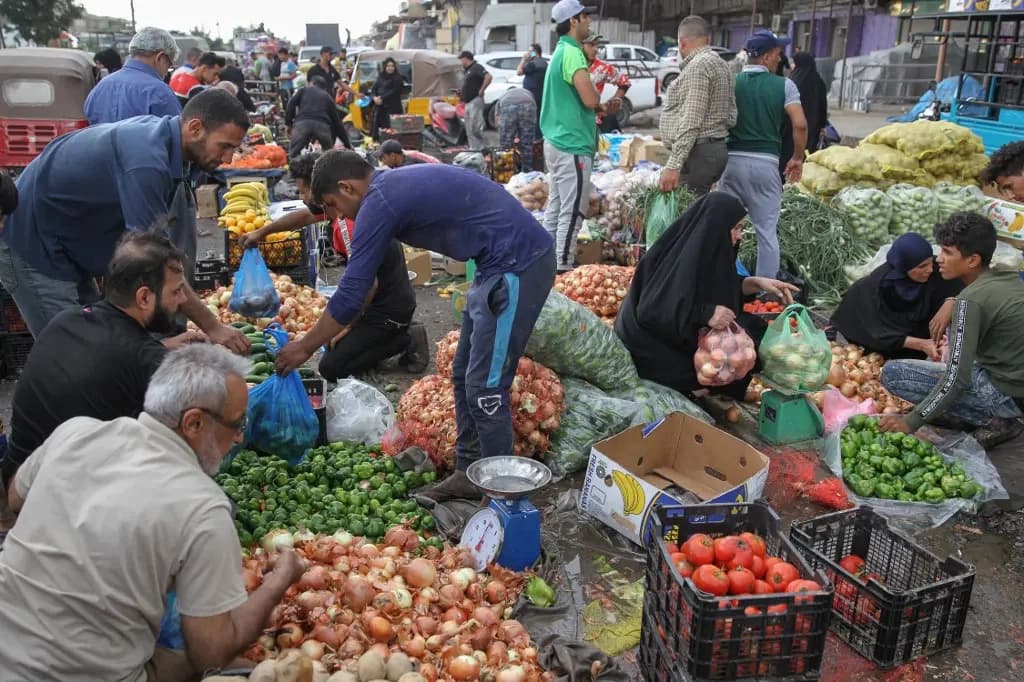
At local markets, prices have risen so sharply that the amount of money that covered a week's worth of supplies a few months ago now barely lasts a few days. Shoppers are increasingly forced to choose between quantity and specific items.
Iraq's Statistics and Geographic Information Systems Authority, which publishes weekly price indicators for 38 food items across all Iraqi provinces, including the Kurdistan Region, shows an upward price trajectory, particularly in the first half of this year compared to the first half of 2025.
For instance, data from the Authority's long-term trends (2018-2026) shows red meat prices climbing across Iraq. Boneless beef rose 108 percent, while lamb rose 49 percent, from 13,600 IQD (about $10.46) to 20,330 IQD (about $15.64).
This piece examines the data behind the price trends and inflation driving the cost-of-living crisis in Iraq and the Kurdistan Region.
Price extremes in provinces, 2026
Based on the 2018-2022 index, weekly essential item prices from the Statistics Authority show average prices for all goods were highest in the Kurdistan Region's Erbil province and lowest in Iraq's northern Nineveh province during that period. However, in the first half of 2026, the rankings shifted sharply. Nineveh became the most expensive province for essential food items, while the southern Diwaniyah province became the cheapest.
Factors such as service costs and labor wages, population size and geographic boundaries, trade and tourism activity, land and real estate values, availability of services and security provision, and goods import and export activity all shape these province-to-province price variations for a given commodity.
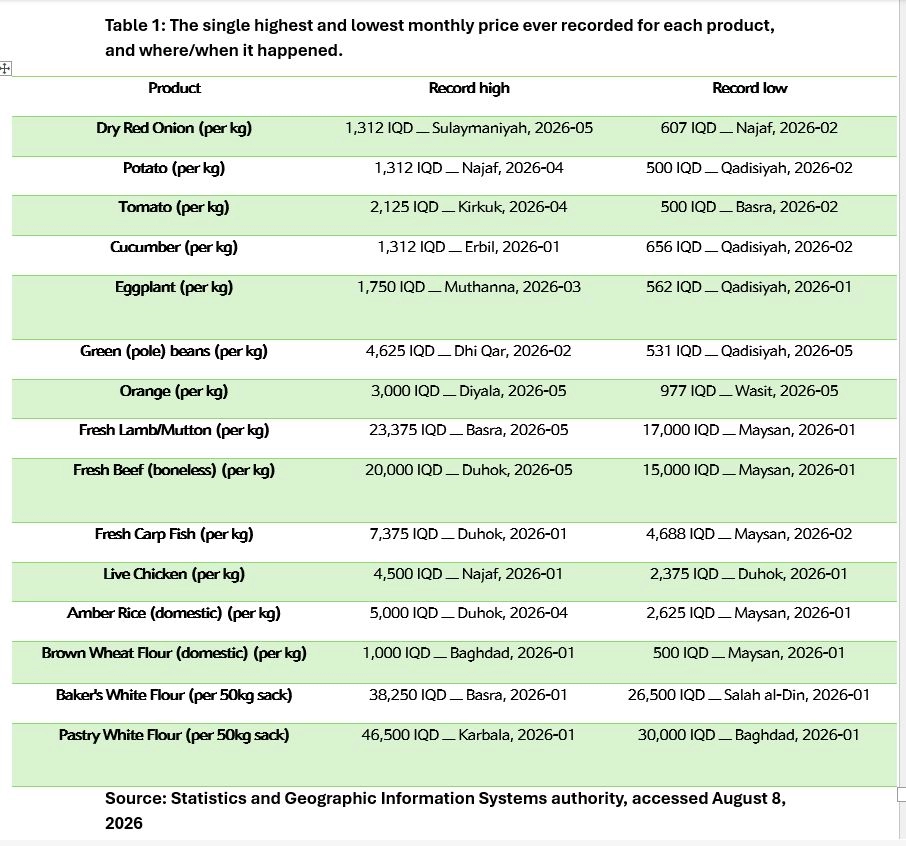
According to Statistics Authority data for the first half of 2026, the highest price for a kilogram of tomatoes was recorded in the northern Kirkuk province in April at 2,125 IQD (about $1.63), while the southernmost Basra province recorded the lowest in February at 500 IQD ($0.38) per kilogram. Prices could have been much higher or lower on a specific day in another area, but weekly and monthly averages were used here.
The major price difference for a commodity between provinces in Iraq traces back to one of the factors noted above. For example, Statistics Authority data shows a difference of nearly 5,500 IQD ( about $4.23) per kilogram of lamb among Iraqi provinces.
The highest price for a kilogram of lamb reached 23,375 IQD (about $17.98) in Basra, while the lowest was recorded in the southeastern Maysan province in January at 17,000 IQD ($13.08) per kilogram. Population size is one factor behind the discrepancy; while Basra has a population of 3.66 million, Maysan has about one-third of that, 1.2 million.
Moreover, unemployment in Basra stands at 20.4 percent compared to 25.3 percent in Maysan, while labor force participation is 40.3 percent in the former versus 31.4 percent in the latter. These gaps help explain why prices in Basra run higher than in Maysan, a pattern reflected across meat, food products, and services alike.
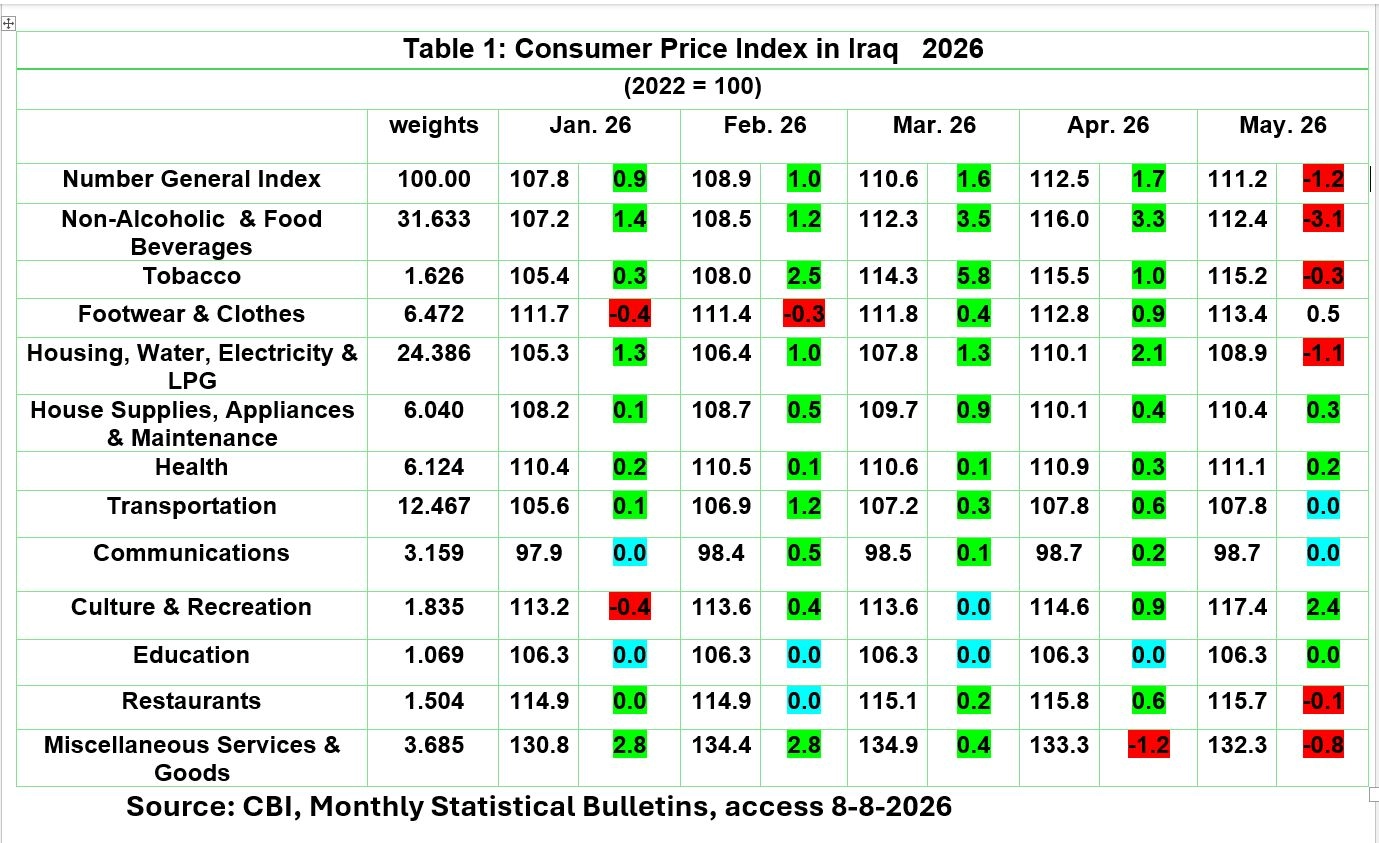
The general inflation trend in Iraq, according to the Central Bank of Iraq (CBI), shows an upward trajectory. The overall price index peaked in April 2026 at 112.5 (+1.7 percent monthly), driven primarily by increases in food and housing prices. In May, the index declined 1.2 percent, bringing it back down to 111.2. From January through the end of May, the general inflation rate stood at 3.4 percent.
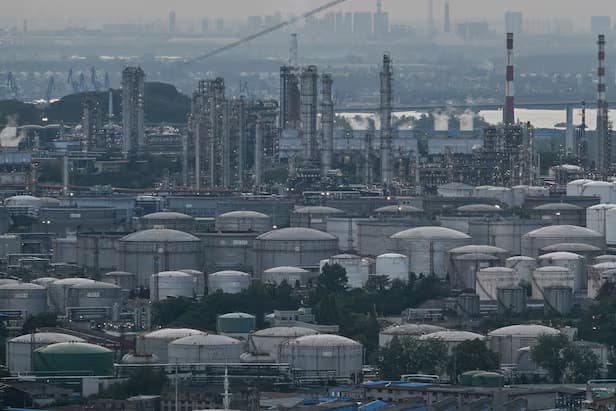
The impact of the Iran war on these shifts is clearly evident in the rate of change. Iraq is an importing nation, bringing in $60 to $80 billion worth of goods and services annually. The Basra Oil Terminal via the Strait of Hormuz was not only the sole exit for oil exports but also a major gateway for imports. That role grew more costly since the introduction of the Automated System for Customs Data (ASYCUDA), alongside broader shifts in border customs policy and increased tax collection.
For instance, due to the conflict, supply chains via Hormuz were disrupted. Cargo shipments to Iraq that previously arrived at the Basra port now go through Turkey and arrive overland instead, placing an additional burden on traders and increasing the initial cost of goods. Consequently, food and non-alcoholic beverages - the heaviest sector in the consumer basket - saw significant price increases in March (3.5 percent) and April (3.3 percent), peaking at 116.0. As the situation calmed and limited vessel transit resumed, data showed a decrease of 3.1 percent in May, bringing the index down to 112.4.
Iraq and the Kurdistan Region import over $1 billion worth of tobacco and related products annually, making these imported goods especially expensive. The CBI's index shows the highest single-month surge among all products occurred in tobacco, which spiked 5.8 percent in March 2026, with the index reaching 114.3.
Tobacco products and food items became significantly more expensive due to supply chain disruptions and import costs. Most factories operating in Iraq and the Kurdistan Region also rely on foreign raw materials, so when those materials are acquired at higher prices, manufacturers are forced to sell their products at higher prices as well.
On the other hand, looking at the table, we see minimal or zero change in sectors not heavily tied to imported goods, trade movement, or raw materials-such as education and communications, which remain the most stable sectors. According to the CBI, education remained completely stable at 106.3 from January to May 2026 (0.0 percent monthly change). Communications also experienced minimal fluctuation, remaining between 98.4 and 98.7.
Kurdistan Region price trends
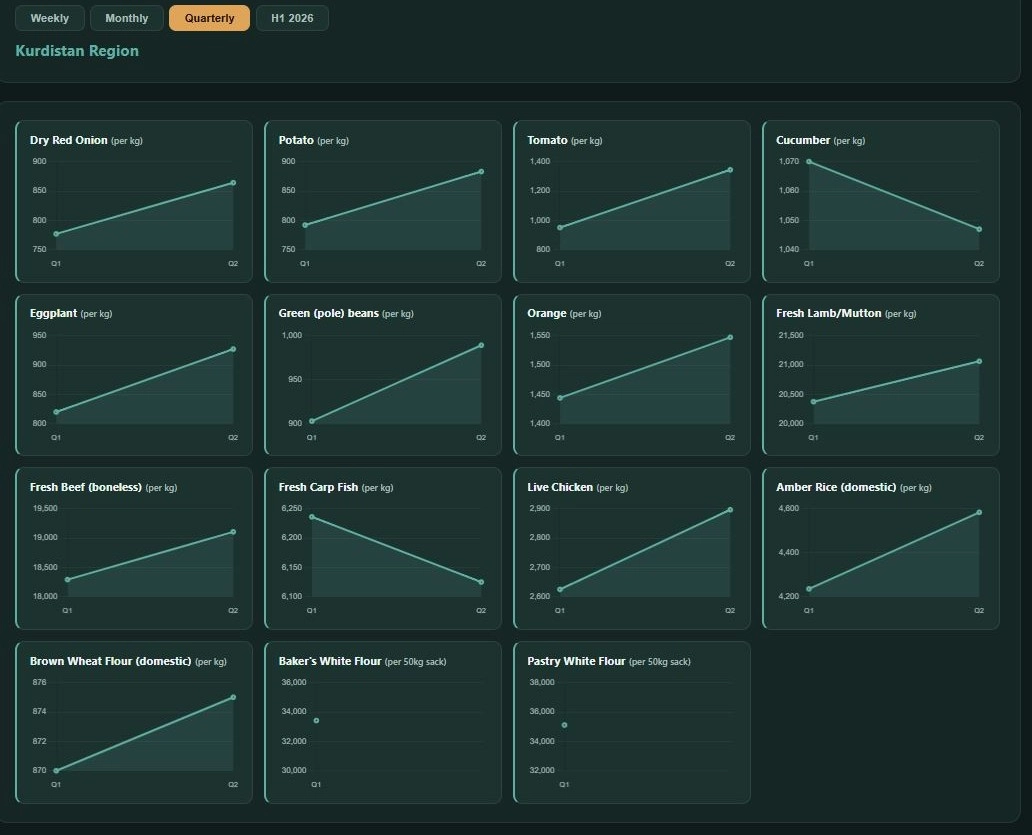
At the province level in the Kurdistan Region, price trends for most food items - excluding cucumbers and carp fish - shifted upward, especially for products requiring energy, raw materials, and imports during production. For example, the average price for a kilogram of tomatoes rose from 792 IQD (about $0.61) in the first quarter of 2026 to 883 IQD (about $0.68) in the second quarter, an 11.35 percent increase.
Chicken followed a similar pattern. The price per kilogram for a live chicken rose from 2,625 IQD (about $2.02) in the first quarter to 2,896 IQD (about $2.23) in the second, marking a 10 percent increase. This tracks with rising costs of inputs used in poultry farming, such as feed, kerosene and diesel. The high price of lamb and boneless beef, by contrast, stems from reduced livestock imports from neighboring countries.
Cucumbers and carp fish moved in the opposite direction. The price per kilogram of cucumbers dropped from 1,070 IQD (about $0.82) in the first quarter to 1,047 IQD (about $0.81) in the second, while carp fish dropped from 6,236 IQD (about $4.80) to 6,125 IQD (about $4.71). The decline in both is attributed to increased supply - the number of greenhouses has now crossed 30,000, and the number of legal and illegal fish ponds has expanded significantly in the Kurdistan Region. Within a single decade (2014 to 2024), fish pond projects grew by nearly 80, rising from 340 to 420, alongside an ongoing rise in unlicensed ponds.
The road ahead
Factors such as supply chain disruptions, production costs, sustained demand, supply reductions, and increased transportation costs and raw material procurement represent part of the story behind rising food prices and inflation in Iraq and the Kurdistan Region. The larger, primary factor is the printing and issuance of currency without the backing of domestic GDP growth, which exceeded 13 trillion IQD (about $10 billion) in the first half of this year.
This trend of issuing currency without accompanying revenue and production not only causes price surges and elevated inflation but also weakens GDP growth. The World Bank Group, in its June report on national GDP growth, projected Iraq's economic growth for this year and next year to be below zero.
When inflation rises, central banks typically raise interest rates to reduce market liquidity and restore balance to the pricing of goods and services. During the COVID-19 era, for instance, massive injections of subsidized liquidity meant it took nearly four years for global nations and major institutions like the International Monetary Fund (IMF) and the World Bank Group to bring inflation rates back down.
In the short term, high prices and doubled costs might bring profit to traders and capitalists, but they reduce individuals' ability to afford living expenses, weaken GDP and national economic growth, and slow trade activity.
The continuation of this trend will push inflation into double digits. Under current conditions in Iraq and the Kurdistan Region - where most of the population's income is tied to fixed salaries - unemployment, poverty, and the number of people falling below the poverty line are likely to rise, alongside severe political, economic, and social consequences.
There is, however, one positive sign. Based on figures from the first half of this year for the 28 food products whose weekly average prices were tracked, prices for certain imported food items have decreased - Turkish lentils by 25 percent, Saudi sugar by 15.6 percent, and Indian Basmati rice by 5.5 percent. The price of local Amber rice, by contrast, increased 7.3 percent, pointing to a rise in local product consumption - a step in the right direction.