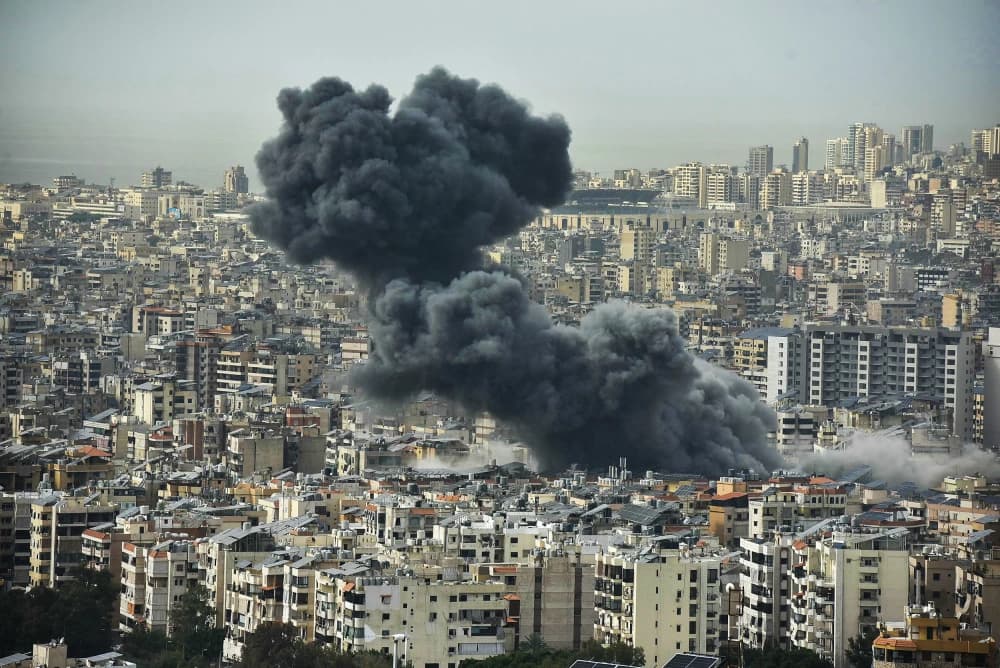

ERBIL, Kurdistan Region - Israel on Sunday said it carried out retaliatory strikes against an alleged command center of the Iran-backed Hezbollah group in Beirut’s southern suburbs, widely known as Dahieh, despite a looming preliminary agreement between Iran and the United States after more than two months of fluctuating tensions and stalled negotiations.
“The command center was used by Hezbollah terrorists to advance terrorist attacks against Israeli civilians and [Israeli Defense Forces] IDF soldiers operating in southern Lebanon,” the Israeli military stated.
A senior Israeli official rejected notions of the attacks being “a clear attempt by Israel to sabotage the President’s deal and drag the United States back into war.”
Before announcing the attack, the IDF said Hezbollah attacked northern Israel with three projectiles.
Hezbollah media sources have reported three killings and six injuries as a result of the attack.
Hezbollah’s launch of projectiles came hours after the IDF sent evacuation notices to 29 locations in southern Lebanon notifying their residents to leave their homes in the face of imminent strikes.
In response, Mohammed Bagher Ghalibaf, Iranian Parliament Speaker and top negotiator with the US, accused Washington of “giving the green light to the regime,” noting that “the game of bad cop and good cop is outdated.”
He added, “If you lack the will and ability to fulfill your commitments, continuing on the path [of negotiations] is not possible.”
Meanwhile, Ebrahim Rezae, head of the Iranian parliament’s national security committee, said that even if Iran reached “agreement or understanding [with the US], its path is disciplining the zionist regime.”
“If this rabid dog is not controlled, the ink of an agreement not yet dry will bite our own foot,” he said.
The Sunday clashes come amid a critical period for the US and Iran, as both sides are nearing a preliminary agreement after nearly six weeks of direct confrontation in February preceded by over two months of fluctuating tensions.
US President Donald Trump announced on Saturday that a deal with Iran was set to be signed within 24 hours.
“Hopefully, this process will all work out quickly, easily, and smoothly. If it doesn’t, we have the ultimate alternative, hopefully never to be used again!” he said.
Iran has stressed that halting Israeli military operations in Lebanon is part of its shaky ceasefire agreement with the US. In early June, it launched a wave of missiles against Israel after the latter struck Beirut’s Dahieh, raising the death toll in Lebanon to more than 11,000 since early March.
The attack triggered a two-day exchange of strikes before Trump called Israeli Prime Minister Benjamin Netenyahu, dissuading him from further escalations.
Referring to the strike as a "warning," the Iranian Revolutionary Guard Corps stated that if Israel continues its attacks on Lebanon, Tehran's response would be broader to "encompass all American and Zionist targets in the region."
The US brokered a ceasefire agreement between Israel and Lebanon in early June. The truce, contingent upon Hezbollah laying down arms, was categorically rejected by the militant group.
“The outcomes of the [negotiations] are futile, humiliating, and disgraceful,” Hezbollah chief Naim Qassem said, adding that “when the primary objective of any agreement is the disarmament of the resistance, it means that such an agreement destroys Lebanon’s strength.”
Israel has also continued its ground offensive in southern Lebanon, raising its flag earlier in June over the medieval Beaufort Castle, which served as an Israeli base during its two-decade occupation of Lebanese territory in the 1980s and 1990s.
Israel views Hezbollah - an Iran-backed group that has been fighting Israel since the mid-1980s - as an existential threat to its security, justifying its continued attacks on Lebanon and the presence of its troops in the country as preemptive measures.