
ERBIL, Kurdistan Region - Senior Kurdish politician Elham Ahmed on Monday called on Damascus to fully implement agreements on Kurdish participation in Syria’s state institutions and guarantee Kurdish cultural and linguistic rights in the constitution, warning that provisions on power-sharing have yet to be implemented at the national level.
Speaking at the Middle East Research Institute (MERI) Forum in Erbil, Ahmed, a member of Syria’s interim parliament, said the country was undergoing significant political and security changes following the integration of the Kurdish-led Syrian Democratic Forces (SDF) and other armed groups into the new Syrian army.
She described the integration process as “excellent,” saying it had helped establish a degree of stability and paved the way for reconnecting cities and advancing reconstruction efforts.
However, Ahmed stressed that military integration alone was insufficient to ensure lasting stability, calling for constitutional guarantees that reflect Syria’s ethnic, religious and cultural diversity.
“It is essential to talk about a constitution that expresses the hopes and rights of all components of Syrian society, at the forefront of which is the Kurdish people,” she said.
She rejected suggestions that recognizing multiple languages could threaten Syria’s territorial integrity.
“Therefore, speaking or learning in multiple languages in Syria does not lead to the division, fragmentation, or scattering of Syria,” Ahmed said.
“On the contrary, learning languages enhances Syrian cultures and enriches them societally and culturally.”
She also called for the implementation of the March 10 and January 29 agreements between Kurdish authorities and Damascus, which she said included provisions for Kurdish representation across state institutions.
“Per the agreements of March 10 and January 29, there is a specific clause that speaks about partnership and representation in all Syrian ministries, foreign embassies, parliament, the army, General Security, and all state institutions,” she said.
Ahmed said the agreements stipulated that Kurds should be represented in state institutions under their Kurdish names and identity.
She complained that progress on implementing the power-sharing provisions had been limited largely to Kobane and Hasaka, with little achieved in Damascus or national ministries.
“Therefore, the state and the government are necessarily responsible for implementing this agreement, this proportion of partnership,” she said.
Ahmed also emphasized the importance of inclusive elections and political competition, arguing that meaningful participation in governance would strengthen Syrians’ sense of belonging and responsibility toward their country.
On women's rights, she expressed concern about what she described as a regression in women's participation in Syria, contrasting the situation with the prominent political and social role women had achieved in the Kurdish region of Rojava in northeastern Syria.
Syrian official hails integration progress
Najib Ghadbian, a senior advisor to Syria’s foreign minister, also welcomed the progress made in integrating Kurdish-led forces into the Syrian army, saying the process had contributed to improvements in the country's security situation.
He described the integration as a “great achievement,” while acknowledging that several political and cultural questions remained unresolved.
Ghadbian said the status of the Kurdish language required extensive discussions as negotiations continued between Kurdish political representatives and Damascus over cultural rights.
He said Syria was seeking to rebuild its regional and international relationships following the fall of Bashar al-Assad's government.
Under Assad, Syria had become an exporter of terrorism, displacement and drugs, Ghadbian said, adding that the new authorities were working to reconnect the country with the international community and neighboring states.
The Syrian official also acknowledged the severe economic difficulties facing the country, saying combating poverty and advancing reconstruction were among the government's main priorities.
Expert warns against exclusion
Amy Austin Holmes, a research professor of international affairs at George Washington University's Elliott School of International Affairs, warned that Syria risked renewed conflict unless it addressed the underlying grievances that contributed to the country's civil war.
Drawing on international research into post-conflict transitions, Holmes said many conflicts since the end of the Cold War had been recurrences of earlier wars rather than entirely new confrontations.
She argued that unresolved grievances, including the highly centralized governance system under Assad, could contribute to renewed instability.
“One of the takeaways from these studies of post-conflict transitions is that in order to escape a conflict trap or in order to prevent a conflict from re-occurring, it's essential that there be inclusion,” she said.
Holmes identified political, economic and cultural inclusion as essential elements of a sustainable transition, arguing that representative institutions and equal opportunities could help prevent renewed violence.
She also highlighted the economic importance of women's participation in the workforce, citing World Bank research suggesting that greater gender equality in employment could significantly boost Syria's economy.
According to Holmes, women's labor force participation in Syria stood at approximately 13 percent, while increasing participation to match that of men could raise long-term gross domestic product (GDP) per capita by as much as 74 percent.
She said the economic benefits would extend beyond women and their families to the broader Syrian economy, particularly as the country struggled with widespread poverty.
Holmes also advocated mother-tongue education, including Kurdish and Aramaic alongside Arabic, citing UNICEF findings that multilingual education could improve literacy, reduce school dropout rates and produce better educational outcomes.
She argued that such policies would benefit both minority communities and the country as a whole.
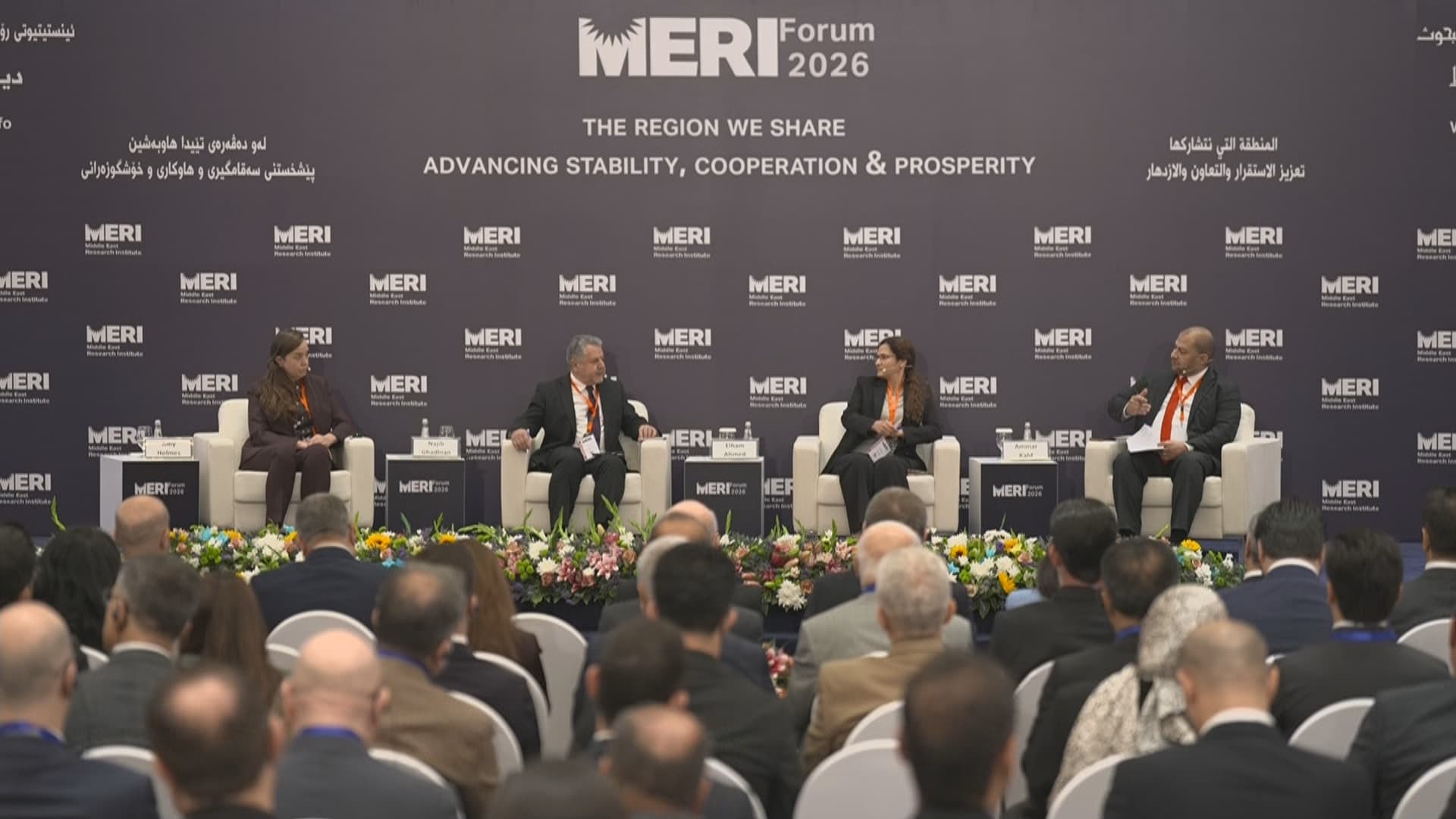
The three speakers addressed the MERI Forum's opening panel, titled "The New Syria: From Division to a Shared State," which focused on the country's political transition, integration of armed forces, minority rights and the challenges of building an inclusive state after years of conflict.
Rudaw is the media sponsor of the event.