The report published in late July by Iraq's Federal Board of Supreme Audit (FBSA) has unveiled 530 distinct cases of financial improprieties - ranging from accounting deficiencies and numerical discrepancies to ambiguities in purchasing and sales contracts - with values ranging from as low as 500,000 Iraqi dinars (IQD), about $381.6, to as high as 27 trillion IQD (about $20.61 billion).
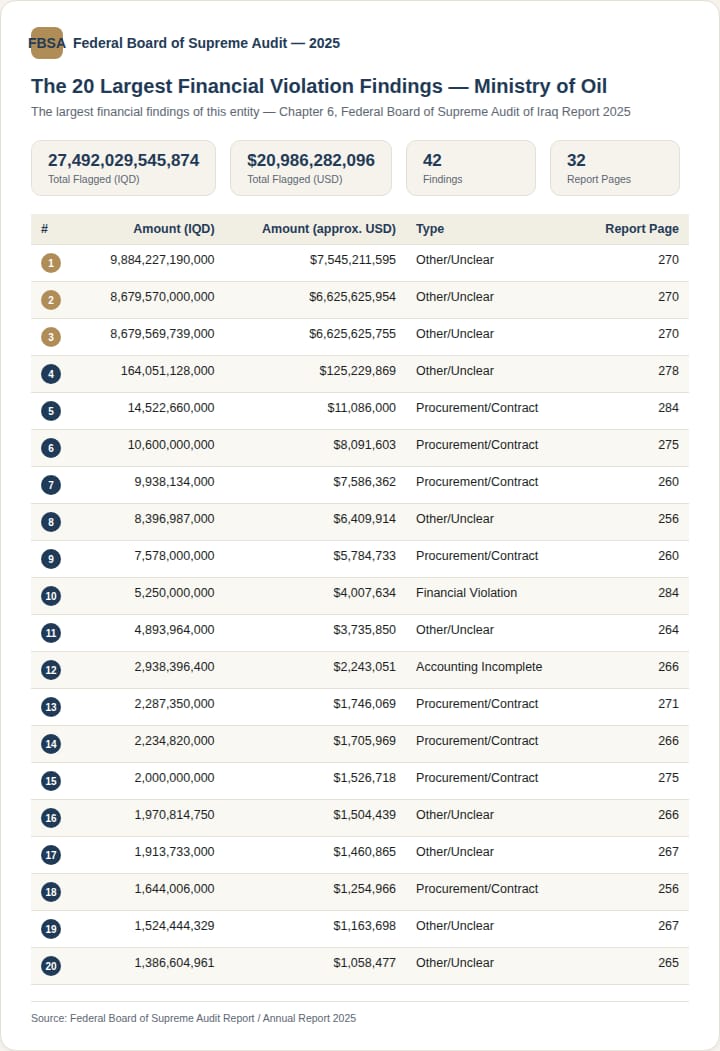
According to the report, the oil ministry accounted for the largest share of financial observations, with 42 cases valued at 27.5 trillion IQD (about $21.0 billion). The electricity ministry ranked second with 20 cases valued at 5.7 trillion IQD (about $4.4 billion), followed by the east-central Wasit province in third place with 49 cases worth 2.1 trillion IQD (about $1.6 billion).
The FBSA's 713-page report for 2025 audited 4,728 entities across 23 ministries and 15 provinces. Among all financial findings, 530 impropriety cases resulted in financial losses totaling 39 trillion IQD (about $29.7 billion).
By outlining the report's details across ministries, provinces, and institutions, we highlight a fraction of the financial impropriety at the oil ministry, which alone accounts for 70 percent of the total value of all improprieties recorded by the FBSA in its 2025 report.
Impropriety by institution, ministry and province
Improprieties were recorded across most Iraqi institutions, ministries, and provinces, though severity varies. While the oil ministry ranked first in terms of squandered funds, the health ministry ranked first in the total number of administrative observations and improprieties.
The report's page 185 highlights an impropriety amounting to 84 billion IQD (about $64 million) in the defense ministry's contracts. The ministry signed multiple contracts in one day with a single company totaling 84.1 billion IQD (about $64.2 million), even though the company's annual revenue in 2023 was only 34.1 billion IQD (about $26.0 million). The FBSA report notes, "This vast gap raises serious doubts regarding the company's financial capability."
Moreover, page 202 shows the foreign ministry is implicated in two cases valued at over 244 billion IQD (about $186 million). Iraqi diplomatic missions abroad were misclassified into foreign service salary groups, including placing cities outside the Eurozone into Eurozone pay tiers, leading to incorrect foreign service salary disbursements.
Meanwhile, page 232 indicates that electricity payments made to Iran by the electricity ministry amounted to 2.8 trillion IQD ($2.2 billion), pointing to ambiguity and doubts regarding accounts at the Trade Bank of Iraq (TBI).
As for the Iraqi health ministry, page 319 pertains to the procurement of cancer medication, showing that a contract to supply 10,401 packages of medication was signed at a price 8 percent higher than the estimated cost. In this 28 billion IQD contract (about $21.4 million), approximately 2.2 billion IQD (about $1.7 million) was overpaid beyond the actual cost, adding an excess to packages priced at 2.7 million IQD each (about $2,060 per package).
In the case of the ministry of agriculture, page 413 of the report pertains to 11 cases, the most prominent of which involves uncollected agricultural loans. Farmers in the southern Dhi Qar province owe 4.6 billion IQD (about $3.5 million) for agricultural equipment provided years ago, which remained unrecovered by the end of 2024, violating government debt collection laws.
Likewise, a discrepancy of 14.5 billion IQD (about $11.1 million) is spotted on page 458 in the expenditures of the youth ministry, which received 62.1 billion IQD (about $47.4 million) from the finance ministry as financial support for champion athletes, but actual spending totaled only 47.6 billion IQD (about $36.3 million), leaving the remaining funds unaccounted for.
Meanwhile, page 535 of the report reflects discrepancies amounting to 26.8 billion IQD (about $20.5 million) in Wasit province, specifically in an urban development project in the University District, where discrepancies were found between the resident engineer's report on implementation issues and the claims made by the beneficiary party.
For its part, the southern Babil province ranked fourth among all ministries and provinces, with 15 cases valued at 510 billion IQD (about $389.3 million). One case involves the construction of a bridge without obtaining land acquisition permits for connecting roads. A field visit by the FBSA team revealed that the bridge offers no actual utility; it stands abandoned in the middle of agricultural land without connecting roads.
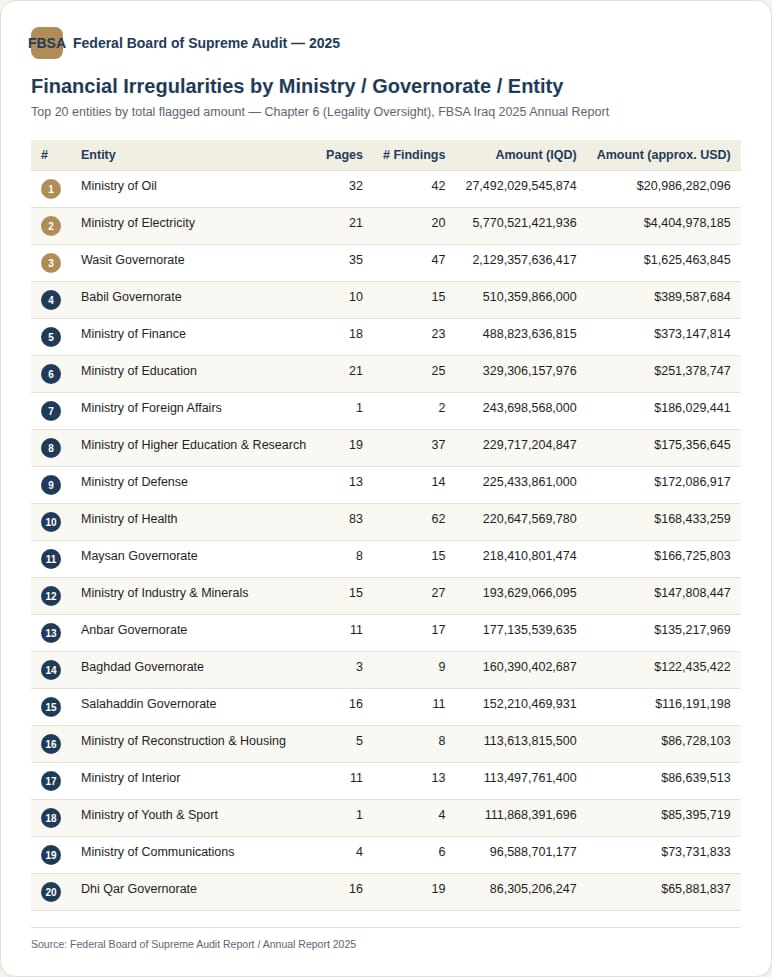 Of note, out of the 530 impropriety cases in the FBSA’s report, 42 cases valued at 27.5 trillion IQD (about $21 billion) - representing 70 percent of the total financial value of all cases detailed across 32 pages of the report - are linked directly to the oil ministry.
Page 270 of the report shows the most notable observation regarding account balance ambiguities, which is an unaccounted overall balance within the ministry's accounts, reaching 9.8 trillion IQD ($7.5 billion) in general debtor balances against institutions utilizing crude oil without legal documentation. Furthermore, 88 percent of these debts lacked legal confirmation in the records of supplier companies.
A contract valued at 10.6 billion IQD (about $8.1 million) was awarded to a company with weak qualification criteria, as page 275 shows, to transport petroleum products for Iraq's State Oil Marketing Organization (SOMO), the national oil marketer. The company submitted proof of financial capability from a bank despite not holding its own dedicated bank account, raising questions about its compliance with participation requisites.
Additional discrepancies of 1.97 billion IQD (about $1.5 million) are shown on page 266 regarding petroleum product sales processed via electronic payments and the amounts transferred by the smart card company, with no explanation offered to reconcile the difference.
Meanwhile, page 264 of the report shows that a project completion certificate was issued to a contractor despite the executive committee's own records showing only 66 percent of the project had actually been completed, while page 276 shows that the state-owned Basra Oil Company was forced to pay $2.5 million to a Dutch company after losing a legal dispute in Dubai, United Arab Emirates (UAE), over a settlement agreement tied to a prior contract.
 Beyond the audit
Of the 530 recorded impropriety cases, 239 are directly linked to contracting and procurement procedures, while the remainder are classified as administrative improprieties, accounting ambiguities, and balance discrepancies. Notably, only three cases were explicitly categorized as corruption and bribery.
The 2025 report raised flags over approximately 39.5 trillion IQD (about $30.2 billion), representing roughly 28 percent of total Iraqi government expenditures for that year, estimated at 141 trillion IQD (about $107.6 billion) - an alarming signal regarding the scale of negligence and financial waste in state institutions.
Transparency International defines corruption as "the abuse of entrusted power for private gain." The phenomenon erodes public trust, weakens democratic foundations, hinders economic growth, and deepens social inequality, poverty, societal fragmentation, and environmental crises. All aspects of this definition, and its negative consequences, are visibly manifest in Iraq's current situation.
In truth, exposing corruption and activating legal accountability for violators can only succeed through a deep understanding of corruption mechanisms and identifying the systems and structures that facilitate it - not merely showcasing billions of dinars in front of cameras while trillions disappear.
This analysis focuses primarily on evaluating the financial dimensions and statistical metrics of financial impropriety in the 2025 FBSA report. However, beyond these numbers, a host of strategic, long-term risks - including the loss of land due to boundary disputes, the proliferation of unlicensed fish farms using freshwater, uncollected service fees and electricity tariffs from both public and private sectors, crippled administrative systems, accumulated government debt owed by citizens, and expanding desertification - collectively pose a serious threat that pushes the country's political and economic future toward an uncertain fate.