
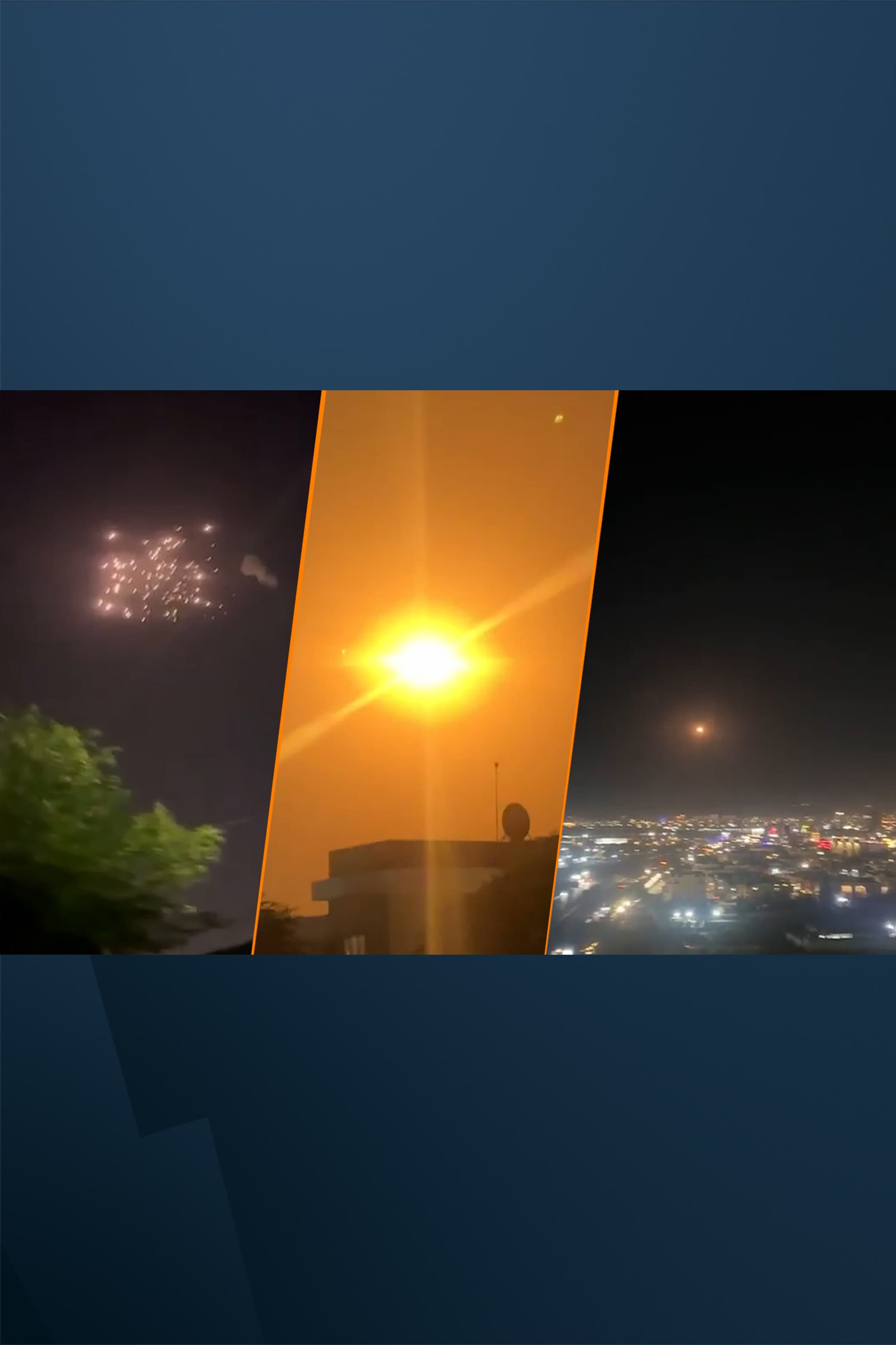

ERBIL, Kurdistan Region - Several explosions were heard in Erbil on Wednesday evening, with eyewitnesses and residents in the northern part of the Kurdish capital telling Rudaw that the blasts were caused by drones. The series of attacks notably coincides with the landmark visit of Iraqi Prime Minister Ali al-Zaidi to the United States.
Video footage obtained by Rudaw showed projectiles exploding in the sky over the the Kurdish capital.
A Kurdish security source also told Rudaw that at least “six one-way attack drones were intercepted over Erbil.”
Later on Wednesday, the Erbil-based Counter-Terrorism Directorate confirmed that the US-led Coalition had “intercepted and shot down eight explosive-laden drones” over Erbil “between 8:53 pm and 9:20 pm,” local time.
“No casualties were reported,” the directorate added.
The timing
The series of attacks comes as Iraqi Prime Minister Zaidi began a landmark visit to the United States on Monday, where he met with US President Donald Trump and senior American officials to discuss elevating Baghdad-Washington ties to a partnership level.
Zaidi on Wednesday met with US Secretary of War Pete Hegseth to discuss ways to enhance military cooperation with Iraq. “To deepen our partnership, Iraq must assert its sovereignty and disarm the Iran-aligned militias responsible for 600+ attacks on U.S. personnel this spring,” Hegseth said in a statement on X.
Notably, ahead of the visit, the Iran-aligned Islamic Resistance in Iraq (IRI) group expressed its “principled rejection” of the trip, citing ongoing US-Israeli military operations against “innocent people in Iraq, Iran, Lebanon, Yemen, and Palestine.”
In a statement released Sunday, the IRI said “the continued presence of US forces on Iraqi soil represents an occupation,” adding that “one of the government’s priorities must be to work, through various means, to end it according to the announced schedule” by the end of September.
The IRI emerged in the immediate aftermath of the outbreak of the Gaza war in October 2023 and includes powerful Iraqi armed groups including the Asa’ib Ahl al-Haq, Kata’ib Hezbollah, Harakat Hezbollah al-Nujaba and Kata’ib Sayyid al-Shuhada.
In late February, the US and Israel launched a coordinated military campaign against Iran, carrying out thousands of strikes across the country.
In response, Tehran launched thousands of drone and missile strikes across the Middle East, targeting alleged US assets in the region, particularly in Gulf Arab states, while also carrying out retaliatory attacks against Israel.
The Iranian response has also involved armed groups aligned with the Tehran-led ‘Axis of Resistance,’ including factions affiliated with the IRI. In early April, the umbrella group claimed to have carried out more than 750 attacks against alleged US targets across Iraq, including the Kurdistan Region, since the start of the Iran war.
According to Rudaw' data, the majority of the attacks were concentrated in Erbil province, which recorded 560 drone and missile attacks by early April.
The US and Iran agreed on April 8 to a preliminary Pakistan-brokered ceasefire to create space for negotiations. On the same day, the IRI announced a halt to its military operations, which have since significantly declined.
The bigger picture
The renewed attacks on the Kurdistan Region’s capital coincide with an escalation in military exchanges between Iran and the US in the region for over a week.
Iranian state and semi-official media on Wednesday reported several explosions they attributed to US forces across southern Iran, including in the port cities of Chabahar and Bandar Abbas, the town of Sirik in Hormozgan province, the strategic islands of Qeshm and Kish near the Strait of Hormuz, and Ahvaz, the capital of the southwestern province of Khuzestan.
The US Central Command (CENTCOM) on Wednesday stated that its forces “completed a morning round of strikes against Iran,” detailing that “precision munitions” were launched “against coastal defense systems and cruise missile storage and launch sites.”
“The strikes further degraded Iran’s ability to attack commercial shipping in the Strait of Hormuz,” the Command added.
Later in the day, US forces launched “a second wave of strikes” targeting “Iranian military capabilities used to threaten vessels freely transiting the Strait of Hormuz, an international waterway vital to global commerce,” CENTCOM said.
The US strikes coincided with Washington's reinstatement of its naval blockade on Iranian ports on Tuesday. By the time of publication, US forces had “redirected two commercial vessels attempting to run the blockade,” CENTCOM said, adding that “the US military remains vigilant and prepared to ensure full compliance.”
Meanwhile, Iran's Islamic Revolutionary Guard Corps (IRGC) said Wednesday it launched a new wave of attacks on a US military base in Kuwait, claiming to have hit its “satellite communications center, missile and air defense radar systems, Patriot air defense battery, a logistics depot, and HIMARS missile launchers.”
The IRGC on Tuesday said its “navy and aerospace” units struck “weapons and equipment depots” for US vessels and aircraft at Sheikh Isa Air Base in Bahrain in a “coordinated missile and drone operation.” The Corps also claimed to have hit “the deployment ramp for MQ-9s at Ali Al Salem Air Base in Kuwait,” reporting damage and destruction of several aircraft.
In a separate statement released Tuesday, the IRGC said they had targeted "vital facilities and the deployment site of the American enemy" at an air base in Jordan with ballistic missiles.
The ongoing escalation comes weeks after Iran and the US signed the Islamabad Memorandum of Understanding in mid-June, which established a halt to military operations on all fronts and reopened the Strait of Hormuz to commercial shipping.
Washington and Tehran also committed to holding talks toward a comprehensive settlement within 60 days of signing, with room to extend by mutual consent.
However, given the latest developments, the fate of the MoU and the wider settlement remain unclear - as do the implications of the continued escalation for the region as a whole.
Last updated at 11:25 pm

.jpg&w=3840&q=75)
.png&w=3840&q=75)