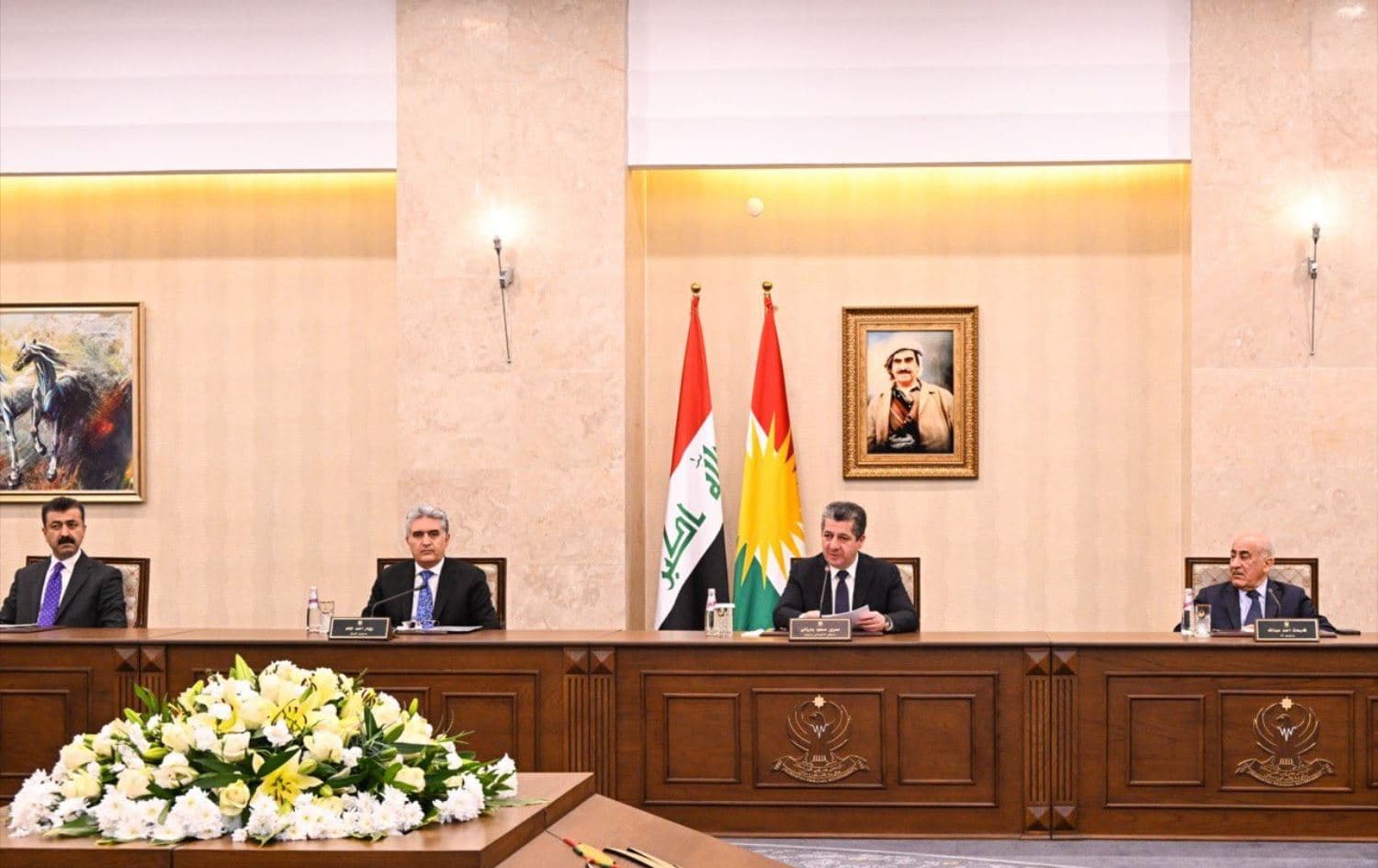

Discussing the latest governmental delegation visit to Baghdad, Prime Minister of the Kurdistan Region Masrour Barzani told members of the Region’s Council of Ministers that Erbil is ready to resolve outstanding issues with Baghdad within the framework of the constitution.
“KRG and the Kurdistan Region’s delegation have played their role to reach an agreement and that they await Baghdad to implement the agreements,” a statement from the KRG quoted Barzani as saying.
Barzani further expressed “his disappointment with the Federal Court of Iraq and highlighted the court’s role in destroying every agreement reached with Baghdad,” the statement added.
Unable to reach a final agreement over the Kurdistan Region’s share of the budget and independent oil sales at the time, an agreement was made between the KRG and the Iraqi federal government in 2021 where Baghdad would send 200 billion dinars ($125 million) monthly to the Kurdistan Region.
The newly-formed Iraqi cabinet, headed by Mohammed Shia’ al-Sudani, recently approved the payment of 400 billion dinars ($250 million) to the Region for the months of November and December last year.
However, Iraq’s Federal Supreme Court on Wednesday ruled against Baghdad's payment of the Kurdistan Region’s financial entitlements, claiming it violates the 2021 Iraqi Budget Law.
The budget has been a point of contention between Erbil and Baghdad for several years, especially after the Kurdistan Region's decision to sell its oil through Turkey, and the emergence of the Islamic State (ISIS) in Iraq in 2014.
Almost two years after Iraq passed its last budget law, Erbil and Baghdad remain in disagreement over several different issues.
Kurdish government delegations have traveled to Baghdad on several occasions to reach a common ground with the Iraqi government, however, none of the visits have had a solid outcome.
The Federal Court’s latest decision was slammed by different Kurdish officials, with the Region’s President Nechirvan Barzani claiming that the court’s decision is “unjust and tyrannical”.
However, the decision is not unprecedented.
The Iraqi Federal Court last February found the Kurdistan Region’s oil and gas law to be “unconstitutional,” therefore striking down the legal basis for the independence of the Region’s oil and gas sector. The court’s decision was at the time repeatedly slammed by top Kurdish leaders, who challenged the legality of the court and called it “unconstitutional.”