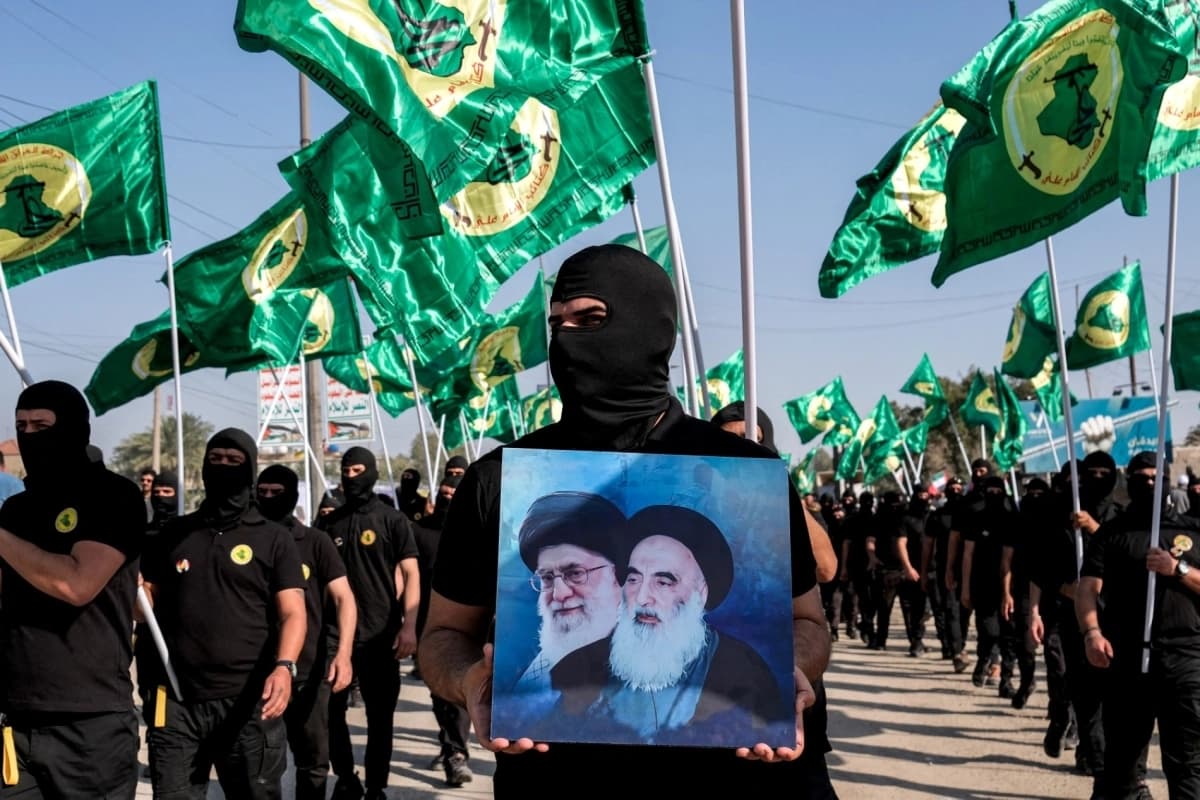

ERBIL, Kurdistan Region - Pro-Iran Kataib Hezbollah on Tuesday accused Iraqi Prime Minister Ali al-Zaidi’s government of undermining the country’s sovereignty, alleging corruption in discounted oil sales to the United Arab Emirates, violations of Iraqi airspace by foreign aircraft, and participation in an economic blockade against Iran.
In a statement published on Telegram, Abu Mujahid al-Assaf, the group’s security chief, questioned why an agreement he said had been signed between the pro-Iran Islamic Resistance in Iraq (IRI) - an umbrella of Shiite armed factions - and the Coordination Framework’s negotiating committee had not been handed over to the armed factions.
“The Islamic Resistance is still waiting, as of today, for a copy of the agreement signed between the victorious Islamic Resistance and the [Coordination] Framework committee,” Assaf said.
“Will the authorized director continue keeping it in his pocket, or do you have another opinion?” he asked, adding that “our men honor their commitments, and the resistance remains committed to its pledge.”
The statement comes amid a prolonged standoff between aidi’s government and powerful Iran-aligned factions over Baghdad’s efforts to bring all weapons outside state control under government authority. The factions have disputed the government's proposed disarmament timetable, while negotiations through a Coordination Framework committee have yet to produce an agreement publicly accepted by all parties.
Zaidi initially set the end of last September as the deadline for armed factions to surrender their weapons, coinciding with the end of the US-led coalition’s military mission in Iraq. However, following negotiations, he extended the deadline to the end of June 2027.
Kataib Hezbollah and other factions rejected the new timetable, insisting that they had not agreed to the government’s proposals.
In mid-October, Assaf said that negotiations remained at “square one,” accusing Zaidi of failing to respond to a document on regulating weapons that had been agreed upon through the Coordination Framework’s negotiating committee.
Tuesday’s statement appeared to acknowledge the existence of an agreement with the committee, although Assaf maintained that the factions had not received a copy.
He also announced that the IRI had suspended military operations inside Iraq until further notice.
“The Islamic Resistance has ceased all military operations inside the country up to this day, and if it carries out any operation, it will announce it immediately,” he said.
Assaf's reiteration of the suspension of armed activities, announced following the US withdrawal, was to deny the group’s involvement in an incident over Baghdad’s heavily fortified Green Zone last week, when a drone was shot down. Assaf claimed the group wasn't involved and said it was a "friendly fire" incident of a US aircraft targeted by US fire.
Oil corruption allegations
In a separate set of accusations directed at the Coordination Framework, Assaf questioned Iraq’s oil sales to the United Arab Emirates’ Abu Dhabi National Oil Company (ADNOC), alleging that Iraqi crude was being sold at a discount of $47 per barrel.
“Are the oil sale contracts with ADNOC being concluded with your knowledge? Do you approve of selling oil at a discount of $47 per barrel?” he asked the alliance’s leaders.
Assaf also alleged that several individuals, including US special envoy to Iraq Tom Barrack, the UAE’s Tahnoon bin Zayed, Hassan al-Zaidi, brother of Ali a-Zaidi, and Iraqi businessman Saad Waheeb were benefiting from the transactions.
Saad Waheeb is the founder and chairman of Raban Al-Safina Group, a conglomerate established in 1997 with major interests in electricity generation, oil and gas, construction, and infrastructure. The group has secured substantial government contracts, including a $2.6 billion project to develop associated gas at the Nahr Bin Omar field in southern Iraq’s Basra province.
Waheeb is also a founder of the American University of Iraq–Baghdad. His son, Ali Saadi Waheeb, who previously served as deputy chief executive of the family-owned group, became Iraq’s electricity minister in May 2026 as its youngest minister at 38 years old.
He claimed that profits distributed among the individuals he named exceeded 4.5 trillion Iraqi dinars ($3.4 billion) monthly. He provided no supporting documentation for the allegations.
Iraq has been offering substantial discounts on its crude oil exports amid disruptions caused by the conflict involving Iran and restrictions on shipping through the Strait of Hormuz.
In September, Reuters reported that ADNOC had purchased tens of millions of barrels of Iraqi crude at discounts generally ranging from $18 to $27 per barrel.
A subsequent Reuters report, citing a document from Iraq’s state oil marketer SOMO, found that discounts offered for October-loading Basrah crude had increased to between $34.50 and $37 per barrel.
Assaf also accused the Iraqi government of failing to address alleged violations of the country’s airspace by aircraft he identified as jointly operated by the UAE and Syria.
He asked whether Zaidi had informed Coordination Framework leaders about the activities of aircraft known as “Shaheen,” claiming that one had crashed at the Fadak farm in Karbala and another near the southern city of Samawa.
According to Assaf, the wreckage was in the possession of the Popular Mobilization Forces’ (PMF) intelligence service.
Assaf further accused Iraqi political leaders of approving participation in what he described as an economic blockade of Iran.
He claimed that an Iraqi official had informed Iranian authorities that the State Administration Coalition and the Shiite Coordination Framework had approved participation in measures aimed at economically isolating Tehran.
The allegation comes amid heightened US economic pressure on Iran, which has also affected Iraq.
In September, Iraq and the Kurdistan Region suspended flights operated by Iranian airlines following expanded US sanctions targeting Tehran’s aviation sector.
The restrictions prompted criticism from Iran-aligned Iraqi political and armed groups, which accused Baghdad of yielding to Washington’s pressure.
Assaf also accused the prime minister and his office of altering legislation governing the PMF before submitting it to parliament. He called for the original and amended versions to be made public so Iraqis could determine whether changes had been made.
The Kataib Hezbollah official reiterated the group’s refusal to surrender its weapons or abandon its political and ideological commitments.
"We would like to reiterate for the lovers and supporters of the resistance, that the Islamic Resistance will not compromise on its beliefs even if they were to award us the earth and all that is on it," the group said.
Assaf also reiterated their membership in the pro-Iran "Axis of Resistance," saying that "until the last breath, we will hold on to the oneness of the arenas [of combat] established by Imam al-Khamanei."
He also denied that the armed group was seeking government positions, rejecting suggestions that its stance was motivated by demands for political appointments.