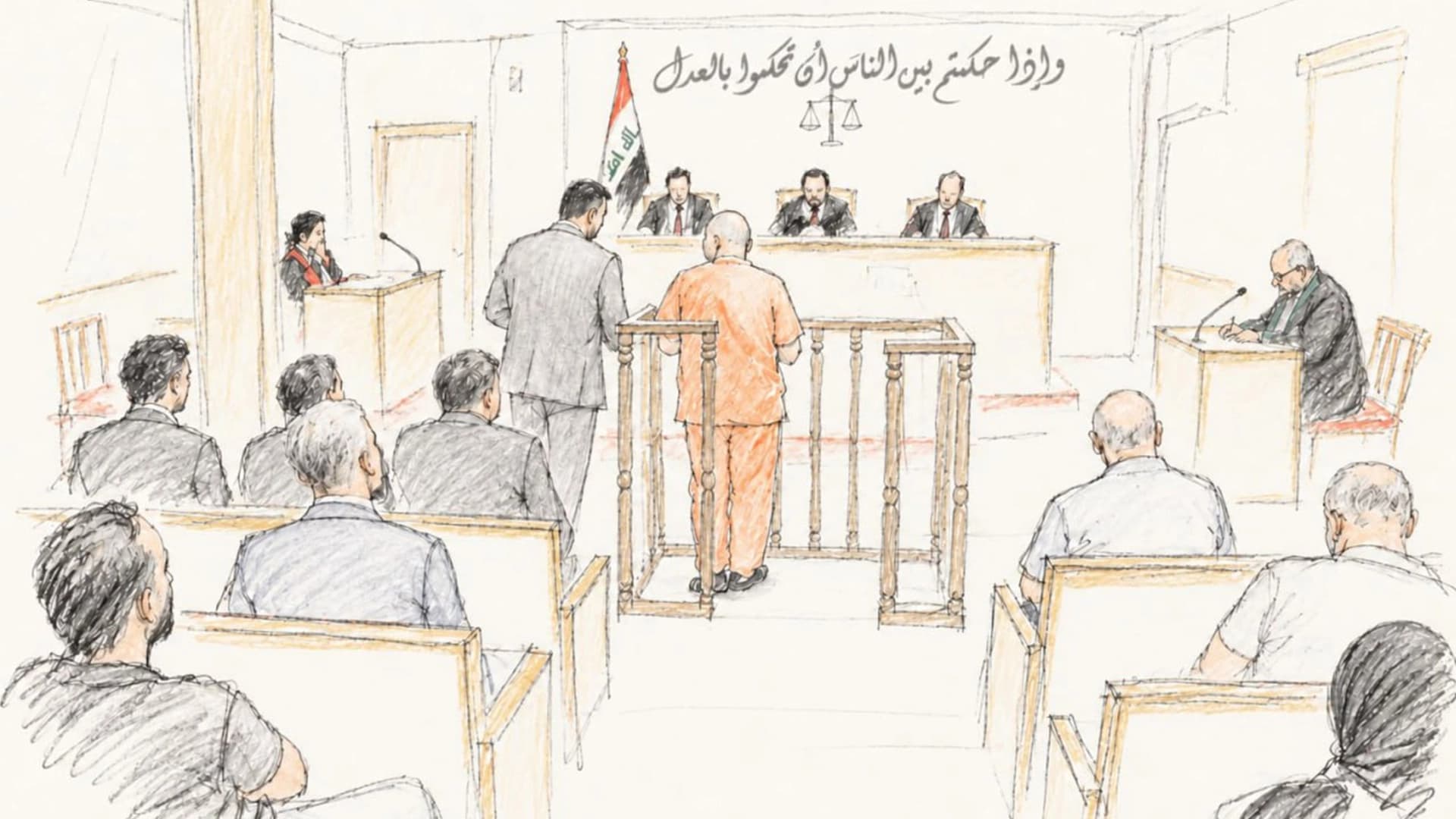

ERBIL, Kurdistan Region - An Iraqi court on Tuesday sentenced six French nationals to life imprisonment and a seventh to 15 years after convicting them of membership in the Islamic State (ISIS), amid ongoing prosecutions of foreign ISIS suspects transferred from detention facilities in neighboring Syria.
Iraq's Supreme Judicial Council (SJC) announced the sentences in a Tuesday statement, adding that the trial occurred “in the presence of their defense lawyers and representatives from the French Embassy in Iraq."
"The convicts are classified as 'high-risk' elements due to their role in threatening Iraqi national security and destabilizing Iraq and Syria, in addition to their involvement in inciting the execution of terrorist operations in other countries," the SJC stated.
The court said the sentenced individuals were part of 47 French nationals Iraqi authorities received last year from northeast Syria during a US-led global coalition transfer mission.
The 47 had been part of a large number of foreign and local ISIS detainees transferred from detention facilities in neighboring Syria earlier this year.
The US Central Command (CENTCOM) reported that between January 21 and February 12, more than 5,700 adult male ISIS fighters were relocated from detention facilities in Syria to Iraqi custody.
In February, the SJC confirmed it had received 5,704 suspected ISIS members across 61 nationalities during the US-led transfer operation, with the Karkh Central Prison in Baghdad designated as the main assembly facility.
The transferred detainees include 3,543 Syrians, 467 Iraqis, 710 nationals of other Arab countries, and 983 foreigners from Europe, Asia, Australia, and the US, according to figures released in August by the National Center for International Judicial Cooperation (NCIJC), which was established by the SJC to take over the United Nations Investigative Team to Promote Accountability for Crimes Committed by ISIS (UNITAD) after their closure in 2024.
Iraq tries most ISIS suspects under Article 4 of the 2005 Counter-Terrorism Law, which mandates the death penalty or life imprisonment for anyone who "commits, incites, plans, finances, or assists" a terrorist group.
In February, Human Rights Watch (HRW) accused Iraqi authorities of conducting rushed trials of ISIS detainees, raising concerns over due process, alleging that some convictions relied on confessions obtained through torture, and estimating that around 8,000 detainees are on death row.
Iraq’s parliament conducted a first reading of a bill to address legal gaps in prosecuting mass atrocities early in October. The bill formally criminalizes genocide, crimes against humanity, and war crimes, including "enslavement, forced displacement, forced pregnancy, persecution, enforced disappearances," and demographic changes.
The draft law establishes jurisdiction over offenses committed aboard Iraqi ships and aircraft, crimes committed by Iraqi nationals abroad, and atrocities carried out by ISIS and affiliated groups.
Iraq is not a state party to the Rome Statute, leaving the Hague-based International Criminal Court with no jurisdiction over crimes committed on Iraqi soil.
The legislative push follows the late 2024 closure of the UNITAD, which withheld a significant portion of its evidentiary archives from Baghdad because strict UN policies prohibit sharing evidence in proceedings where capital punishment can be imposed.