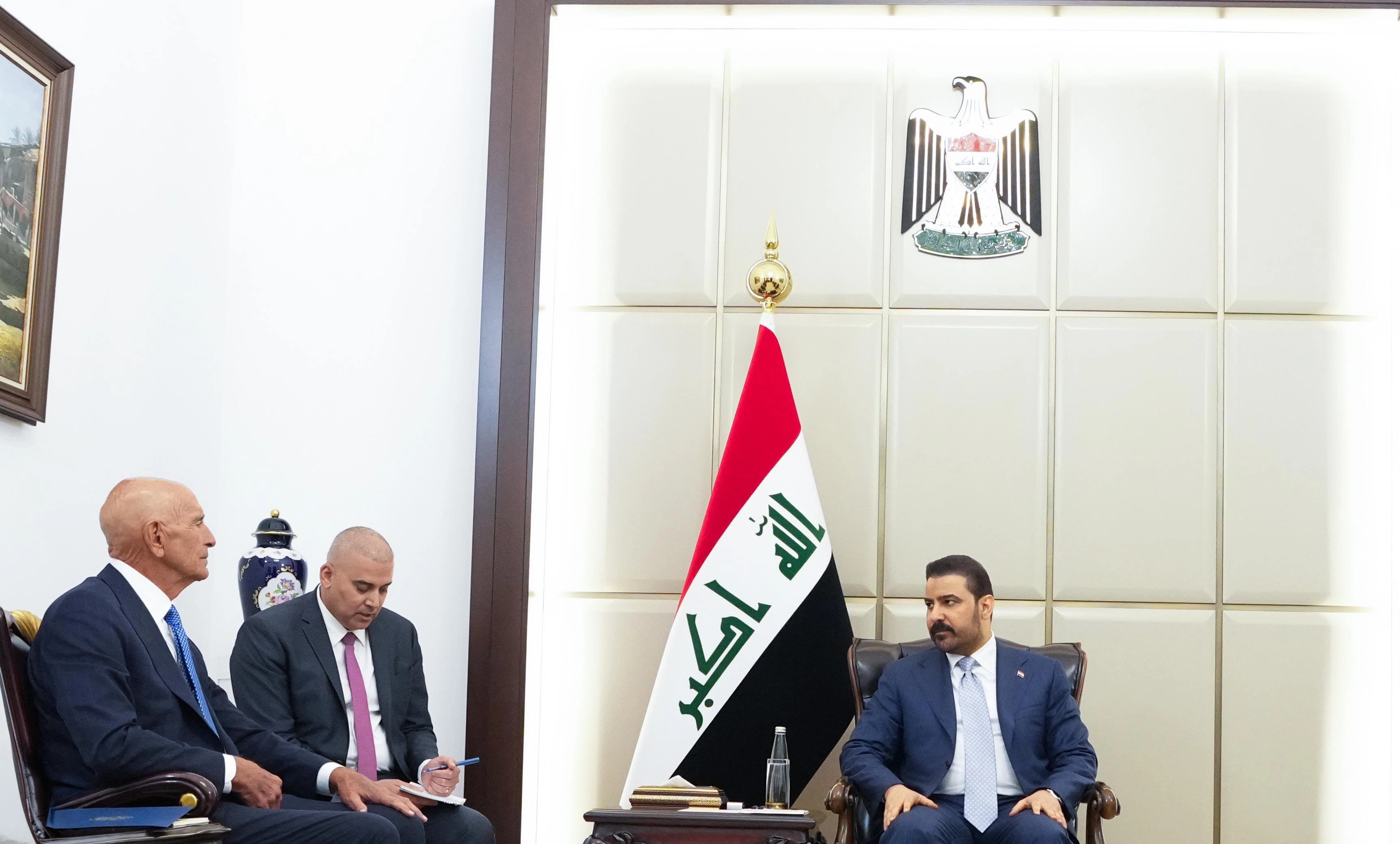
ERBIL, Kurdistan Region - Iraqi National Security Advisor Qasim al-Aboudi said Tuesday that the country's armed forces are prepared to assume responsibility for security following the US-led coalition's withdrawal, predicting that the issue of armed groups in Shingal (Sinjar) could be resolved within a week, as Kurdistan Region Interior Minister Rebar Ahmed warned of persistent security threats and urged continued international support.
Speaking at the annual Middle East Research Institute (MERI) Forum in Erbil on Tuesday, Aboudi acknowledged gaps in Iraq's surveillance capabilities but maintained that its security institutions were capable of confronting remaining threats from the Islamic State (ISIS) and other armed groups.
"The international community feels Iraq is a main partner in fighting terrorism," Aboudi said, adding that Iraqi forces had made significant progress in recent years.
The discussion came nearly two weeks after the US-led coalition formally ended its military mission in Iraq on September 30, leaving Baghdad responsible for the country's security as concerns persist over ISIS sleeper cells, armed groups operating outside state control and regional tensions. The withdrawal has also raised questions about future military cooperation between Baghdad, Erbil and Western partners.
Aboudi said the government had assessed the preparedness of different branches of the security forces before the coalition's departure, concluding that the military was ready to assume its new responsibilities.
However, he acknowledged shortcomings in Iraq's ability to detect and track militant movements in remote areas, saying the government was working to acquire the necessary technology.
"I agree that Daesh is active in certain areas. We know these areas and know of their presence. There are sleeper cells there," he said, using the Arabic acronym for ISIS.
ISIS is known to operate in remote rugged valleys in Diyala, Salahaddin, Kirkuk, and Nineveh provinces, all part of disputed territories claimed by both Baghdad and Erbil. The two sides have been working to deepen cooperation to prevent ISIS from exploiting security gaps that exist along the contact lines between the security forces of the two governments.
He also warned that other armed groups were being monitored by Iraqi intelligence services and could eventually emerge as new extremist threats.
The national security advisor argued that the withdrawal had strengthened the case for consolidating military decision-making and bringing weapons under state control.
"There is a great conviction, even among those who were skeptical or opposed to US withdrawal, that now is the time for Iraq to have a united military decision-making center," he said.
Aboudi claimed that armed groups had agreed to surrender their weapons and cease their activities, describing the government's efforts to consolidate its authority as an essential step toward improving national security.
However, KRG interior minister Rebar Ahmed offered a more cautious assessment, arguing that the decision to withdraw coalition forces had been driven primarily by political considerations rather than security requirements.
"The withdrawal of the coalition doesn't mean the end of relations with the countries of the coalition," he said, stressing the need for bilateral agreements to preserve military training, intelligence sharing and security assistance.
Ahmed praised the coalition's contribution to Iraq's fight against ISIS, particularly its air support during the campaign against the extremist group.
"Without American and Coalition air support, we might not have been sitting here today," he said.
While acknowledging that Iraq's security capabilities had improved significantly since ISIS seized large parts of the country in 2014, the KRG minister warned against underestimating the organization's ability to reorganize.
"Some might say that Daesh's threat has decreased compared to the past. That is true. However, Daesh now is stronger than the Daesh of pre-2014," Ahmed said.
"The threat is there. Daesh isn't gone," he added, warning that extremist ideology could regain ground if governments failed to improve public services and respect Iraq's ethnic and religious diversity.
Ahmed also identified organized crime, corruption and narcotics trafficking as growing security challenges, arguing that international cooperation remained necessary even as the threat from ISIS had changed.
"The impact of narcotics is worse than terrorism on societies. It gradually affects societies and the family unit," he said.
The minister said proposals to establish bilateral security arrangements with the United States and European countries had not been adopted by Baghdad, urging the federal government to reconsider them.
The US military has maintained that ISIS no longer poses a systemic threat to Iraq and that Iraqi and Kurdish forces can address the remaining danger. Washington has nevertheless pledged continued cooperation, including intelligence and training support, following the coalition's departure.
Shingal: Armed groups, foreign forces and reconstruction
The two officials also addressed the unresolved security and administrative situation in Shingal, the Yazidi majority district in northwestern Iraq that has remained divided among competing political and armed groups since its liberation from ISIS.
Aboudi said Baghdad had reached an understanding with local armed groups affiliated with the Kurdistan Workers' Party (PKK) to surrender their weapons and integrate individual members into official security institutions.
"The Sinjar question will be resolved within a week," he said, expressing optimism that the government could settle the armed-groups issue without resorting to military confrontation.
According to Aboudi, 1,500 fighters have already been integrated into Iraq's security forces, while work is underway to incorporate another 1,500. He added that 500 female fighters were being integrated into the community police.
He stressed that former fighters would not be allowed to retain their existing armed formations as independent units within the security apparatus.
The national security advisor said the armed groups had initially expressed concerns that the Yazidi population could again face attacks similar to those committed by ISIS in 2014, prompting Baghdad to pursue a negotiated settlement.
He argued that Iraq's commitment to ending the presence of unauthorized armed groups had also helped secure an understanding with Turkey over the withdrawal of its troops from the Bashiqa-Zilkan military base near Mosul.
Aboudi said Iraqi officials had raised the issue of Turkey's military presence during high-level talks in Ankara, emphasizing that foreign troops could no longer remain on Iraqi territory without Baghdad's approval.
He recalled Iraqi Prime Minister Ali al-Zaidi describing the Turkish deployment as an affront to Iraq's dignity during discussions with Turkish intelligence officials.
The remarks follow a September 23 joint statement by Zaidi and Turkish President Recep Tayyip Erdogan committing to the gradual handover of the Bashiqa-Zilkan base, in Nineveh province, as Baghdad progresses toward disarming armed groups in Shingal.
Turkey has long maintained that PKK-linked groups use the district and its mountainous terrain to move between Iraq, Syria and Turkey, citing their presence as a security threat.
Ahmed welcomed efforts to bring weapons under state control and end unauthorized foreign presence but argued that Baghdad's approach to Shingal must comply with the agreement reached with the KRG in October 2020.
The agreement was intended to restore security and governance in the district, remove unauthorized armed groups, establish a locally recruited security force and facilitate the return of displaced Yazidis.
Ahmed accused successive federal governments of failing to fully implement the agreement, citing interference by armed groups and continued disputes over the district's administration.
He said the KRG had proposed three candidates for the position of Shingal district administrator and that former Iraqi Prime Minister Mohammed Shia' al-Sudani had agreed to one of them, but an armed group opposed the appointment.
The minister also criticized Baghdad for forming committees to address Shingal without sufficient coordination with the KRG.
"We call on the Iraqi government to implement the provisions of the agreement as they are and that committees that are formed to implement the agreement or undertake any measure in Sinjar be formed in coordination with the Kurdistan Regional Government," Ahmed said.
He insisted that Baghdad and Erbil, as the two parties to the 2020 agreement, should remain responsible for implementing its provisions rather than allowing political parties or armed groups to dictate decisions.
Aboudi acknowledged that political rivalries had complicated the selection of a district administrator, calling for an independent candidate acceptable to the local population.
"I hope the brothers in the Kurdistan Region will help us so that we are able to settle the issue of the mayor away from partisanship to appoint an independent person," he said.
Despite their differences, both officials stressed the importance of enabling displaced Yazidis to return to their homes.
Aboudi said approximately 100,000 people displaced from Shingal remained in the Kurdistan Region and called for cooperation between the federal government and the KRG to facilitate their return.
He acknowledged that reconstruction would be more complicated than resolving the armed-groups issue, noting the extensive destruction caused by years of conflict.
"Security forces, including the army, the federal police, or Hashd al-Shaabi [Popular Mobilization Forces (PMF)] will not stay in Sinjar forever. At the end of the day, the people of the city need to administer it," he said.
Aboudi added that Shingal's historic ties with the Kurdistan Region should be preserved and that cooperation between Baghdad and Erbil was essential for its long-term stability.
The disagreement over Shingal shows a broader challenge Iraq is faced with after the coalition’s withdrawal: establishing unified security authority while balancing federal and regional powers, addressing local grievances and preventing neighboring countries from using Iraqi territory as an arena for their conflicts.
For Ahmed, that requires a national security strategy grounded in Iraq's constitutional framework and a partnership that protects the interests of all its communities.
Aboudi, meanwhile, argued that Iraq must pursue balanced relations with regional and international powers while avoiding involvement in their rivalries.
"Iraq might be the only neutral country in the Middle East," he said. "We don't have any proxy group in any country. We don't have an active military intervention in any country."
He stressed that Baghdad should continue building military, intelligence and economic partnerships without joining an alliance directed against another country.