
ERBIL, Kurdistan Region - Emily Giffin spent her first few hours in Baghdad drinking tea and playing American country music for two Iraqi gentlemen she and fellow American traveler Laredo Ertel had met only minutes earlier on a lively, buzzing street in the capital.
The men later took the two travelers to a rooftop overlooking the city, where they stood admiring the lights emanating from the bustling metropolis at night.
Then came a phone call.
A local friend waiting at their hotel informed them that police and intelligence personnel were there looking for them. Giffin and Ertel immediately told the two Iraqi men they needed to return, and the men offered to drive them back.
They didn't make it to the hotel.
About five minutes into the drive, Giffin said, their vehicle was surrounded by flashing lights and several marked and unmarked vehicles. The Iraqi men were pulled from the car, while two plainclothes men got inside and drove the young women away.
“The minute that the car came to a screeching halt,” Giffin recalled, around a dozen “officers and intelligence swarmed the car,” including at least one vehicle with flashing lights and two or three unmarked cars.
The encounter marked the beginning of an hours-long ordeal late into the early morning hours that would end with Giffin and Ertel escorted out of Baghdad and back to the Kurdistan Region, with little explanation beyond repeated assurances that evacuation was being done “for your own safety.”
Giffin, a 22-year-old American travel vlogger whose content focuses heavily on the Middle East, entered Iraq through Erbil International Airport in late September on a tourist e-visa after which she and Ertel, 28, drove to Baghdad.
“I wanted to see the marshes and Basra and I really, really wanted to walk through the Baghdad book markets and, more than anything, just talk to locals and get to experience, you know, the Iraqi hospitality,” she said.
Giffin was also aware that her visit coincided with the end of the US-led coalition mission in Iraq on September 30.
“Traveling especially in this region, I have to be very politically aware,” she said. “I was very aware of the situation and I took that responsibility upon myself. I knew what I was getting into.”
But she stressed that she was traveling as a tourist and content creator, not as a journalist or political activist.
“A big part of why I tend to feel safer than others traveling in this region is because I’m not a journalist. I’m just a tourist who happens to have an Instagram,” she said.
After arriving in Baghdad, Giffin, Ertel and an Iraqi friend checked into their hotel and went out for dinner. Giffin and Ertel later became tired and decided to return to the hotel alone by taxi.
On the way, they noticed a busy street - and a monkey.
“Of course I’m American. We don’t have monkeys in the US,” Giffin said.
They asked the driver to stop. There, they met two Iraqi men who, she said, were curious about what they were doing in Iraq and eager to extend local hospitality. The men invited them into their shop for tea.
“We played American country music for them. Just had a really lovely time,” she said.
The men then offered to show them more of Baghdad and took them to a rooftop overlooking the city. Giffin said she and Ertel discussed whether they felt safe before deciding to join and that the Iraqi men encouraged them to take photos and update loved ones of their whereabouts.
“They were really looking out for us and making sure that we felt comfortable and that we felt safe,” she said.
Then their friend at the hotel called.
After security personnel stopped the car, Giffin said the two Iraqi men were forced out of the vehicle and she and Ertel were taken to what appeared to be a police station. No one explained their rights or why they had been stopped.
“They didn’t speak any English. My Arabic is terrible,” she said.
Giffin said that after repeatedly asking, in her limited Arabic, “Shoo mushkila?” - “What is the problem?” The men eventually identified themselves only as police. She believed that both police and some form of intelligence personnel were involved, but did not know which agency.
She estimated that they remained at the station for around 10 to 15 minutes before being placed in another unmarked vehicle and escorted back to their hotel.
The two Iraqi men were also at the police station, Giffin said. It was the last time she saw them.
“I do worry about them and I feel very sorry that they had to go through that just for the sake of being kind and welcoming,” she said, adding that she has not been able to contact them since.
Back at the hotel, Giffin and Ertel sat in the lobby for another two to three hours while security personnel spoke with the Iraqi friend who had traveled with them.
Eventually, they were notified they had to leave Baghdad and return to Erbil.
Giffin said they were initially told they could return to Baghdad after several days. But after arriving back in the Kurdistan Region and making further inquiries through contacts, they were told they were not welcome in federal Iraq “for the time being.”
No timeline was given, she said.
“We were told Mosul, Baghdad, Basra - none of those were okay,” said Giffin, whose inquiries regarding travel through federal Iraq were rejected. Griffin said no one told them they had violated a law, filmed a restricted site or faced a specific security threat.
“The only explanation that we were able to get was ‘for your own safety,’” she said. “As far as I know, there was no actual threat against us. Nobody had said anything.”
Nor, she said, did any official raise their American nationality, the US military withdrawal, militias or other recent political developments during the encounter.
They returned north in the same private vehicle in which they had traveled to the capital, but were escorted the entire six-hour journey by several unmarked cars and “numerous security personnel,” she recounted.
According to Giffin, one escort vehicle would accompany them to the next checkpoint, where another was waiting to take over.
Lieutenant General Saad Maan, head of Iraq’s Security Media Cell, told Rudaw’s Nahro Mohammed earlier that authorities were following up on the case, describing the treatment of the two Americans as an “individual act” that was “unacceptable.”
Maan said “Baghdad is calm and safe.Thousands of foreigners live in the Iraq and Baghdad capital without any issues.”
It remains unclear whether Maan meant that the initial decision to remove Giffin and Ertel from Baghdad was made by an individual acting without authorization, rather than describing the entire operation used to carry it out.
Maan later called Giffin personally after Rudaw provided him with her contact details.
She described him as “very kind and very apologetic” and said he told her what happened was not normal procedure and that he intended to conduct a thorough inquiry.
“He was very adamant that he was going to make it right,” Giffin said. “He said he would be in contact with the different departments.”
Giffin said Maan’s tone made her feel that he wanted her to be welcome in Baghdad again, but did not identify the officer or agency responsible, explain who had ordered Giffin and Ertel out of Baghdad or explicitly give them permission to return.
“Based on our conversation, he really wants to make things right. And he wants me to leave the country feeling like I’m welcome back,” she said.
Giffin said security personnel inspected their passports but did not confiscate their phones, cameras or other belongings. They were not given any written order, warning, deportation notice or other document explaining what had happened.
She also chose not to contact the US embassy.
“I’ve traveled extensively to a lot of places that are labeled as Level Four, ‘Do Not Travel,’” she said. “As long as I don’t feel like I’m unsafe, I don’t feel a need to contact the embassy.”
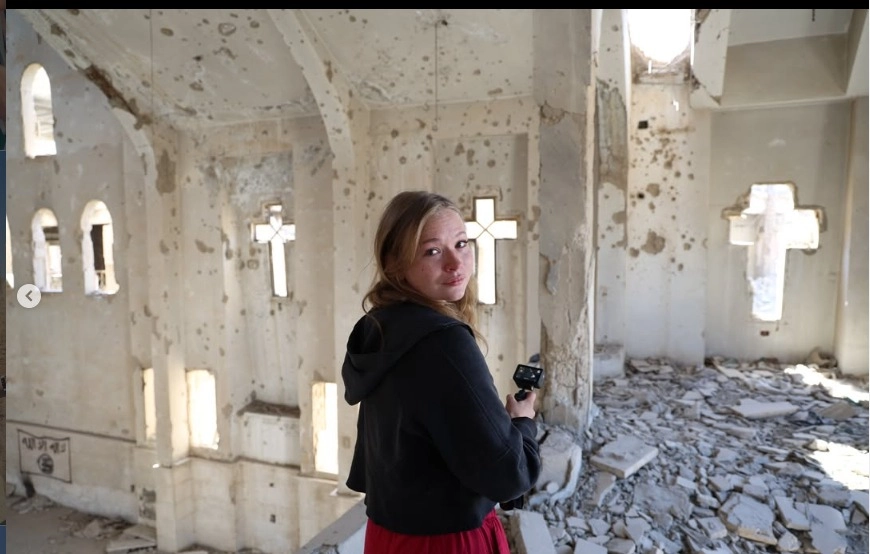
Giffin during a trip to Syria. Photo: social media
Giffin described her strongest reaction not as fear, but disappointment.
“At the beginning of it, I was confused and a little concerned that we had somehow accidentally done something wrong,” she said. “But at no point did we do anything wrong. I think the feeling of frustration just grew.”
That frustration increased once she was told she could not return to Baghdad.
The trip had largely been planned around Baghdad, Basra and other parts of federal Iraq. After returning to Erbil, Giffin made inquiries hoping she and Ertel could salvage the rest of the visit, but eventually booked a flight out of Iraq.
Despite what happened, Giffin said the experience had not changed her view of Iraqis or her desire to return.
Her own content, she added, focuses heavily on showing people outside the Middle East that “people are good everywhere” and that what they read in news headlines does not tell the full story.
The hospitality she wanted to show was precisely what she said she experienced during her brief time in Baghdad, including in the hours immediately before security forces intervened.
“I don’t think it’s going to change the way that I talk about Iraq or Baghdad,” she said. “I’ve still had lovely experiences with the people.”
She was reluctant even to give the incident too much prominence on her own social media, saying she did not want prospective visitors to see it and conclude that they should avoid Iraq.
On the contrary, “if someone were to reach out for me and guarantee that I was welcome back into federal Iraq, I would be there tomorrow,” Giffin said, expressing a staunch desire to return.
For now, however, she plans to leave the country and hold on to the memories she recorded.
“I think I’ll save my Iraqi footage for when I’m able to come back and see the whole picture.”