
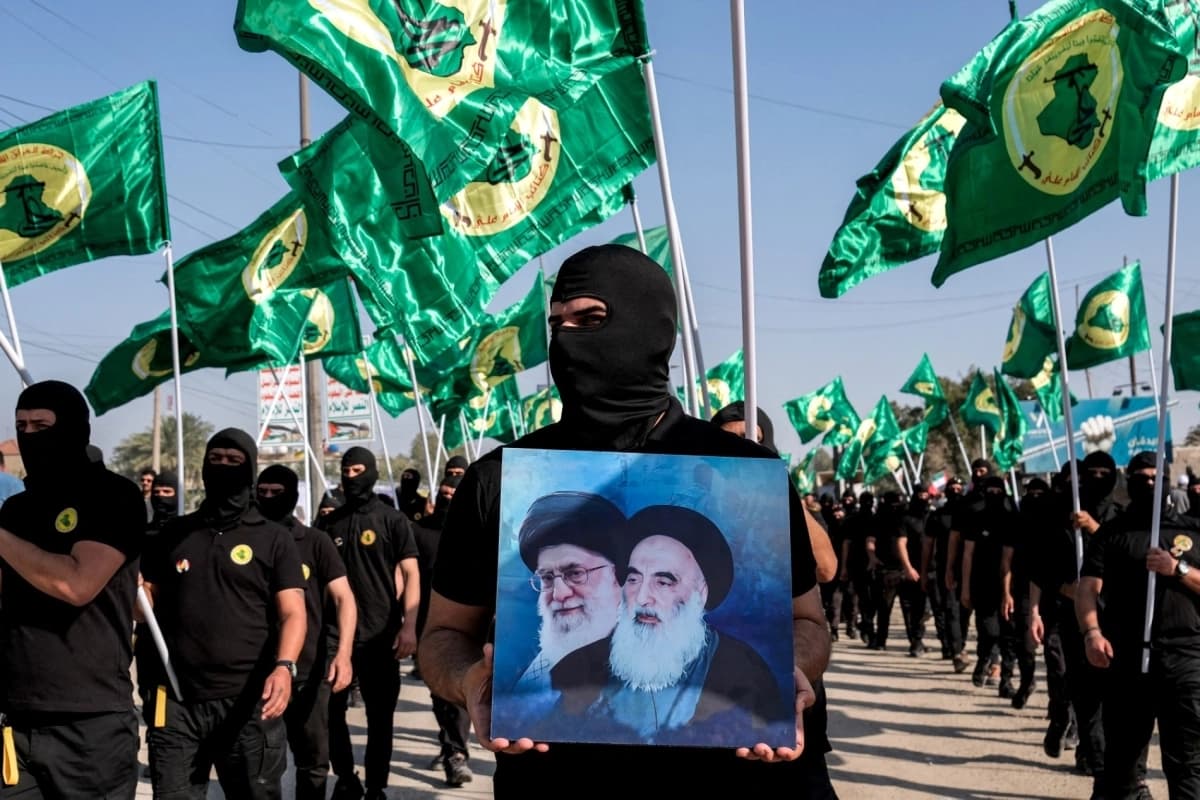

ERBIL, Kurdistan Region - Iraq's Iran-aligned armed group Kata’ib Sayyid al-Shuhada on Wednesday denied a claim by an Iraqi lawmaker that it had handed over weapons to the government, saying he had no authority to speak on its behalf.
Against the backdrop of the Iraqi government’s looming September 30 deadline for the US-led Global Coalition against the Islamic State (ISIS) to complete its drawdown which coincides with a disarmament campaign to confine all non-state arms to state control, Ali Anheri, member of the Parliamentary Defense and Security Committee, on Tuesday claimed that the faction had begun the process of handing over weapons and stated that only Kata'ib Hezbollah and Harakat Hezbollah al-Nujaba had yet to comply.
Speaking to Iraqi TV channel al-Rasheed TV, Anheri said the group's head, Abu Ala al-Wala'i, was among those who had handed over heavy weapons to the Popular Mobilization Commission, and that the handed-over items, including drones, had been catalogued and recorded.
Kata'ib Sayyid al-Shuhada rejected Anheri's account in a statement issued in the early hours of Wednesday, branding them as "false claims."
"We reaffirm to the public that what was stated in those remarks is completely untrue,” the group stated, adding that “the aforementioned member of parliament does not represent any official spokesperson for the brigade and has no authority to issue positions or statements on its behalf.”
Only members of the group are entitled to speak on its behalf, it reiterated.
According to Anheri, there is a wide consensus that the Iraqi government should hold an exclusive monopoly on weapons capable of crossing borders, including drones, missiles and heavy anti-air weaponry - except among the factions themselves.
"They have some conditions. There could be some flexibility on some of these conditions," Anheri said on Tuesday, naming the US-opposed PMF Law, which seeks to institutionalize armed factions - some of whom are US-designated terrorist groups - as a core demand.
The Popular Mobilization Forces (PMF) was established in 2014 by decree of Grand Ayatollah Ali al-Sistani, Iraq's highest Shia religious authority, as an umbrella of roughly 70 mostly Shia armed groups with around 250,000 members formed to fight the ISIS insurgency.
Despite being state-funded, the PMF includes factions aligned with Iran's "Axis of Resistance" - Asa'ib Ahl al-Haq, Kata'ib Hezbollah, Harakat Hezbollah al-Nujaba and Kata'ib Sayyid al-Shuhada - with the latter three having yet to heed the disarmament call and who have progressively raised their demands which include the dissolution of Kurdish Peshmerga forces, removal of Kurdish groups with cross-border ties to Iran and Turkey, and a full US troop withdrawal from Iraq as a pretext for noncompliance.
In his inaugural address to parliament in mid-May, Prime Minister Ali al-Zaidi pledged security reforms including "confining weapons under state control," and in June ordered a committee formed to oversee the separation of political parties and armed factions from the PMF of which Asa’ib Ahl al-Haq was among the first to agree to Zaidi's push, severing ties with their fighters within the PMF.
A committee of senior Coordination Framework figures, including former Prime Minister Nouri al-Maliki, is negotiating the process with the factions.
With the deadline a mere two weeks away, rhetoric among Iraqi politicians has shifted from talk of disarmament toward "organizing" or "restricting" weapons, particularly those capable of striking neighboring countries - a focus sharpened by an attack on Saudi Arabia's East-West pipeline that an Iraqi government investigation found was launched from Maysan province, heavily damaging its pumping stations.
Nouri al-Maliki, currently a member of the ruling Coordination Framework, in early September even rebranded September 30th as the "start of the process."
Nevertheless, Iraqi government spokesperson Haider al-Aboudi, speaking to Iraqi channel al-Sharqiya in Paris on Tuesday, reiterated the government's position that it must hold a monopoly on the use of force.
"The reasons that allowed arms to remain outside state control during the events of 2014 no longer exist today... after September 30, Iraq and the Iraqi state will have a monopoly over the tools of force, and this constitutes a return to normal constitutional stipulations," he said.
No other party would be permitted a security role on the government's behalf, he said, warning that groups who fail to comply "will have to face the law."
.jpg&w=3840&q=75)