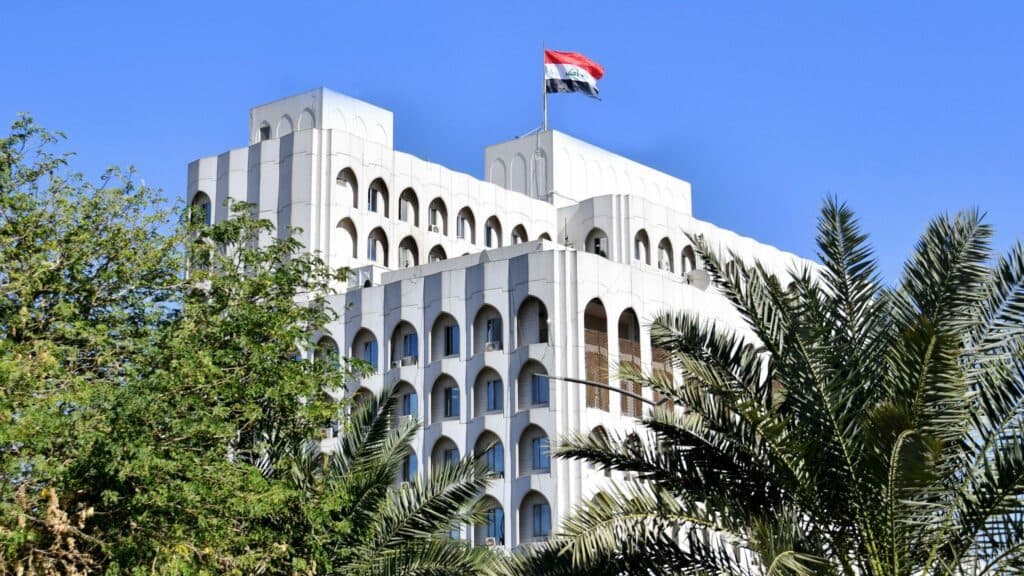

ERBIL, Kurdistan Region - The Iraqi foreign ministry on Thursday condemned the attacks on Bahrain, Jordan, and Kuwait recently carried out by Iran, which Tehran said targeted alleged US positions in those countries. Baghdad’s stance comes amid a broader rapprochement the new Iraqi government appears to be pursuing with its Arab neighbors.
In a statement, the ministry relayed Iraq’s “condemnation of the attacks on the territories of the Hashemite Kingdom of Jordan, the Kingdom of Bahrain, and the State of Kuwait,” stressing that “the stability of Arab and neighboring countries is an integral part of Iraq’s stability and national security, which necessitates maintaining strategic relations among regional states and safeguarding shared interests that serve their peoples’ aspirations for development and prosperity.”
Baghdad further expressed “deep regret over the renewed escalation in the region and the serious consequences that may ensue,” calling on all parties to “exercise self-restraint” and “adopt diplomatic means and peaceful solutions to address existing crises, in a way that enhances regional security and stability.”
The escalation
The remarks come as the US and Iran have been locked in a three-day military escalation - the most intense since both sides agreed to a Pakistan-brokered ceasefire in early April.
The US Central Command (CENTCOM) reported that its forces carried out a series of “self-defense strikes” against targets in Iran over the past two days on the orders of President Donald Trump, following the downing of a US Army Apache helicopter over the Strait of Hormuz on Tuesday - an incident Washington has blamed on Tehran.
In the first wave on Tuesday, US fighter jets struck around 20 targets in the southern Iranian port city of Bandar Abbas and on Qeshm Island. The precision strikes focused on air defense batteries, ground-control stations, and maritime surveillance radar sites.
CENTCOM broadened the campaign on Wednesday, launching 49 Tomahawk land-attack cruise missiles at targets in the southern coastal towns of Sirik, Minab, and Kargan, while also striking sites in the industrial outskirts of Tehran, including Karaj, Nazarabad, and Pishva.
Meanwhile, Iran’s Islamic Revolutionary Guard Corps (IRGC) launched two waves of drone and missile attacks on Wednesday and Thursday targeting what Tehran described as US military installations across Bahrain, Jordan, and Kuwait. The IRGC claimed to have struck 21 targets in the first wave and 18 in the second.
In Jordan, the IRGC said it targeted Muwaffaq Salti Air Base, also known as al-Azraq Air Base, and its integrated US command-and-control center in two separate attacks. The first involved long-range solid-fuel ballistic missiles and drones, with Iran claiming it destroyed a hangar housing US fighter jets. In the second, the Corps said it fired 12 ballistic missiles at what it described as US aircraft infrastructure and command-and-control facilities.
In Bahrain, the IRGC claimed it had “hit and destroyed” targets at the US Navy’s Fifth Fleet headquarters in Juffair and Sheikh Isa Air Base south of Manama using a combination of drones and missiles.
Meanwhile, Kuwait’s Ali Al Salem Air Base and Ahmad al-Jaber Air Base also came under attack, with the IRGC claiming it targeted US Army and Air Force infrastructure at both installations. The strikes prompted Kuwaiti authorities to briefly close the country’s airspace as a precautionary security measure.
Iraq’s stance
Amid the escalation, Iraq appears to be aligning more closely with its Arab neighbors, in what may reflect a broader effort by Baghdad for rapprochement.
In late May, Iraq’s newly appointed Prime Minister Ali al-Zaidi ordered the formation of a “special committee” to coordinate with Saudi Arabia and the United Arab Emirates (UAE) on investigations into attacks on their territories that they said originated from Iraq.
Zaidi instructed that “all necessary measures be taken against those involved if it is indeed proven that Iraqi territory was used as a launch point for the attacks.”
Iraqi government Spokesperson Sabah al-Numan then conveyed Baghdad’s condemnation of the assaults, stressing its “rejection of the use of Iraqi territory or airspace to attack brotherly Arab countries and friendly regional states."
Meanwhile, Iraq’s National Security Advisor then affirmed that Iraq is an “integral part of the Arab world and that the Iraqi constitution does not permit the use of Iraqi territory to carry out attacks or launch aggression against other countries.”
He further underscored “the importance of building balanced relations with the international community based on shared interests and mutual respect,” while emphasizing “the need for international law and the United Nations [Charter] to serve as the foundation for regulating relations between states, in accordance with the principle of mutual respect.”
Baghdad’s softened tone comes amid strains in its relations with regional neighbors, fueled by the recent involvement of Tehran-backed Iraqi armed groups in the regional conflict alongside Iran.
The US and Israel launched a large-scale aerial campaign against Iran in late February, striking thousands of targets across the country during six weeks of hostilities.
In response, Iran carried out thousands of drone and missile strikes across the Middle East, targeting alleged US assets - particularly in Gulf Arab states - as well as launching retaliatory attacks against Israel.
The Iranian response has also included strikes by factions aligned with the Tehran-led ‘Axis of Resistance’, including by shadowy armed groups in Iraq that have claimed numerous attacks against alleged US targets in the country and the wider region.
As a result, the UAE in mid-April handed the chargé d’affaires at the Iraqi embassy a “strongly worded” letter of protest over what it described as “terrorist attacks” launched from Iraqi territory by Iran-aligned armed groups targeting facilities in Gulf Arab states, despite the ongoing truce.
Abu Dhabi then warned that the continuation of such attacks places ties with Baghdad “under highly sensitive strain.”