
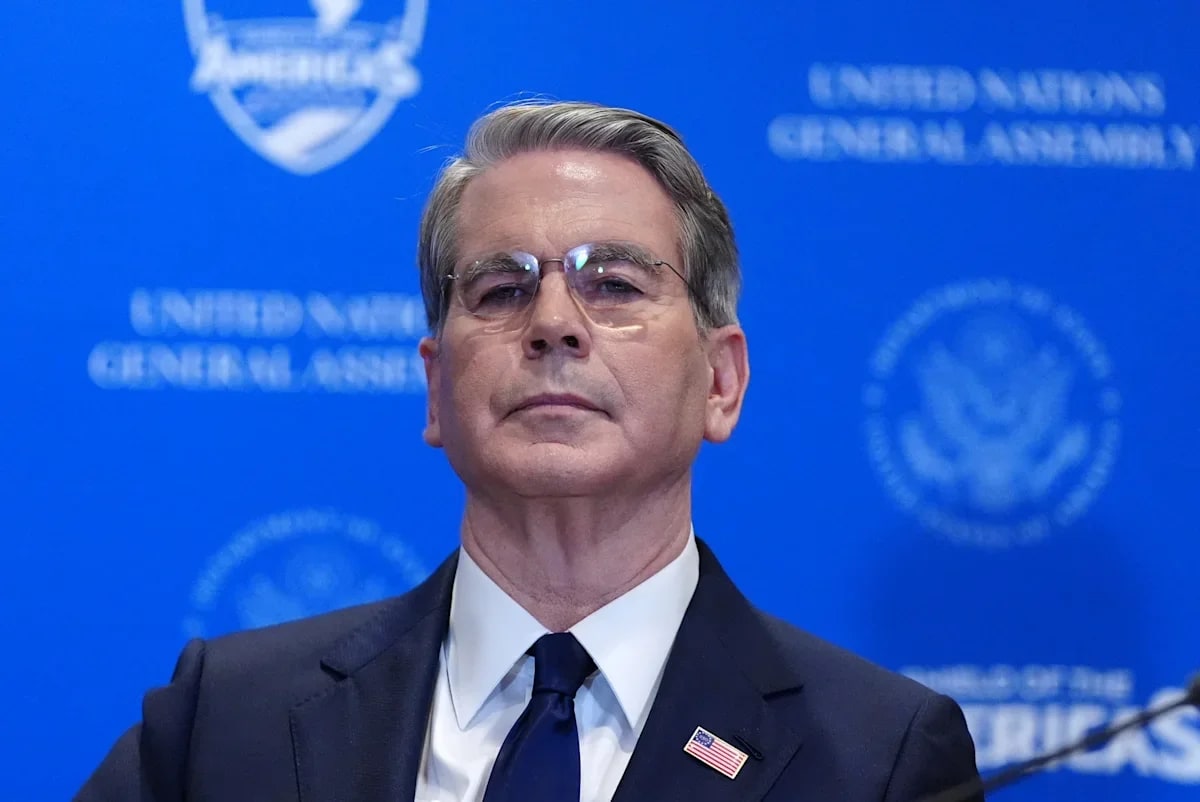

ERBIL, Kurdistan Region - US Treasury Secretary Scott Bessent said Wednesday that Iran had exhausted its seaborne oil supplies under Washington's naval blockade, describing the Islamic Republic as a "sinking ship", as the Iranian currency plunged to a new record low amid growing economic and military pressure.
"The Iranian regime is a sinking ship. After failing to load a single tanker since the Treasury launched Operation Economic Outcast in August, Iran doesn't have a drop of oil on the water left to sell," Bessent wrote on X.
The claim comes as Washington intensifies efforts to cripple Iran's economy, particularly its oil exports, a crucial source of government revenue. The US Treasury launched Operation Economic Outcast on August 24, targeting Iran's oil industry, financial networks and sanctions-evasion operations.
Washington has imposed two naval blockades on Iranian ports this year as part of its campaign to cut off Tehran's maritime trade and oil revenues. The first began on April 13 and lasted until June 18, when Washington and Tehran lifted it following an interim understanding. US Central Command (CENTCOM) reimposed the blockade on July 14 after the agreement unravelled amid renewed hostilities in the Strait of Hormuz.
The Trump administration has also exerted increasing pressure in recent weeks on Iran’s neighbors, including Iraq, Pakistan and Turkey, to sharply restrict commercial exchanges through land border crossings, seeking to isolate Tehran further economically.
In a November 20 statement, the department said Tehran was struggling to recover billions of dollars from intermediaries involved in previous oil sales.
Iran’s Islamic Revolutionary Guard Corps (IRGC)-affiliated Fars News Agency reported on Wednesday that a large shipment of US dollar banknotes had recently arrived in Iran from a neighbouring country, without identifying its origin or disclosing the amount. The report follows an announcement by Iran’s central bank governor that $2 billion had been allocated for distribution to eligible applicants, with purchases capped at $10,000 per person, as Tehran seeks to stabilise its currency amid mounting economic pressure.
Meanwhile, Iran's rial plunged to another record low on Wednesday, with one US dollar trading at more than 290,000 tomans on the open market, reflecting growing economic uncertainty and the impact of Washington's sanctions.
The economic pressure comes as Qatar and other regional mediators continue efforts to bring Washington and Tehran closer to an agreement to end the conflict.
Despite the economic crisis, senior Iranian military officials continue to threaten retaliation against American forces if Washington resumes attacks. “The Islamic Revolutionary Guard Corps, with all its branches, including its aerospace, naval, ground and Quds forces, as well as the Basij, is stronger and more prepared than ever,” IRGC commander-in-chief Major General Ahmad Vahidi said on Wednesday.
He added that Iran's armed forces remained prepared for further confrontation with the US and Israel, insisting that the Guards were stronger than before. Vahidi said, adding that the Guards were ready to “push the enemy back to a considerable depth”, claiming that Iran's retaliatory capabilities had left its adversaries facing strategic uncertainty.
Meanwhile, attacks on commercial shipping continue in the Strait of Hormuz.
On Wednesday, the IRGC Navy claimed that two oil tankers had struck naval mines and caught fire in the strategic waterway. Iran’s Islamic Revolutionary Guard Corps (IRGC) Navy said on Wednesday that a vessel carrying liquefied gas exploded after striking a naval mine in the Strait of Hormuz.
Maritime analyst Noam Raydan said at least 26 attacks on commercial vessels have been reported and confirmed in the Strait of Hormuz and surrounding waterways so far in November, including attacks on at least 10 very large crude carriers (VLCCs). Three tankers - Bahrain Prosperity, Cameroon Prosperity and Romania Prosperity - were struck on November 22 but managed to continue their voyages. Raydan also documented an attack on the bulk carrier CTI Helen, which was struck while anchored near Khor Fakkan in the United Arab Emirates.
The continuing maritime confrontation underscores the challenges facing diplomatic efforts to prevent another escalation between Washington and Tehran.


