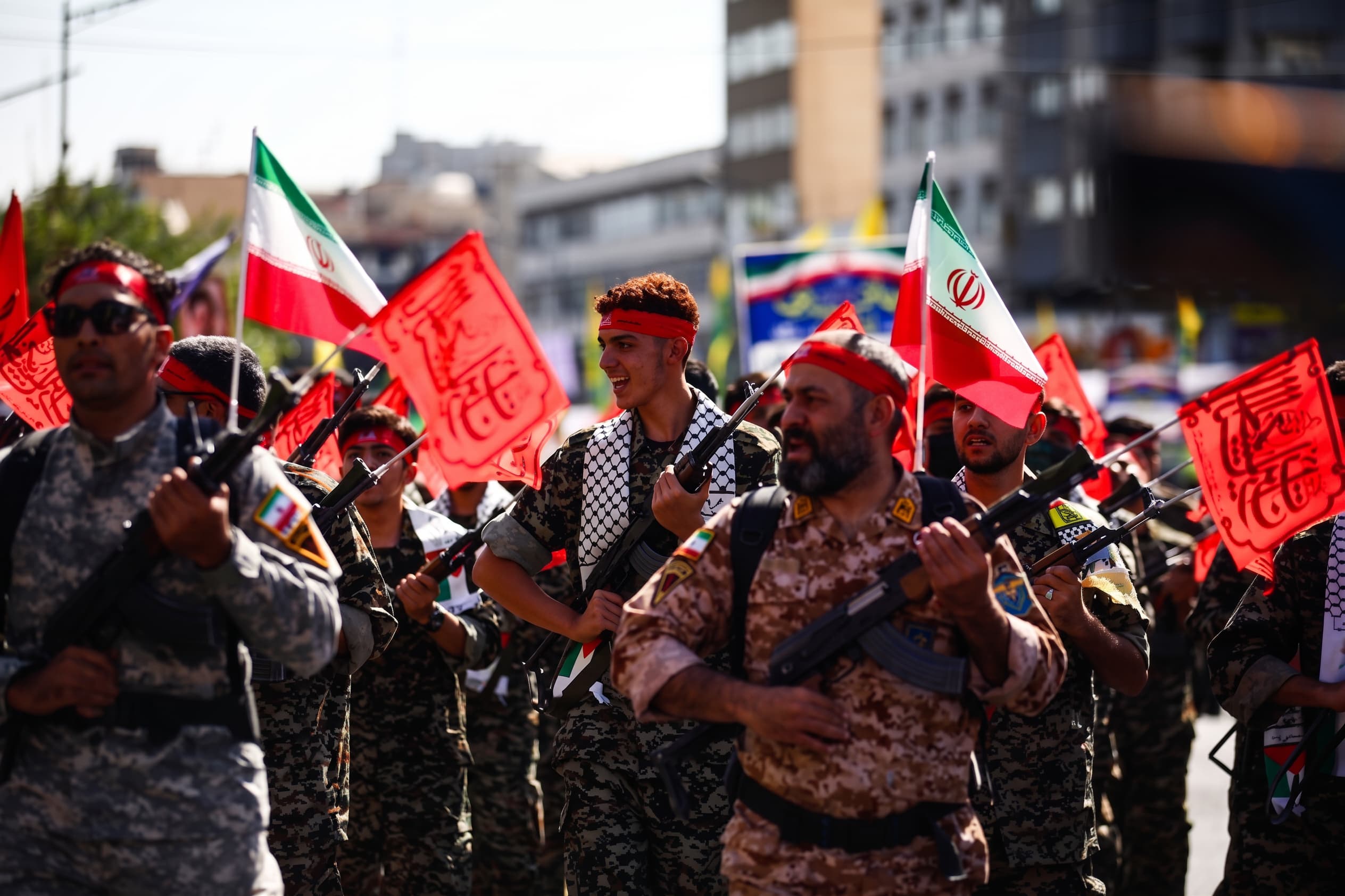

ERBIL, Kurdistan Region - Iran on Friday commenced its main rally featuring 313,000 “self-sacrificing units” along the streets of Tehran as part of its Jan-Fada campaign, state-affiliated media reported, as a high-ranking Islamic Revolutionary Guard Corps (IRGC) official said that preparations for an “all-round defense” are in “full swing.”
Addressing the crowd at the event, head of the Corps' paramilitary Basij Organization Hossein Taeb framed the Jan-Fada campaign, whose name refers to those willing to sacrifice their lives for Iran, as “the largest popular movement in the history of world wars,” featuring “hundreds of thousands of people,” according to Tasnim News Agency, an outlet linked to the IRGC.
The “million-strong movement (military training) that started in the Greater Tehran area will be displayed in all squares and cities," stated Taeb, adding that enlisting supporters "to the defense battalions” and “training in various ground, air and naval ranks and preparing for all-round defense” are “in full swing."
The parade comes days after Iran announced on Sunday it is preparing to train and organize several hundred thousand loyalists into rapidly deployable “national resistance” brigades, semi-official Mehr News Agency reported, aimed at fostering a large pool of back-up forces that can be mobilized on short notice.
On Wednesday, 5,000 people participated in demonstrations including an exercise held in Tehran’s eastern suburbs in Shahid Raisi Square in Pardis and the city of Damavand, respectively, marking 200 consecutive nightly gatherings, according to Iran’s state-run Islamic Republic News Agency (IRNA).
Tehran has increasingly focused on internal security since the outbreak of the Iran war in late February, when the US and Israel launched a joint aerial campaign targeting thousands of targets across the country over a period of six weeks, killing senior military figures - including the late supreme leader.
Pro-government supporters have maintained a lingering presence in public squares and other prominent locations across the country upwards of 200 consecutive nights, occupying spaces that might otherwise provide focal points for anti-government demonstrations as well as serving as a means to organize more regime loyalists who could be deployed to the streets on short notice.
The gatherings are part of the Jan-fada Iran campaign which began on March 29, about a month into the six week war, and has since “grown into a nationwide mobilization with more than 32 million participants,” Tasnim said on Friday.
“Today we are witnessing that people have filled both the battlefield and the streets with their presence for 200 nights, and if necessary, they will stand in the streets for another 100 nights," said Taeb.
Iranian authorities have long deployed Basij, one of the five primary branches of the IRGC, to suppress dissent and quell nationwide anti-government protests.
During the 2022 Jin, Jiyan, Azadi movement - Woman, Life, Freedom uprising, triggered by the death of Kurdish woman, Zhina (Mahsa) Amini in an Iranian prison, authorities deployed the IRGC and Basij forces, alongside riot police and plainclothes officers, to subdue protesters, including through the use of lethal force, according to Amnesty International.
The global rights watchdog said Wednesday that it verified at least 377 deaths during the 2022 uprising, identifying nearly 90 Iranian officials responsible for the killings of protestors, including Iran's late supreme leader Ali Khamenei (1939 - 2026) and the former chief of Iranian armed forces, Mohammed Bagheri.
The same security agencies were mobilized again on a much larger scale in January of this year when another wave of protests broke out, triggered by Iran’s collapsing currency which later developed into widespread anti-establishment protests with explicit calls to overthrow the Islamic Republic.
Tens of thousands of people have since been arrested with authorities repeatedly leveling vague and unsubstantiated accusations against detainees, such as colluding with the US and Israel. Iranian authorities have also executed dozens of people since January, citing the same allegations.
The United Nations-backed Independent International Fact-Finding Mission on the Islamic Republic of Iran on Thursday submitted its report to the global body’s Human Rights Council, accusing Iranian authorities of using lethal force at an "unprecedented" scale against the January 2026 demonstrators and describing the crackdown as “beyond a simple continuation of familiar patterns.”
US-based Human Rights Activists News Agency (HRANA) in early February documented 6,782 verified deaths, mostly protesters, as well as more than 50,000 arrests between late December and until the time of publication of its report.
A report by Oslo-based Iran Human Rights (IHR) stated that Iranian security forces killed at least 3,356 protesters and bystanders on January 8 and 9 alone, accounting for 91 percent of all cases in which the organization was able to establish an exact date of death during the nationwide crackdown.
The Friday parade comes as Iran braces for the possibility of renewed internal unrest, amid mounting military and economic pressure, as the Islamic Republic grapples with sanctions targeting its military capabilities and primary revenue streams amid internal disruptions such as currency devaluation and fuel shortages.
Nevertheless, Taeb framed the mobilization as a “symbol of resistance” designed to “bend the enemy's back.”
“When the enemy sees that our nation is sacrificing tens of millions of lives, it accepts defeat,” the Basij chief said, asserting that Iran “will maintain its defensive straits like the Strait of Hormuz” and that “in the near future the world will see the Americans leave this region in defeat.”