
ERBIL, Kurdistan Region - At least five bridges were struck by US forces in southern Iran on Friday, killing at least seven people, Iranian state and semi-official media reported, as the US military launched its sixth consecutive night of strikes against targets in the country. Strikes have also expanded to areas near the capital Tehran.
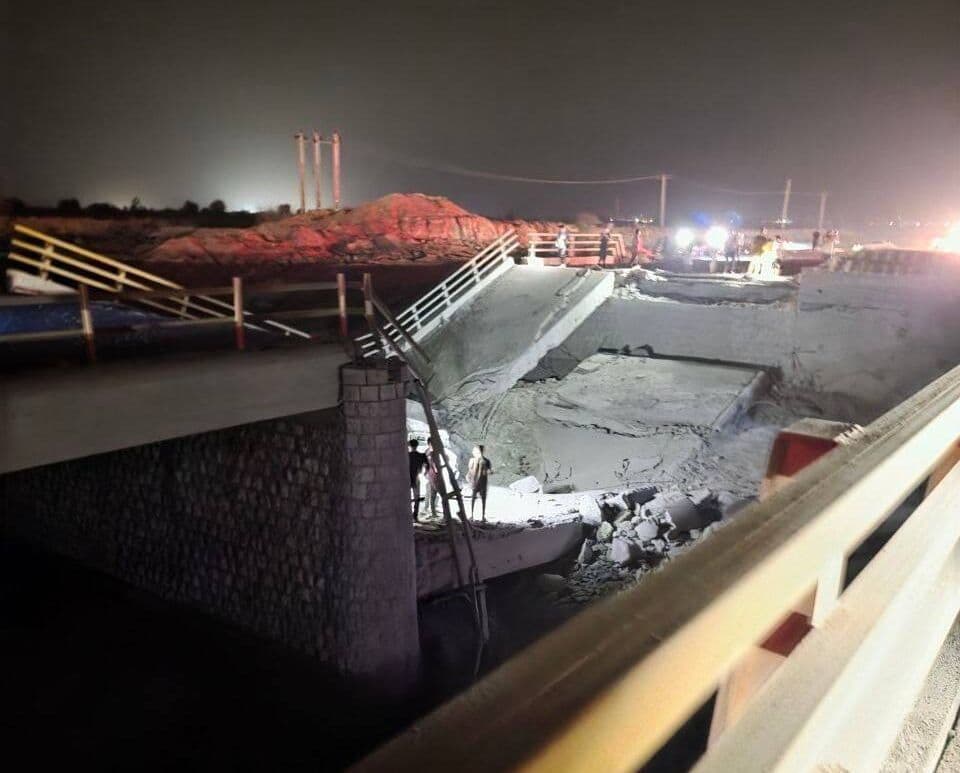
The targeting appeared to have focused heavily on Bandar Khamir county, in Iran’s southern Hormozgan province, where the Kohourestan Bridge and the Giriveh Bridge were heavily hit and damaged, the state-run Islamic Republic News Agency (IRNA) reported.
Meanwhile, the semi-official Mehr News Agency quoted Hormozgan health officials as saying the number of people killed in the attack on the Bandar Khamir bridges "has increased to seven," while "nine people were also injured.”
The outlet added that a "marine control tower" in the southeastern port city of Chabahar, on the Gulf of Oman, was also struck "for the third time in days." Mehr noted that the port infrastructure in the region "plays a vital role in managing vessel traffic," adding that no official information has been released "regarding the extent of damage and the potential casualties."
Residents of Hormozgan's port city of Bandar Abbas and the nearby Qeshm Island, located at the heart of the strategic Strait of Hormuz, reported around a dozen explosions, Iranian media reported.
Locals in Ahvaz, the capital of Iran's southwestern Khuzestan province, also heard around a dozen explosions. Meanwhile, the governor of Bushehr province was quoted as confirming at least two large explosions in the province's coastal capital, Bushehr city, home to Iran's civilian nuclear plant.
Munitions were also reported to have struck Iranshahr Airport in southeastern Iran's Sistan and Baluchestan province.
Importantly, for the first time in this cycle of violence that started less than two weeks ago, strikes expanded to areas near the capital, Tehran, and Semnan province - known as the home of Iran's ballistic missile production and space program.
In the aftermath of the strikes, Iran's Islamic Revolutionary Guard Corps (IRGC) said it "targeted the deployment sites of helicopters and P-8 maritime patrol aircraft" at the US's Al Sakhir Air Base in Bahrain, using "Arash kamikaze drones."
In a separate statement, the IRGC said it also targeted US "deployment sites of forces and logistical support centers" in Kuwait using one-way drones, framing the attacks as a response to deadly American strikes on the country's "urban and civilian infrastructure."
Notably, the IRGC also claimed to have launched "a surprise attack" on a "special operations command center" for US forces in southeastern Syria's al-Tanf region, near the tri-border area of Syria, Jordan, and Iraq.
The Corps claimed to have destroyed "a radar system and several specialized special operations helicopters" in al-Tanf, alleging that the attack caused a number of casualties among American forces.
The Iranian military added that "full control of the Strait of Hormuz" remains in the hands of its forces, threatening that "as long as US hostilities continue, not a single drop of oil or gas will be exported from this region."
Ebrahim Zolfaghari, spokesperson for the Khatam al-Anbiya Central Headquarters - equivalent to the Iranian military's joint operations command - said attacks by the US on Iran's civilian infrastructure would be met with "crushing blows" to regional infrastructure.
Tehran would "under no circumstance" allow the US, "as a foreign and extra-regional country," to interfere in the Strait of Hormuz, he said, adding, "This is Iran's unbreakable red line.”
The escalation comes as the US Central Command (CENTCOM) announced late Thursday that its forces had begun conducting airstrikes on Iran for the sixth consecutive night.
RELATED: US strikes Iran for the sixth consecutive night amid increased escalation