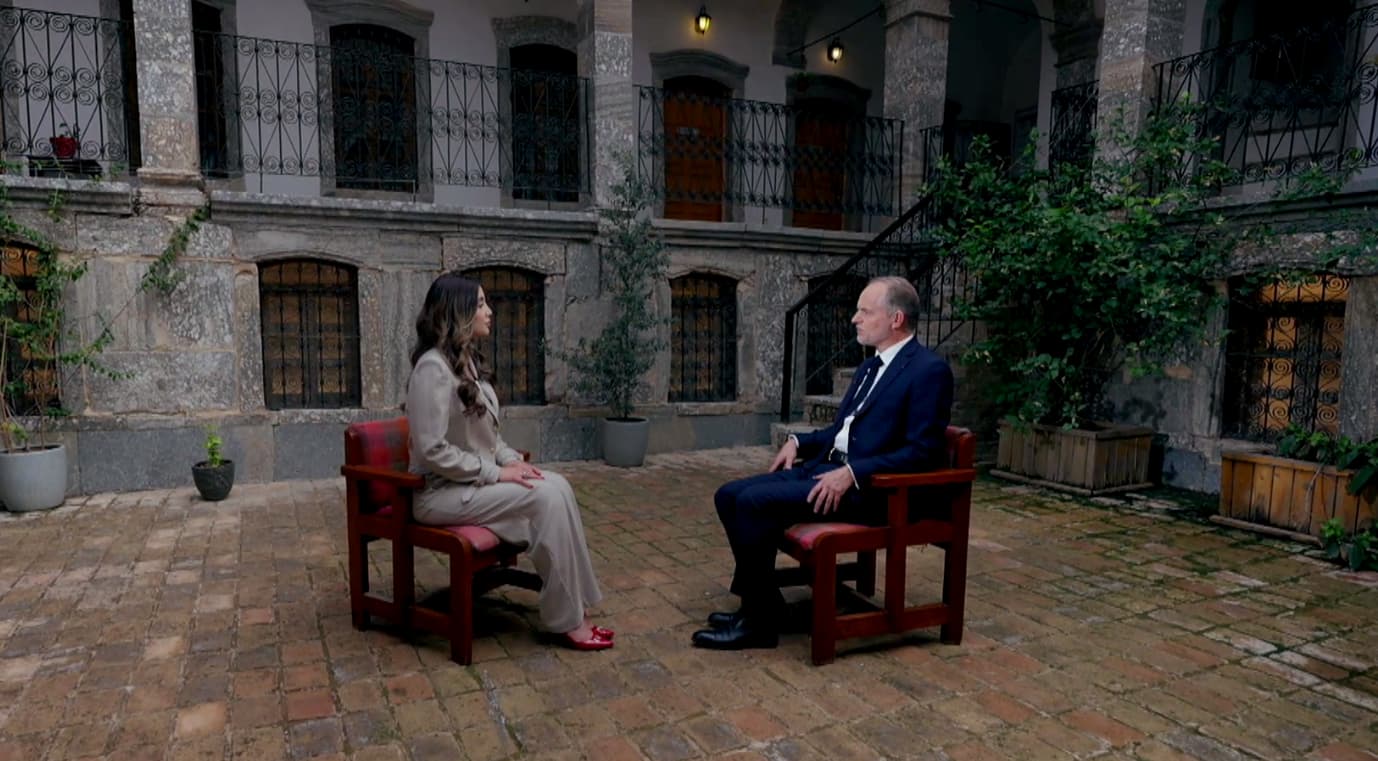
ERBIL, Kurdistan Region - Finland supports the Iraqi government's efforts to bring weapons under state control but expects tangible progress in disarming armed factions ahead of next summer’s deadline, Finnish Ambassador to Iraq Antti Putkonen told Rudaw in an exclusive interview.
Speaking to Rudaw's Nma Nabaz on the sidelines of the MERI Forum in early October, Putkonen said the Iraqi government needed to achieve concrete results in its efforts to ensure that weapons remain exclusively in the hands of state security institutions.
"Our support is diplomatic and political to the Iraqi government as they pursue to disarm and have weaponry in the control of state security entities," Putkonen said.
"It's a very important step for any sovereign country to have sole responsibility for that kind of armaments," he added.
The ambassador acknowledged that the disarmament process would require additional time but stressed that progress was essential.
"Results are needed so that at the end of the day, as we approach the deadline next summer, we will hopefully be in a position where much of the factions have given their heavy weaponry to the state security entities," he said.
NATO's possible return to Iraq
Addressing the future of international security cooperation following the withdrawal of the US-led coalition at the end of September, Putkonen said Finland hopes NATO Mission Iraq will resume its activities in Baghdad.
"NATO Mission Iraq still continues to support the Iraqi defense and security institutions and Ministry of Defense and also Ministry of Interior in Baghdad with advisory and capacity building," he said.
The ambassador explained that NATO personnel are currently operating from Naples rather than Baghdad, saying he hoped the mission could soon return to Iraq to continue its “advisory work.”
However, Putkonen emphasized that no timetable has been established.
"We, of course, hope that that will happen soon. But at the moment, there are no details on the return of the NATO mission to Baghdad."
In addition, the possibility of this support would take place “in a smaller way than previously when [Finland] still had troops in the coalition base.”
He added that the timing would be determined through discussions between NATO headquarters and Iraqi security officials.
Finland's continued support for the Peshmerga
Finland participated in the international coalition against the Islamic State (ISIS) for nearly a decade, deploying troops to Erbil before ending its contribution in December 2024.
Putkonen said assessments of Iraqi and Kurdish security forces indicated that they had developed the necessary capabilities to confront terrorism more independently.
He nevertheless cautioned that continued vigilance and readiness to act against a possible resurgence of the militant group remained necessary.
The ambassador said Finland continues to contribute to Iraq's security through Finnish personnel serving in the European Union advisory mission, including police advisers in Erbil, as well as through NATO's advisory activities.
Kurdistan Region government formation
Turning to the political situation in the Kurdistan Region, where the two ruling parties the Kurdistan Democratic Party (KDP) and Patriotic Union of Kurdistan (PUK) have remained deadlocked for nearly two years since parliamentary elections, Putkonen encouraged Kurdish political parties to advance the process of forming a new regional government.
"In any democratic process it is needed that the process takes the final steps in terms of parliament formation and government formation in a timely manner," he said.
No plans for Finnish consulate in Erbil
Asked whether Finland intends to establish a diplomatic consulate in Erbil, Putkonen ruled out any immediate plans.
"At the moment, we do not have plans to open a consulate," he told Rudaw.
Nevertheless, he insisted that the absence of a permanent Finnish diplomatic mission in the Kurdistan Region does not undermine bilateral relations.
Finland maintains diplomatic engagement through regular visits to Erbil and Sulaimani, while its embassy in Baghdad remains responsible for relations with the entire country.
Putkonen did stress that Finland’s diplomatic mission was primarily observation of the dynamics of Iraq, encouraging “dialogue for consensus” where possible.
Kurdish Diaspora in Finland
Putkonen acknowledged the sizable Kurdish diaspora in Finland, which is estimated to be between 15-18,000 according to Institut Kurde de Paris.
On the topic of asylum applications and the assurance of migrant safety, Putkonen discussed how his country hosted both legal and illegal migrants from Iraq. “The migration and returns file is part of our bilateral relations with Iraq, and that of course includes the Kurdistan Region,” he said.
The ambassador said that Finland has good ties with Baghdad in this regard, particularly on promoting voluntary returns where possible.
Putkonen encouraged young people in the Kurdistan Region considering migration to think twice.
“I encourage the youth who think of perhaps seeking better fortunes in Europe to really build their dreams here in Kurdistan.”
When asked about how Finland hopes to extend bilateral relations with the Kurdistan region beyond security, Putkonen offered that Finland has a lot to offer the region, identifying not only investment and trade but education, information technology, digitalization, environmental management, and energy production as potential areas for cooperation.
Finland’s Kurdish diaspora is important in this regard, supplying local and linguistic knowledge to Finnish companies looking to invest, he said. He added that some Kurds in Finland “have returned to set up their own businesses here”, the support of whom Putkonen considers part of his role.
The ambassador admitted the ongoing need for greater cultural ties with the Kurdistan Region and hoped for this in the future.
The ambassador also mentioned that Finland's cooperation with Iraq extends to a long standing obligation to the children and their mothers of ISIS fighters in the camps of North-east Syria, “quite actively repatriating” them to Finland. Finland repatriated a minor in early April of this year following an Iraqi court’s decision that the minor had no affiliation with ISIS.
Puktonen further clarified that his nation was “one of the few” with such a policy.