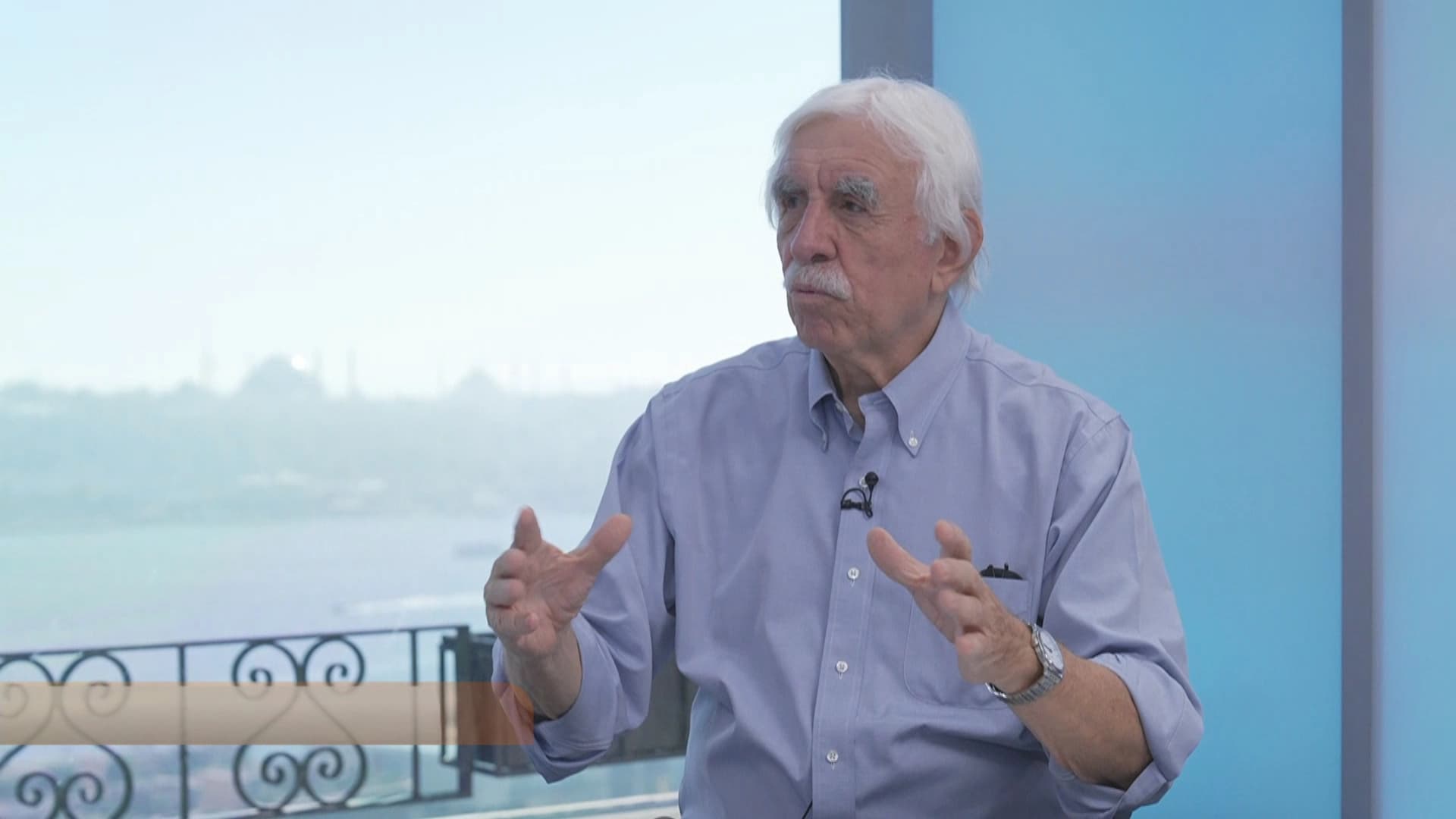
ERBIL, Kurdistan Region - The United Nations is calling for an end to fighting in the Gulf and a return to freedom of navigation in the Strait of Hormuz, UN Secretary-General spokesperson Stephane Dujarric told Rudaw in an interview on Monday.
“We have been pushing for a return to freedom of navigation within the waters of the Strait of Hormuz,” Dujarric told Rudaw’s Namo Abdulla, stressing that “we need it to be reopened.”
His comments came ahead of the high-level general debate of the 81st session of the United Nations General Assembly at UN Headquarters in New York City.
Dujarric said the Secretary-General’s agenda during the UN General Assembly includes conflicts in Gaza, the Gulf, Yemen and Sudan, alongside less-noticed crises in eastern Congo and Myanmar.
“The temperature is very high,” Dujarric said, describing the global situation, while also highlighting climate change and artificial intelligence as “existential threats” facing humanity.
Asked about Secretary-General’s meeting with Iranian President Masoud Pezeshkian, Dujarric said the two are expected to meet and confirmed that the Strait of Hormuz would be a key issue.
Dujarric also said the UN continues to discuss a proposed mechanism to facilitate the movement of humanitarian aid and other goods through the strait, but that it requires agreement from all parties.
He stressed that the Washington-Tehran conflict’s repercussions have extended beyond Iran, saying Iraq, Jordan, Qatar, the UAE and Saudi Arabia have all been affected.
“This needs to stop,” Dujarric said. “This conflict, like many conflicts, shows the limits of brute power, of brute military force. It doesn’t solve the issue.”
On artificial intelligence, Dujarric said the UN is seeking international safeguards and cooperation between governments and corporations.
“There needs to be guardrails or regulations… at different levels,” he said, adding that AI’s risks must be addressed while its benefits are preserved.
The following is the full transcript of the interview with Stephane Dujarric:
Rudaw: Thank you very much, Stephane, for this interview.
Stephane Dujarric: It's great to be here, great to be back in Rudaw, and also thank you for covering the UN like you do. I mean, you and I see each other every day...
Absolutely.
We don't have a choice. You ask me questions, I try to give you answers, but we really appreciate the coverage that Rudaw has been giving us.
We really appreciate you being so journalism-friendly and answering all of our questions. Which meetings matter most to the Secretary-General this week? I know he has a lot of meetings scheduled.
Well, I mean, you know, it's important for the Secretary-General to meet as many heads of state, heads of government, heads of delegations that come to New York. It's for him a way to get kind of a temperature of where the world is at. And right now, the temperature is very high, let's be honest, right? We have crises that we're all paying attention to in Gaza, in the Gulf, in Yemen, in Sudan, but there are crises that we're not paying attention to, right? The eastern part of the Congo, Myanmar. There are a lot of people who are suffering and who are forgotten because no one is paying attention to them. And in addition to that, you have obviously what the Secretary-General calls the existential threats that we're facing: climate change and artificial intelligence. So there's a lot, a lot on his plate.
Is a meeting with President Trump scheduled already?
We don't know yet. Sometimes they happen in the last minute, sometimes there are scheduling issues, but I'm sure they will have a chance to speak, whether in a formal meeting or just a pull-aside at some point during the week.
What about with Iran's president, Pezeshkian?
Yes, there will be a meeting while the president of Iran is here, and the Secretary-General has obviously a lot of issues to raise, and I'm sure the president of the Islamic Republic also has a lot of issues to raise.
And the Strait of Hormuz will obviously be one of those [issues].
Of course, first on the top of the agenda. You know, we have been pushing for a return to freedom of navigation within the waters of the Strait of Hormuz. It is important not only for the region, for the Gulf countries, for Iran, obviously, but for all of us, right? It is such a choke point in international commerce that we need it to be reopened. And so the reverberations of this conflict go far beyond the Strait of Hormuz. And let's be honest, this fighting needs to stop. I mean, how many months has this been going on, and what has been achieved? Nothing.
Stephane, the Secretary-General had a proposal for the fertilizer project. What happened to that?
So there's still a there's still a plan on the table, a mechanism that would be set up to help humanitarian aid and other goods flow in and out of the Strait of Hormuz. The challenge is, of course, that it needs to have the agreement of all parties. So the discussions are all still ongoing.
Can you tell us which party is not agreeing to it?
No, I mean, you know, because it's one of these things that nothing is agreed upon until everyone agrees to it, so.
Right. And, you know, like, not everyone is here at the United Nations. Iranian President finally got his visa, but the Palestinian President Mahmoud Abbas hasn't gotten his visa, and this is the second year in a row that he doesn't get his visa from the United States. Where does the Secretary-General stand on that?
It's very disappointing. The United States has obligations under the host treaty agreement to facilitate travel into New York City, into the United States, for people who have business in front of the United Nations, whether they be delegates or journalists. We have no leverage, right? But we have raised this directly with United States authorities on a number of a number of times, and we'll continue to do so. That being said, we saw that the General Assembly is allowing President Abbas to address via video.
Yes. And going back to Iran, sorry, one of the spillover effects of the Iran war has been the bombing of the neighboring countries by drones, by missiles from Iran mostly. When the Secretary-General meets Pezeshkian, how will he raise this issue that countries that have nothing to do with this war should not be attacked?
I mean, of course. This is something the Secretary-General has been speaking about quite a lot is that there's a spillover effect, right? You have two countries who are involved in what we would call kinetic activities, it doesn't stick to those two countries. We've seen areas of Iraq being hit, we've seen Jordan, we've seen Qatar, the UAE, Saudi Arabia, and others being hit. This needs to stop, because I think this conflict, like many conflicts, shows the limits of brute power, of brute military force. It doesn't solve the issue.
Why do you think, for example, the Kurdistan Region, which has not attacked Iran at all, has been subjected to more drones and missiles than virtually every other country in the region, more than a thousand?
You know, you know the history of the region better than I, you know Kurdistan better than I and the relationships. I don't I can't put myself in the head of other people, but we know what the end result is.
Right. And let's talk about the United Nations itself, this institution. It's had budget issues. Some countries haven't paid their dues in full. The United States recently paid part of its dues. It still, I think, owes more than $4 billion to the United Nations. Yeah, can you talk about that?
Yeah, I mean, we're very grateful that the US paid what, about $724 million. These were assessed contributions that they are that are owed to the UN, because the UN is funded through a number of different pathways. One is assessed contributions, which are obligations under the UN treaty, and others are voluntary. The US paid us for a number of the assessed contributions that it still owes. It will facilitate our liquidity crisis until the end of the year. But as we say, it's no way to run a railroad, right? It is so challenging for the Secretary-General to manage the cash flow in this organization because we don't know when countries will pay, and we don't know if they will pay. And yet he has to keep the UN running, and Antonio Guterres has been doing just that.
So President Trump is coming here, and he will deliver an address, but some other presidents are not showing up. Xi Jinping, he is expected to be in Washington, D.C. on Thursday, but he's not coming here, three-hour train ride. And of course, you know, Vladimir Putin hasn't showed up in more than a decade. What does the Secretary-General think of this? Aren't they dismissing the institution itself?
No, not at all. I mean, you know, on the China thing, President Xi, I think it's just an issue of the calendar, that the visit with President Trump was scheduled then. The Secretary-General has met twice with President Xi in the last in the last two, three months: once in Beijing and then or Shanghai, then another time in Bishkek for the Shanghai Cooperation Council meeting. So the relationship is very good. China has always talked about having an international system with the UN at its core. The Vice President of China will be here representing his country.
Yes, of course, there are other countries like India, like South Africa. They're sending the they're not sending their heads of state.
The Secretary-General literally just spent a long time with Prime Minister Modi in India last week, so.
AI. So, some people inside the industry itself are saying that it's posing a threat, perhaps an existential one, to humanity itself. I think you said it's an existential threat in the beginning of the interview. So what is the Secretary-General's message? What has he done in recent days or weeks to bring the world together on this?
Well, I think this is an issue. There will be meetings on AI here. He created, with the approval of the General Assembly, the Scientific Advisory Board on AI. There needs to be guardrails or regulation, you know, regulations at different levels. Governments have the responsibility to protect its own people, so they have to take they have to take the lead. At the international level, we need to create some sort of system to keep us from this doomsday scenario while, at the same time, harnessing all the positives of AI. AI is a bit like nuclear energy, right? I mean, nuclear energy- a nuclear explosion devastated Hiroshima and Nagasaki- can pose a great threat. On the other hand, think of all the positive uses of nuclear energy, from medicine to just the creation of energy. And so, this has to be regulated. There have to be safeguards, but it cannot be done, I think, by industry alone.
Does the Secretary-General believe that we need binding UN resolutions on this?
Listen, I think we need to get people around the table. We need to get member states around the table and corporations around the table.